ECB advisor Jürgen Schaaf warns that the rapid rise of dollar-backed stablecoins threatens Europe’s financial stability and the euro’s global standing unless strategic action is taken. In a new blog post on the European Central Bank’s website titled “From Hype…ECB advisor Jürgen Schaaf warns that the rapid rise of dollar-backed stablecoins threatens Europe’s financial stability and the euro’s global standing unless strategic action is taken. In a new blog post on the European Central Bank’s website titled “From Hype…

ECB advisor sounds alarm on growing dominance of dollar-denominated stablecoins

3 min read

ECB advisor Jürgen Schaaf warns that the rapid rise of dollar-backed stablecoins threatens Europe’s financial stability and the euro’s global standing unless strategic action is taken.

Summary
  • US dollar-backed stablecoins make up 99% of the market, while euro-based stablecoins remain negligible.
  • Growing adoption of stablecoins for payments, settlements, and savings could weaken the ECB’s control over monetary policy.
  • Interest-bearing stablecoins risk diverting deposits from traditional banks, threatening credit availability in Europe.
  • Schaaf’s call to action includes supporting euro-based stablecoins, advancing the digital euro, and innovating cross-border payments with distributed ledger technology.

In a new blog post on the European Central Bank’s website titled “From Hype to Hazard: What Stablecoins Mean for Europe,” ECB advisor Jürgen Schaaf says that stablecoins pose a strategic threat to the euro’s global standing, warning that “without a strategic response, European monetary sovereignty and financial stability could erode.”

Stablecoins, led by Tether (USDT) and Circle’s USD Coin (USDC), now account for 99% of the stablecoin market cap, nearly all denominated in US dollars. Euro-denominated stablecoins remain marginal, with a combined market cap of less than €350 million.
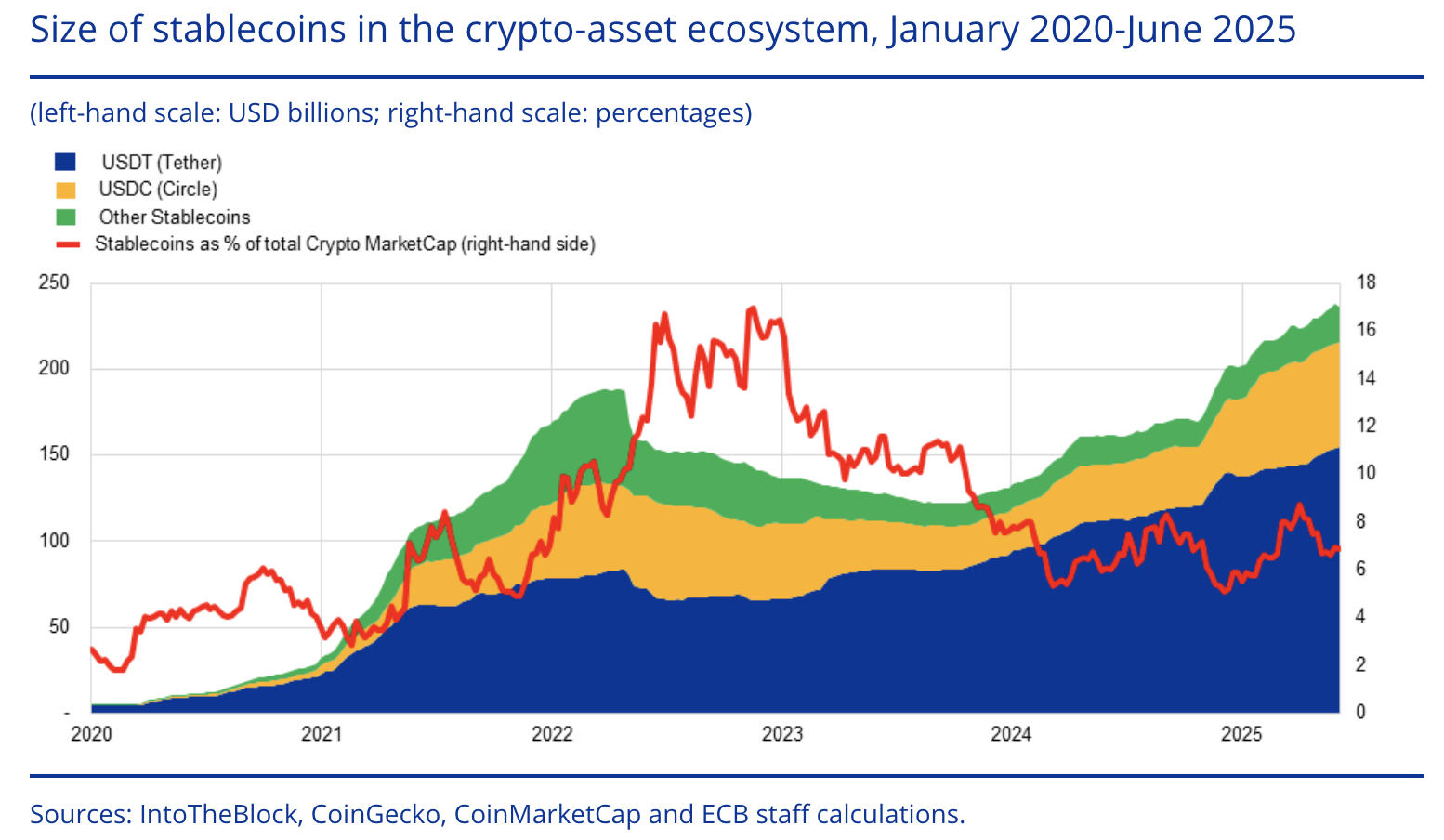
ECB advisor sounds alarm on growing dominance of dollar-denominated stablecoins - 1

The danger, Schaaf warns, is not just speculative. As stablecoins become more widely adopted for payments, settlement, and even savings, they increasingly bypass traditional financial systems—potentially undercutting the ECB’s ability to implement effective monetary policy.

“The larger their footprint, the harder these [dollar-dominated stablecoins] would be to unwind,” Schaaf writes. “This would mean higher financing costs relative to the United States, reduced monetary policy autonomy and geopolitical dependency” for Europe.

Stablecoins’ growing real-world impact and risks to banks

Schaaf points out that stablecoins are already being tested for real-world applications beyond crypto trading, including remittances, e-commerce, and institutional settlement. U.S. firms such as Amazon and Walmart are exploring stablecoin integrations, while global payment giants Visa and Mastercard are rolling them into international services.

Moreover, stablecoins begin to offer interest-like features, such as yield from lending or liquidity provision, which poses a threat to traditional banking models, especially in deposit-heavy economies like the euro area.

“If interest-bearing stablecoins became common… they could divert deposits from traditional banks, which could jeopardise financial intermediation and hamper credit availability,” Schaaf writes.

Schaaf’s call to action to protecting the euro

To tackle the risks posed by stablecoins, Schaaf lays out several practical steps Europe should take to protect its financial system and strengthen the euro’s global role.

His main suggestion is to support well-regulated, euro-based stablecoins. Such stablecoins, he argues, could not only “serve legitimate market needs” but also help “reinforce the international role of the euro,” offering a viable alternative to the growing dominance of dollar-based tokens.

Another key part of the plan is the digital euro, which Schaaf sees as “a robust line of defence of European monetary sovereignty,” especially for everyday payments like shopping and online purchases.

Schaaf also points to the need for innovation in larger, behind-the-scenes payments between banks and financial institutions. Cross-border payments are still slow and expensive. Schaaf argues that distributed ledger technology (DLT) could fix this by allowing faster, more direct settlement of tokenised assets using central bank money. He highlights two new projects from the European Central Bank—Pontes and Appia—as important steps forward.

Finally, Schaaf stresses the importance of global cooperation. Without common rules, he warns, “we risk fuelling instability, regulatory arbitrage and global US dollar dominance.”


Market Opportunity
Hyperliquid Logo
Hyperliquid Price(HYPE)
$33,36
$33,36$33,36
+4,64%
USD
Hyperliquid (HYPE) Live Price Chart
Disclaimer: The articles reposted on this site are sourced from public platforms and are provided for informational purposes only. They do not necessarily reflect the views of MEXC. All rights remain with the original authors. If you believe any content infringes on third-party rights, please contact [email protected] for removal. MEXC makes no guarantees regarding the accuracy, completeness, or timeliness of the content and is not responsible for any actions taken based on the information provided. The content does not constitute financial, legal, or other professional advice, nor should it be considered a recommendation or endorsement by MEXC.

You May Also Like

Vitalik Buterin Reveals Ethereum’s (ETH) Future Plans – Here’s What’s Planned

Vitalik Buterin Reveals Ethereum’s (ETH) Future Plans – Here’s What’s Planned

The post Vitalik Buterin Reveals Ethereum’s (ETH) Future Plans – Here’s What’s Planned appeared on BitcoinEthereumNews.com. Ethereum founder Vitalik Buterin presented the network’s new roadmap, which includes its short-, medium-, and long-term goals, at the Developer Conference held in Japan today. Scalability, cross-layer compatibility, privacy, and security were the prominent topics in Buterin’s speech. Buterin stated that the short-term focus will be on increasing gas limits on the Ethereum mainnet (L1). He said that tools such as block-level access lists, ZK-EVMs, gas price restructuring, and slot optimization will be used in this context. The goal is to maintain the network’s decentralization while increasing scalability. The medium-term goal is to enable trustless asset transfers between Layer-2 (L2) networks and achieve faster transaction finality. In this context, “Stage 2 Rollup” solutions, proof-of-conduct combinations, and optimizations for reading data from L1 are on the agenda. Furthermore, network optimizations such as shortening slot times, fast finality protocols, and erasure coding are planned to improve user experience and security. Buterin emphasized that privacy is a priority for both the short and medium term. Zero-knowledge (ZK) proofs, anonymous pools, encrypted voting, and scrambling network solutions are highlighted to protect the privacy of users’ on-chain payments, voting, DeFi transactions, and account changes. Furthermore, secure execution environments, secret query techniques, and the ability to conceal fraudulent requests and data access patterns are also targeted when reading data from the chain. Buterin’s long-term vision highlights a minimalist, secure, and simple Ethereum. This roadmap includes resistance to the risks posed by quantum computers, securing the protocol with mathematical methods (formal verification), and transitioning to ideal cryptographic solutions. Buterin stated that these strategic steps will transform Ethereum into a more scalable, user-friendly, and secure infrastructure. With the strengthening of L2 networks, more users will be able to use Ethereum with less trust assumptions. The ultimate goal is for Ethereum to become a reliable foundational infrastructure for global…
Share
BitcoinEthereumNews2025/09/18 15:57
SON DAKİKA: Kara Gecede Sürpriz Altcoin İçin Spot ETF Başvurusu Geldi!

SON DAKİKA: Kara Gecede Sürpriz Altcoin İçin Spot ETF Başvurusu Geldi!

Son dakika bilgisine göre, büyük düşüşlerin yaşandığı şu dakikalarda Bitwise, Uniswap (UNI) spot ETF için S-1 başvurusunda bulundu. UNI, son bir ay içerisinde yaklaşık
Share
Coinstats2026/02/06 06:03
Why a Bloomberg Analyst Thinks Bitcoin Could Still Fall Toward $10,000

Why a Bloomberg Analyst Thinks Bitcoin Could Still Fall Toward $10,000

The post Why a Bloomberg Analyst Thinks Bitcoin Could Still Fall Toward $10,000 appeared on BitcoinEthereumNews.com. Bitcoin broke below $71,000, triggering heavy
Share
BitcoinEthereumNews2026/02/06 05:59




