Tesla Stock Price Risks a 15% Drop Despite China Sales Growth
Key Insights
- Tesla stock price has crashed into a correction after falling by 15% from its all-time high.
- The company’s sales in China have continued rising in the past three months.
- Technical analysis suggests that the TSLA stock price has more downside.
Tesla stock has dropped 15% from its December peak, signaling a deep correction in 2026. TSLA now trades at $421 and faces the risk of further decline, even as sales from China continue to rise.
Tesla China Sales are Booming
The latest report from China showed that its sales are doing well even as competition in the country rose. Sales jumped by 9% in January to 69,129, the third consecutive quarter of growth.
The sales growth happened even as the company faced substantial competition in China. There, local brands like BYD, SAIC, Nio, XPeng, and Polestar. It also happened after China introduced a 5% tax on EVs and hybrids.
It achieved sales growth as it launched promotions in the country, including a seven-year low-interest loan and an insurance subsidy.
China has become a bright spot for the company as its other markets struggle. For example, its European business continues to face major headwinds, with deliveries in key markets like Norway and Germany falling.
The US is not doing well either after Donald Trump ended the popular $7,500 subsidy for electric vehicles. He also ended the clean energy credits that made the company substantial sums of money.
The most recent results showed that Tesla’s automotive revenue dropped by 11% in the fourth quarter to over $17 billion. This slowdown was offset by a 25% increase in its energy revenue and its services and other segments.
As a result, the total revenue dropped by 3% in the fourth quarter to $24.9 billion. Its operating margin dropped to 5.7% from the previous 6.2%, while the EBITDA margin fell to 16.7%. Most importantly, Tesla’s free cash flow dropped by 30% to $1.4 billion.
Elon Musk Premium Continues
A key concern about the Tesla stock price is that its valuation is highly stretched because of the Elon Musk premium.
Ideally, a company reporting falling revenue and profitability growth should attract a weak valuation multiple. For example, PayPal spots a price-to-earnings ratio of 7.53, lower than the five-year average of 23. That’s because its revenue growth has stalled in the past few years.
Tesla, on the other hand, continues to trade at a premium because of the Elon Musk premium. Data shows that it has a forward PE of 201, which is much higher than the five-year average of 114. Its forward EV to EBITDA has moved to 104, also higher than the five-year average of 57.
 Tesla valuation multiples |Source: Seeking Alpha
These numbers make it one of the most overvalued companies on Wall Street despite the fact that its growth is decelerating. For example, NVIDIA, a company with faster revenue and profitability growth, has a forward P/E ratio of 38.
Tesla stock holds a premium valuation. The company is developing a cheaper car. It focuses on artificial intelligence and robotics. For example, it plans to launch its Optimus robots soon.
The challenge, however, is that it is unclear whether the new businesses will do well in the long term. Also, its autonomous business will face substantial competition from Waymo, which has taken a pole position.
Tesla Stock Price Forecast: Technical Analysis
The daily timeframe chart shows the TSLA stock price crashed from the December high of $499. It now trades at $421. It has moved below the 23.6% Fibonacci Retracement level.
Additionally, the Tesla stock has moved below the 50-day Exponential Moving Average (EMA). It also moved below the Supertrend indicator, which is a common bearish sign. TSLA stock has formed a head-and-shoulders pattern, a common bearish reversal sign.
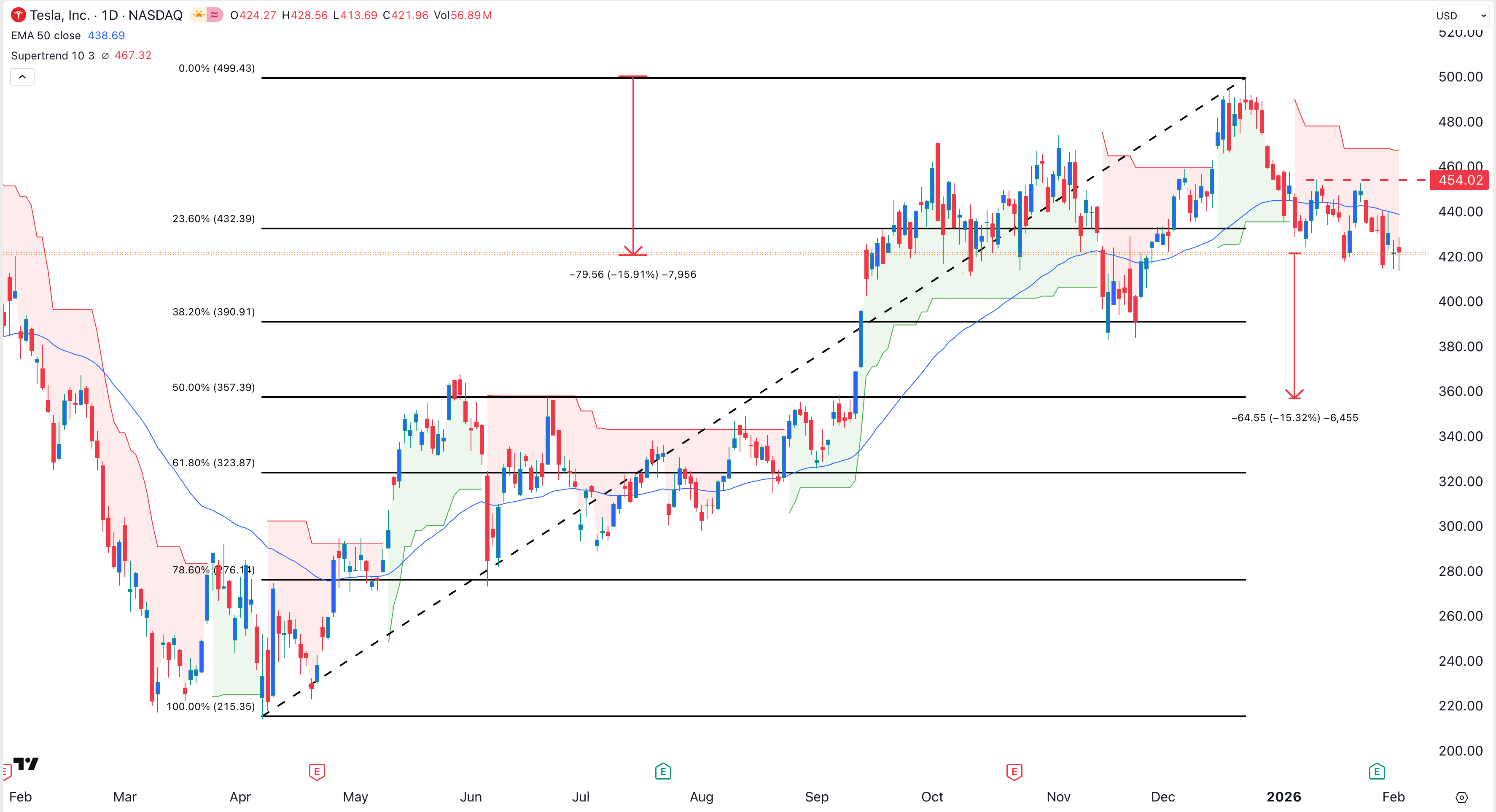 Tesla stock price chart | Source: TradingView
Therefore, the Tesla stock will likely continue falling, potentially to the 50% Fibonacci Retracement level at $357. That’s about 15% below the current level.
On the other hand, a move above the resistance level at $455, the right shoulder, will invalidate the bearish outlook.
The post Tesla Stock Price Risks a 15% Drop Despite China Sales Growth appeared first on The Market Periodical.


You May Also Like

Mobix Labs (MOBX) Stock: Announces 1-for-10 Reverse Split to Regain Nasdaq Compliance

Prediction markets get CFTC relief as legal battles widen