

Inside Kasi Cloud, Nigeria’s first 100MW AI data centre in Lagos
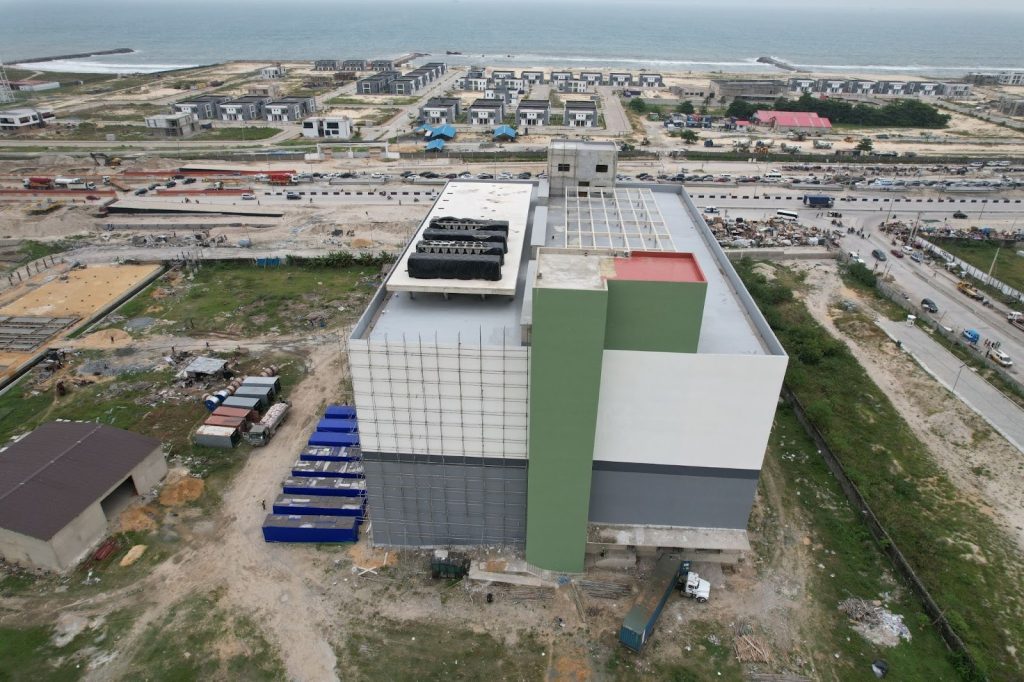
Facing the Atlantic Ocean, where the Lagos–Calabar coastal road stretches into the distance, a vast technology campus is taking shape. Spread across 42 hectares, the Kasi Cloud site feels less like a conventional industrial development and more like a long-term bet on Nigeria’s digital future.
Sea breeze cuts across concrete shells, steel frames, and cleared land, revealing the scale of ambition behind what its builders describe as Nigeria’s first data centre campus, purpose-built for artificial intelligence (AI).
Nigeria has about 17 operational data centres, none with capacity higher than 20 megawatts (MW).
Hyperscale AI campuses typically target 50 to 100 MW or more of installed capacity, several times the 30–50 MW that used to be standard for large enterprise data centres, because dense Graphics Processing Unit (GPU) racks (often 50–150 kW per rack) push overall power demand higher.
“This is not a retrofit,” Johnson Agogbua, founder and chief executive officer of Kasi Cloud, said during a tour of the site on January 25, 2026. “This was designed for AI from day one.”
Kasi Cloud broke ground on its $250 million hyperscale data centre in Lekki, Lagos, in April 2022. Construction began in the second quarter of 2023.
Purpose-built AI data centres matter because Nigeria’s existing facilities were never engineered for the compute-intensive workloads that now define global innovation.
As hyperscale campuses rise worldwide to support the training and deployment of advanced models, Nigeria risks falling behind without infrastructure to match those demands.
Kasi Cloud expects to complete 5.5 MW of capacity in April 2026, and commercial operations will begin in the second quarter of 2026.
 The layout of the 42-hectare data centre campus. Image source: Kasi Cloud
The first building, and the long view
The first building on the Kasi Cloud campus is six floors tall, with four floors dedicated entirely to data halls. Each floor is designed to support an 8 MW data hall, giving the building a total capacity of 32 megawatts. The 5.5 MW to be completed in April will occupy one floor, which will later be upgraded to the full 8 MW capacity.
The company has the government building permit to construct four similar facilities on the campus. While each facility will initially provide 32 megawatts, the campus is engineered to support up to 100 megawatts of sellable power at full density.
“That means we’ll only get to build three facilities,” said Ngozika Agogbua, the company’s Global Director of Marketing and Sales Operations, who is also part of the tour. “We could change the power availability for some of the buildings to spread it across four, but the way that it is divided now, we can only get about three.”
Even before the data halls are completed, the proportions stand out. Ceilings are unusually high, corridors are wide, and concrete columns are thick and closely spaced. Johnson Agogbua pauses often to explain that nothing here is accidental.
“If you don’t design for where you’re going on day one, you’ll pay for it later,” he said. A protective helmet, recently customised by the company in China, sits on his head.
Kasi Cloud says this building is not a standalone facility. It is the anchor for a phased campus designed to scale to 100 megawatts over time. Decisions taken here, around power density, cooling, fibre depth and structural loading, set the template for everything that follows. The aim is to avoid incremental thinking that locks operators into costly limitations.
“World-class is not a slogan for us,” Agogbua added. “It’s a discipline.”
Power first, everything else second
Inside the building, the focus shifts to power infrastructure. Massive steel columns are being installed to support solid busbars instead of conventional cable bundles. Busbars, rigid metal conductors made of copper or aluminium, are housed in insulated, modular channels and can carry large amounts of electricity. Their design allows power to be tapped along the run, making distribution to server racks more efficient and flexible.
The facility is set up with four independent high-voltage feeds, providing separate A and B power paths. This design ensures full redundancy, so operations can continue even if one feed experiences an outage.
“We’re bringing all four lines in here, not just two,” Agogbua explains, pointing upward. “That way, you can schedule any two and remain resilient.”
The busbars, capable of carrying thousands of amps, distribute power through carefully colour-coded systems, backed by numbering for redundancy. “We don’t assume anything,” he said.
Dry-type transformers sit in dedicated electrical rooms, their sheer size influencing door design, wall openings and installation sequences. Agogbua recalls debates with architects who underestimated these realities.
“If you’ve never brought this equipment in, you don’t know how to design it,” he said.
Built for density, not excuses
While many data centres in Lagos are built for racks drawing 5 to 10 kilowatts, Kasi Cloud is engineered for workloads ranging from 10 to as much as 100 kilowatts per rack. That capacity is essential for modern AI systems driven by GPUs and other accelerators.
One section of the building is dedicated to high-density data halls, reinforced to support heavier equipment and liquid-cooling infrastructure.
“This space is custom-fit for AI,” Agogbua said. “You bring liquid directly to the rack, down to the chipset. Nothing is left to chance.”
That design philosophy shapes everything from slab thickness to drainage. Channels are built into the floor because, as Agogbua puts it bluntly, “eventually, a pipe will burst.” The goal is not to pretend failures won’t happen, but to ensure they never become catastrophic.
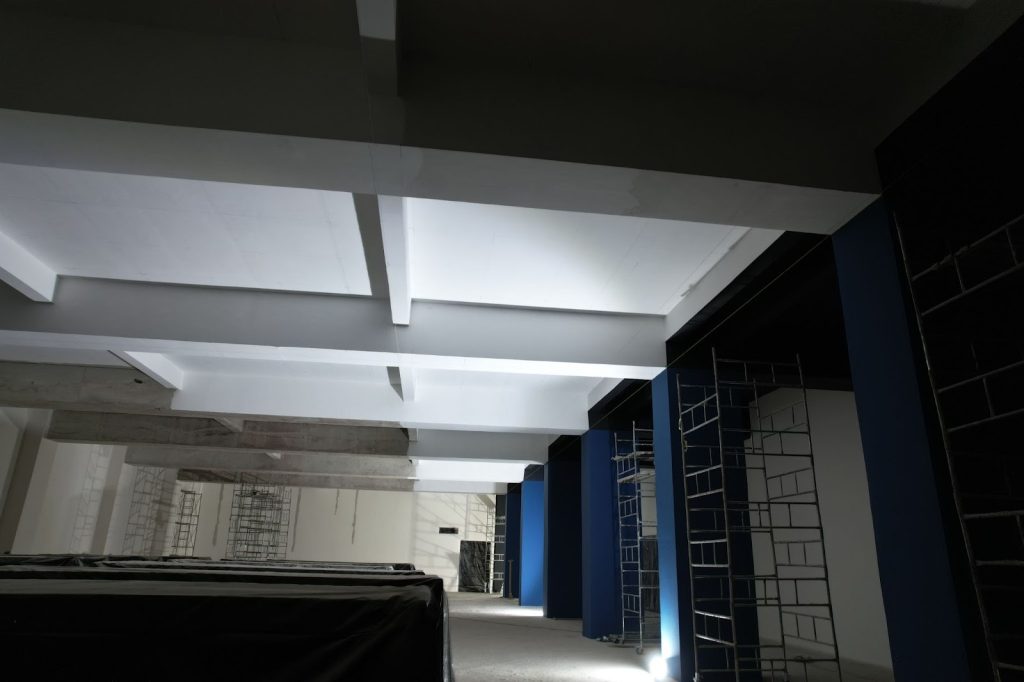 A hall inside the 6-storey facility in the Kasi Cloud campus. Image source: Kasi Cloud
Cooling without the roar
Cooling is one of the areas where Kasi Cloud has taken things a notch higher. Instead of relying solely on noisy, mechanically driven systems, the data centre uses magnetic-drive technologies in critical components.
“All you’ll hear is air moving,” Agogbua said. Reducing noise is not cosmetic; it allows engineers to work without heavy protection and enables cooling systems to ramp up aggressively when AI workloads spike.
Air-handling units rise more than 4 metres high, each capable of managing hundreds of kilowatts of heat. Triple High-Efficiency Particulate Air (HEPA) filtration systems scrub salt, dust and particulates from incoming air, an essential feature so close to the ocean. Production and non-production spaces use different cooling strategies, balancing efficiency with resilience.
Batteries, fire, and the uncomfortable truths
Lithium-ion batteries power the data centre’s uninterruptible power supply systems, housed in reinforced bunkers beneath the building. Their higher energy density allows more IT load to be supported in the same footprint, with less heat and lower cooling requirements. They also last longer, typically 8 to 15 years, compared to 3 to 5 years for older battery types, reducing replacements and downtime.
Just as importantly, their fast-charging and high-cycle performance keep backup power available even when the grid is unstable, a critical safeguard for AI workloads where even brief power interruptions can corrupt training runs or crash entire clusters.
Above them sit layered fire-suppression technologies designed for worst-case scenarios. Agogbua is frank about why this redundancy is necessary.
“Lithium doesn’t need oxygen to burn,” he explained. “That’s the critical thing.”
Kasi Cloud relies on a multi-layered approach: gas-based suppression at the module level, specialised chemical agents to arrest thermal runaway, and a final system that can sacrifice an entire room if necessary.
“You don’t cut corners here,” he said. “You spend the money.”
A network bigger than some data centres
One of the most striking spaces in the building is not a data hall but the meet-me room, where telecom operators interconnect. It is, Agogbua noted, larger than some entire data centres in Lagos. Two such rooms are planned, north and south, filled with patch panels, fibre trays and active networking equipment.
Fibre ducts run deep underground, at a standard depth of 1.8 metres, to prevent future disruption. “When tenants fill up in ten years, you don’t want to start punching holes just to pull fibre,” Agogbua says. Again, the logic is long-term planning over short-term savings.
Kasi Cloud will not wait for cosmetic completion before onboarding customers. Instead, core systems will be completed and tested, with final configurations adapted as tenants arrive.
“If you finish everything and then have to tear it down, it doesn’t make sense,” Agogbua said.
Large customers may take entire floors, triggering customised power, cooling and security setups that can take months to implement. The approach mirrors global hyperscale practices, but remains rare in Nigeria’s data centre market.
The economics of AI infrastructure
Building at this scale is expensive, particularly in Nigeria, where supply chains are fragile, and most specialised equipment is imported. Agogbua declined to share precise figures but acknowledges that preparing a campus for 100 megawatts is a fundamentally different investment from fitting out a single data hall.
According to the Cushman & Wakefield Data Centre Development Cost Guide, a global commercial real estate services firm, building a 100 MW data centre typically costs between $900 million and $1.5 billion. This estimate, covering land, construction, and the full suite of power and cooling infrastructure, is based on an industry average of $9 million to $15 million per megawatt, depending on location and design requirements.
Globally, Africa accounts for less than 1% of announced GPU capacity.
“The arms race is in North America, Southeast Asia and the Middle East,” he said. “Africa is largely absent.” Kasi Cloud, in his view, is an attempt to change that by laying the infrastructure foundation that serious AI investment requires.
Data sovereignty and community
For Agogbua, data sovereignty is not a political slogan but a practical issue of supply.
“You can’t enforce localisation if you can’t host the data,” he said. When data is processed abroad, Nigerian companies pay foreign bandwidth costs and operate under foreign economic conditions.
Hosting cloud and AI infrastructure locally gives governments enforcement tools, reduces costs for businesses and enables developers to build cloud-native products without leaving the country. Nigeria, he argues, can become an anchor market for ECOWAS, much like the European Union’s regional approach to data residency.
Beyond the buildings, the wider campus continues to take shape. Roads are being built, drainage laid, and agreements negotiated with host communities.
“We spend a lot of time on that,” Agogbua says. Infrastructure changes land values and expectations, and those shifts must be managed deliberately.
The long-term plan is to attract complementary infrastructure, tower companies, network operators and service providers, turning the site into a digital ecosystem rather than an isolated fortress.
As the tour ends, Agogbua returns to a phrase he repeats often: world-class.
“Why should you step into Malaysia and see world-class, then come to Nigeria and accept less?” he asks. For him, Kasi Cloud is proof that capability is not a constraint. Intent and discipline are.
The first building is still unfinished, with exposed cabling and floors waiting for epoxy, but the direction is unmistakable.


You May Also Like

US Dollar Carry Trade Appeal Persists as High Yields Attract Investors: MUFG

Trump torn apart for cheering loss of American jobs with Colbert cancellation

Missing Republican racked up travel expenses — despite going AWOL for months of votes



