Binance Shifts From Exchange to Crypto Infrastructure Backbone in MENAP
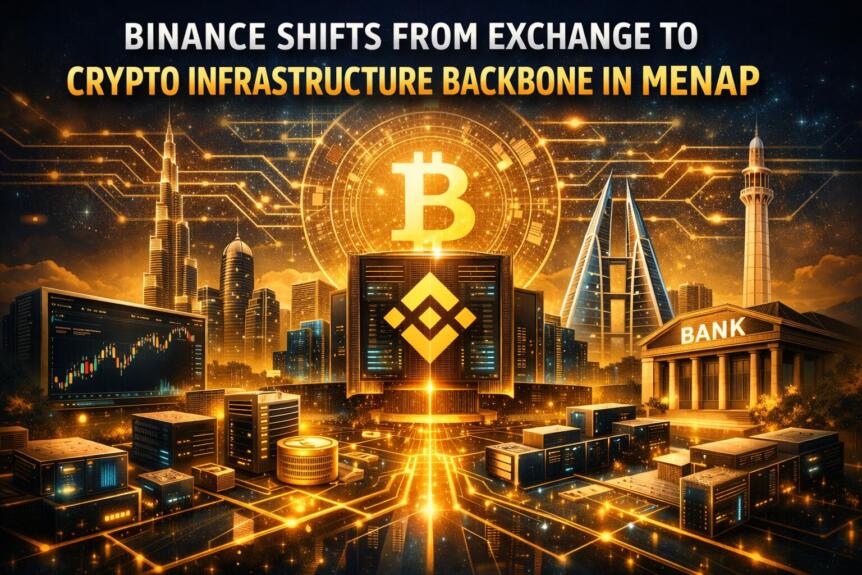
Editor’s note: The press release below outlines how Binance is repositioning its role in the MENAP region as crypto markets mature, shifting emphasis from pure trading activity to regulated infrastructure and institutional integration. It details recent regulatory approvals, compliance milestones, and partnerships across the UAE, Pakistan, and Bahrain, highlighting a strategy focused on long-term adoption rather than rapid user growth. The announcement reflects broader market trends toward regulatory alignment, embedded financial services, and scalable digital-asset infrastructure as governments and institutions across the region formalize their approach to crypto.
Key points
- Binance is emphasizing infrastructure, compliance, and institutional partnerships over speculative trading growth.
- The ADGM FSRA license positions Binance within one of the world’s most stringent regulatory frameworks.
- In Pakistan, Binance has secured AML registration and begun a phased path toward local licensing.
- A Bahrain partnership aims to integrate regulated crypto services directly into a bank’s mobile app.
Why this matters
The MENAP region is moving quickly from crypto experimentation to regulated adoption. As governments and banks seek compliant ways to offer digital-asset services, platforms with proven scale, governance, and regulatory credibility gain a structural advantage. Binance’s recent milestones illustrate how crypto firms are increasingly aligning with traditional financial systems, shaping how digital assets may be accessed, supervised, and used by institutions and consumers across the region.
What to watch next
- Final regulatory approvals tied to announced licenses and registrations.
- Implementation timelines for bank-led crypto integrations in Bahrain.
- Further regional partnerships with financial institutions or regulators.
As the global crypto market enters a more mature phase, a quiet transformation is underway. What was once driven by speculative trading and rapid experimentation is increasingly being shaped by institutional participation, regulatory clarity, and real-world financial integration.
At the center of this shift is a growing focus on infrastructure, the systems, liquidity, compliance frameworks, and technical rails that allow digital assets to operate at scale. Binance, long known as the world’s largest cryptocurrency exchange, currently serving more than 300M users, is repositioning itself to reflect this new reality: not simply as a trading platform, but as core crypto infrastructure supporting the next generation of digital finance.
This evolution is particularly visible across the region, where regulators and financial institutions are actively building frameworks for digital-asset adoption. From the UAE to Bahrain to Pakistan, Binance’s recent regulatory milestones and partnerships point to a strategy centered on long-term integration rather than short-term growth.
From Trading Venue to Infrastructure Layer
Global market data illustrates how crypto usage is changing. On-chain activity reached record levels in 2025, with both spot and derivatives volumes rising, signaling a transition from early experimentation to consistent execution. At the same time, stablecoins have become a foundational settlement layer, processing more than $3.5 trillion in daily volume, surpassing traditional payment networks. These trends favor platforms that can operate at scale, with deep liquidity, technical reliability, and regulatory alignment. In 2025 alone, more than $34 trillion was traded on Binance’s platform, with spot volume exceeding $7.1 trillion. All-time trading volumes across products have now surpassed $145 trillion, underlining Binance’s central role in global crypto liquidity.
Compliance Becomes a Catalyst for Growth
As crypto markets mature, compliance is increasingly seen not as a constraint, but as a driver of sustainable growth. Binance’s compliance investments have expanded significantly alongside its growth. In 2025, the company’s controls prevented $6.69 billion in potential fraud and scam losses, protecting more than 5.4 million users. Binance also processed over 71,000 law-enforcement requests globally, reflecting deeper cooperation with authorities and an increasingly formalized compliance posture. For MENAP markets in particular, where regulators are designing digital-asset frameworks in parallel with rapid fintech growth this compliance-first approach has become central to Binance’s regional strategy.
ADGM License Sets a New Regulatory Benchmark
A key milestone in this shift was Binance securing a comprehensive global license from Abu Dhabi Global Market’s Financial Services Regulatory Authority (FSRA), widely regarded as one of the world’s most respected financial regulators. The authorization represents a world-first for the crypto industry and positions Binance among a select group of global financial institutions operating under ADGM’s regulatory framework. The license confirms compliance with stringent international standards covering governance, risk management, and consumer protection. The FSRA license therefore serves as a gateway for deeper institutional relationships, from custody and payments to cross-border partnerships.
Pakistan: Phased Regulation and Market Entry
Binance is advancing a phased regulatory strategy in Pakistan, one of the region’s largest and fastest-growing digital economies. Following high-level engagements with government stakeholders, Binance has obtained Anti-Money Laundering (AML) registration under Pakistan’s Virtual Assets Regulatory Authority (PVARA). The move marks a significant step toward full local licensing and incorporation.
In parallel, Binance has signed memorandums of understanding with local fintech players, including JazzCash, to explore cooperation on education initiatives and compliant digital-asset products, signaling a longer-term commitment to ecosystem development rather than transactional market entry.
Bahrain: Integrating Crypto Into Banking
In Bahrain, Binance’s strategy has moved further into traditional financial infrastructure through a partnership with Bank of Bahrain and Kuwait (BBK), one of the Kingdom’s leading retail and corporate banks. Under a memorandum of understanding, BBK plans to integrate Binance Bahrain’s regulated Crypto-as-a-Service (CaaS) solution directly into its mobile banking app, subject to final approval from the Central Bank of Bahrain. The integration would allow customers to trade and manage crypto assets within their existing banking environment, alongside traditional financial products.
The partnership positions BBK as the first bank in the GCC to join the Binance Link Program and reflects a broader trend toward embedded digital-asset services within mainstream financial platforms. For regulators and policymakers, such models offer a pathway to crypto adoption that maintains oversight while expanding access through established banking channels.
Infrastructure for the Next Phase of Digital Finance
Across the MENAP region, the emphasis is on how digital assets can be integrated responsibly into national financial systems, payment networks, and institutional investment frameworks.
As the region positions itself as a global hub for digital finance, platforms that can combine scale, liquidity, regulatory credibility, and technical depth are likely to play a defining role. For Binance, the message is clear: the future of crypto in the region is being built not on trading alone, but on the infrastructure that makes digital finance sustainable.
This article was originally published as Binance Shifts From Exchange to Crypto Infrastructure Backbone in MENAP on Crypto Breaking News – your trusted source for crypto news, Bitcoin news, and blockchain updates.


You May Also Like
Analog Devices (ADI) Pursues $1.5 Billion Acquisition of Empower Semiconductor

Why Businesses Need Professional Machine Design and Development Services