Polymarket and Kalshi, two prominent prediction markets, have continued to record substantial trading activity into 2025, with volumes, active accounts, and market offerings reflecting ongoing participation beyond the 2024 U.S. Election. Data Shows Polymarket Volumes Remain Above Pre-Election Levels Metrics from Dune Analytics show that Polymarket, the blockchain-based predictions marketplace, has maintained activity into 2025. […]Polymarket and Kalshi, two prominent prediction markets, have continued to record substantial trading activity into 2025, with volumes, active accounts, and market offerings reflecting ongoing participation beyond the 2024 U.S. Election. Data Shows Polymarket Volumes Remain Above Pre-Election Levels Metrics from Dune Analytics show that Polymarket, the blockchain-based predictions marketplace, has maintained activity into 2025. […]

Election Highs Ease but Activity Remains for Prediction Markets Polymarket and Kalshi

Polymarket and Kalshi, two prominent prediction markets, have continued to record substantial trading activity into 2025, with volumes, active accounts, and market offerings reflecting ongoing participation beyond the 2024 U.S. Election.

Data Shows Polymarket Volumes Remain Above Pre-Election Levels

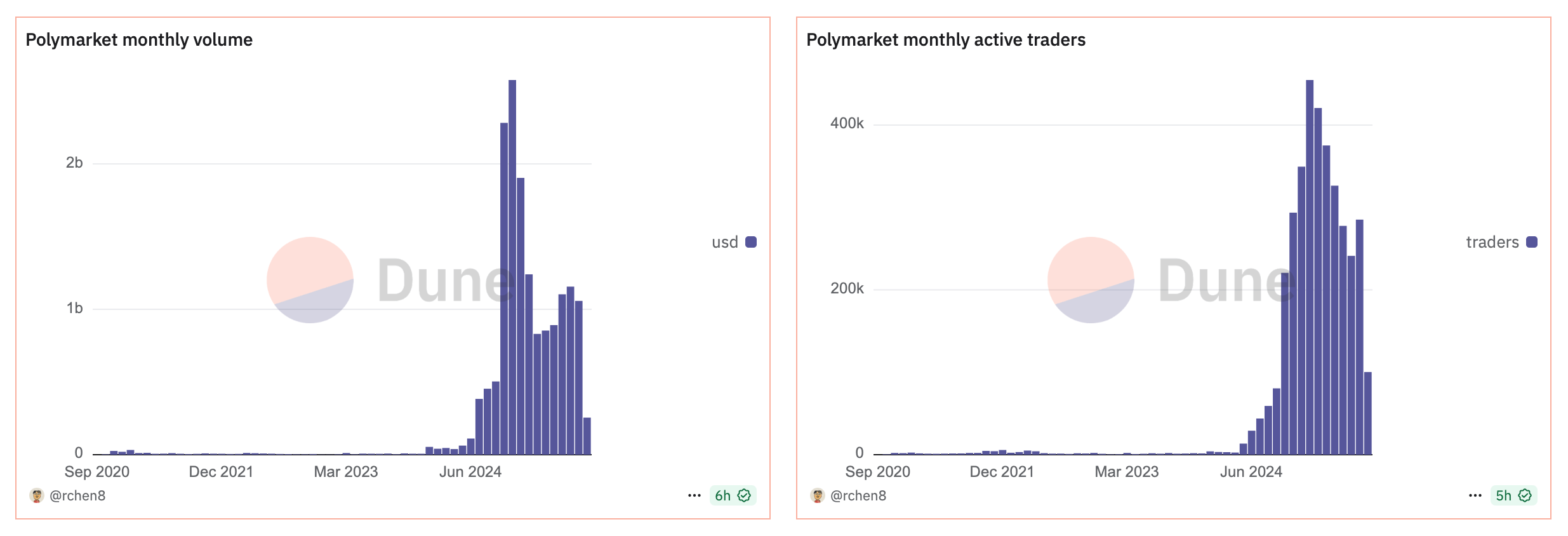
Metrics from Dune Analytics show that Polymarket, the blockchain-based predictions marketplace, has maintained activity into 2025. Monthly volume, which reached more than $2 billion during the election period, has decreased but remains above pre-election levels.

Trading volume ticked higher in mid-to-late 2024, with several months above $2 billion in value exchanged. Activity has declined since the election, but recent months have reported more than $1 billion in trades. Daily totals generally range between $20 million and $50 million, with occasional days above $70 million during major events.
Election Highs Ease but Activity Remains for Prediction Markets Polymarket and KalshiSource: Dune Analytics

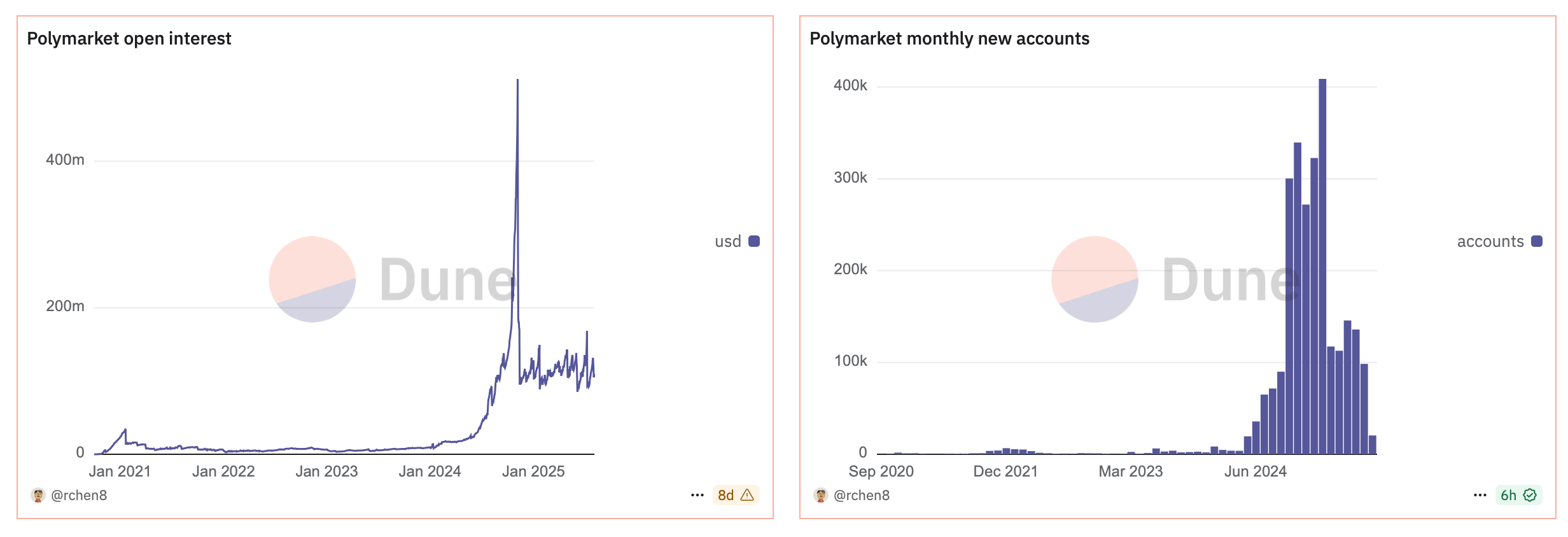
Monthly active accounts surpassed 400,000 during the election between Trump and Harris and have remained in the hundreds of thousands through mid-2025. Daily active accounts typically range from 20,000 to 30,000, with increases during major deadlines or developments. New account creation peaked above 400,000 in one month and has continued each month since.

Polymarket wagers with the highest recent volumes include sports, geopolitics, and event-based contracts. On Aug. 5, 2025, the markets with the largest daily volumes were “LIV Golf Chicago Winner,” “UFC Fight Night” matchups, and “Megaquake by September 30?” Political markets remain active, including contracts on a possible meeting between President Trump and Vladimir Putin, ceasefire agreements, and central bank policy decisions.
Election Highs Ease but Activity Remains for Prediction Markets Polymarket and KalshiSource: Dune Analytics

Political markets include contracts with significant liquidity. As of early August, the market for a Trump-Putin meeting before Aug. 15 showed an 87% probability with nearly $1 million in trades. Other active contracts include the 2028 U.S. presidential election, the Bolivian presidential election, and possible changes to Federal Reserve leadership.

Data indicates that activity after the election includes both political and non-political markets. While political events coincide with higher volumes, participation is also present in sports, economic, and niche contracts.

Figures over the past year show activity beyond the election cycle, with consistent daily volumes, ongoing active accounts, and continuing account creation.

Kalshi Trading Patterns Mirror Post-2024 Election Trends

Kalshi, a U.S.-based prediction market, continued operations into 2025 with activity levels different from those of Polymarket. Dune Analytics figures show Kalshi’s daily trade volume rose in late 2024 during the U.S. election period and has since maintained a consistent range. Daily volumes vary, with occasional larger changes, including a 231% increase on June 22, 2025.
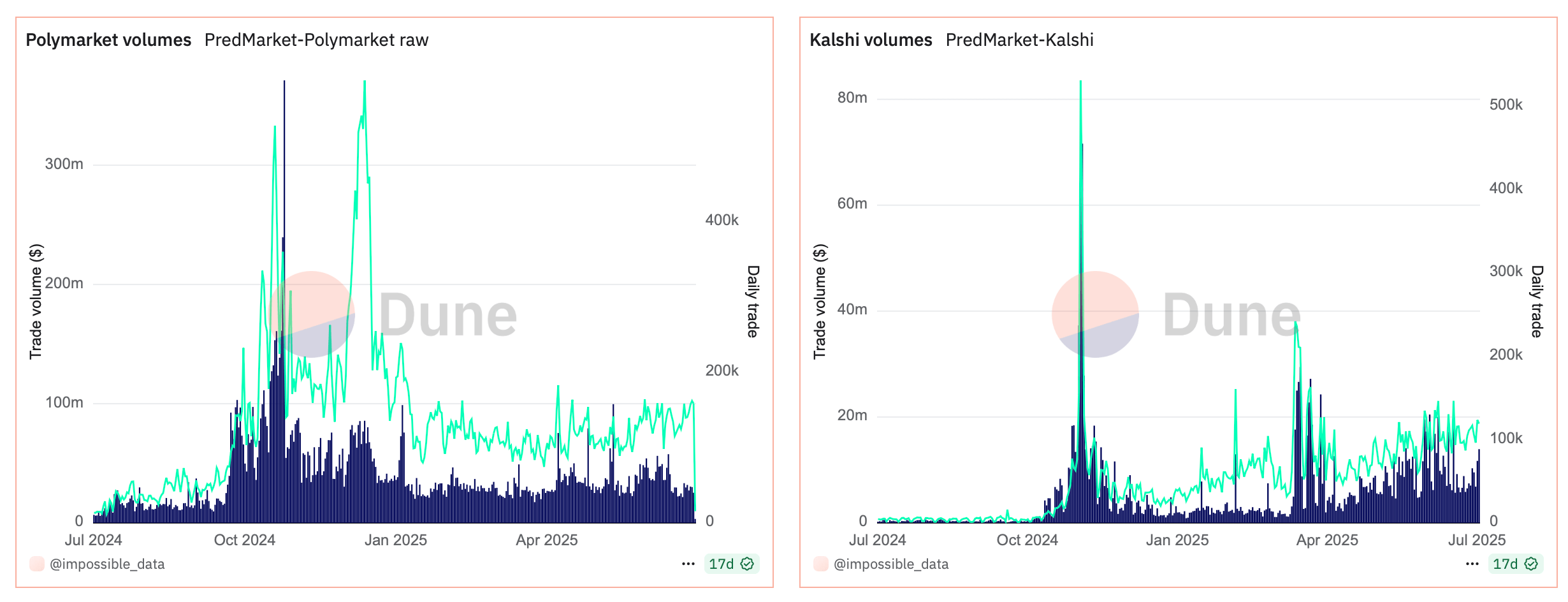
Election Highs Ease but Activity Remains for Prediction Markets Polymarket and KalshiSource: Dune Analytics

In comparative volume charts, Kalshi’s highest single-day volume reached about $80 million. The platform’s daily trade counts have remained consistent. Its structure enables participation from U.S.-based users. Just like Polymarket, Kalshi’s markets cover politics, sports, economics, and popular culture.

As of August 2025, active markets include “Fed decision in September” (pricing a 76% probability for a 25-basis-point cut with nearly $150 million in traded volume), “Which party will win the House next year?” (68% probability for Democrats), and “Pro Football Champion?” along with contracts on movie review scores and celebrity relationship outcomes.

Political and economic markets represent a significant portion of Kalshi’s activity. The market “Who will Trump meet with this year?” prices a 94% probability for Vladimir Putin and 69% for Xi Jinping. Other contracts focus on consumer price index releases, hurricane formation timelines, and foreign elections.

Daily change data shows fluctuations tied to news events, with both increases and decreases sometimes exceeding 20%. On several dates, Kalshi recorded changes above 50% in daily volume.

Data from both Polymarket and Kalshi indicate that prediction markets remain active beyond major election cycles. Polymarket records higher global volumes, while Kalshi operates within U.S. regulations and concentrates activity in political and economic contracts. Together, the figures show activity across multiple event categories throughout the year.


Disclaimer: The articles reposted on this site are sourced from public platforms and are provided for informational purposes only. They do not necessarily reflect the views of MEXC. All rights remain with the original authors. If you believe any content infringes on third-party rights, please contact [email protected] for removal. MEXC makes no guarantees regarding the accuracy, completeness, or timeliness of the content and is not responsible for any actions taken based on the information provided. The content does not constitute financial, legal, or other professional advice, nor should it be considered a recommendation or endorsement by MEXC.

You May Also Like

The Channel Factories We’ve Been Waiting For

The Channel Factories We’ve Been Waiting For

The post The Channel Factories We’ve Been Waiting For appeared on BitcoinEthereumNews.com. Visions of future technology are often prescient about the broad strokes while flubbing the details. The tablets in “2001: A Space Odyssey” do indeed look like iPads, but you never see the astronauts paying for subscriptions or wasting hours on Candy Crush.  Channel factories are one vision that arose early in the history of the Lightning Network to address some challenges that Lightning has faced from the beginning. Despite having grown to become Bitcoin’s most successful layer-2 scaling solution, with instant and low-fee payments, Lightning’s scale is limited by its reliance on payment channels. Although Lightning shifts most transactions off-chain, each payment channel still requires an on-chain transaction to open and (usually) another to close. As adoption grows, pressure on the blockchain grows with it. The need for a more scalable approach to managing channels is clear. Channel factories were supposed to meet this need, but where are they? In 2025, subnetworks are emerging that revive the impetus of channel factories with some new details that vastly increase their potential. They are natively interoperable with Lightning and achieve greater scale by allowing a group of participants to open a shared multisig UTXO and create multiple bilateral channels, which reduces the number of on-chain transactions and improves capital efficiency. Achieving greater scale by reducing complexity, Ark and Spark perform the same function as traditional channel factories with new designs and additional capabilities based on shared UTXOs.  Channel Factories 101 Channel factories have been around since the inception of Lightning. A factory is a multiparty contract where multiple users (not just two, as in a Dryja-Poon channel) cooperatively lock funds in a single multisig UTXO. They can open, close and update channels off-chain without updating the blockchain for each operation. Only when participants leave or the factory dissolves is an on-chain transaction…
Share
BitcoinEthereumNews2025/09/18 00:09
Trading time: Tonight, the US GDP and the upcoming non-farm data will become the market focus. Institutions are bullish on BTC to $120,000 in the second quarter.

Trading time: Tonight, the US GDP and the upcoming non-farm data will become the market focus. Institutions are bullish on BTC to $120,000 in the second quarter.

Daily market key data review and trend analysis, produced by PANews.
Share
PANews2025/04/30 13:50
CEO Sandeep Nailwal Shared Highlights About RWA on Polygon

CEO Sandeep Nailwal Shared Highlights About RWA on Polygon

The post CEO Sandeep Nailwal Shared Highlights About RWA on Polygon appeared on BitcoinEthereumNews.com. Polygon CEO Sandeep Nailwal highlighted Polygon’s lead in global bonds, Spiko US T-Bill, and Spiko Euro T-Bill. Polygon published an X post to share that its roadmap to GigaGas was still scaling. Sentiments around POL price were last seen to be bearish. Polygon CEO Sandeep Nailwal shared key pointers from the Dune and RWA.xyz report. These pertain to highlights about RWA on Polygon. Simultaneously, Polygon underlined its roadmap towards GigaGas. Sentiments around POL price were last seen fumbling under bearish emotions. Polygon CEO Sandeep Nailwal on Polygon RWA CEO Sandeep Nailwal highlighted three key points from the Dune and RWA.xyz report. The Chief Executive of Polygon maintained that Polygon PoS was hosting RWA TVL worth $1.13 billion across 269 assets plus 2,900 holders. Nailwal confirmed from the report that RWA was happening on Polygon. The Dune and https://t.co/W6WSFlHoQF report on RWA is out and it shows that RWA is happening on Polygon. Here are a few highlights: – Leading in Global Bonds: Polygon holds 62% share of tokenized global bonds (driven by Spiko’s euro MMF and Cashlink euro issues) – Spiko U.S.… — Sandeep | CEO, Polygon Foundation (※,※) (@sandeepnailwal) September 17, 2025 The X post published by Polygon CEO Sandeep Nailwal underlined that the ecosystem was leading in global bonds by holding a 62% share of tokenized global bonds. He further highlighted that Polygon was leading with Spiko US T-Bill at approximately 29% share of TVL along with Ethereum, adding that the ecosystem had more than 50% share in the number of holders. Finally, Sandeep highlighted from the report that there was a strong adoption for Spiko Euro T-Bill with 38% share of TVL. He added that 68% of returns were on Polygon across all the chains. Polygon Roadmap to GigaGas In a different update from Polygon, the community…
Share
BitcoinEthereumNews2025/09/18 01:10