Key Takeaways : In 2024, Germany sold nearly 50,000 BTC for $2.89 billion, missing out on an estimated $3.17 billion in profit. By August 2025, those holdings would have been worth around $6 billion. Although no longer a top-four government BTC holder, Germany supports crypto adoption and regulation. With BTC making new all-time-highs, countries like Germany are missing out on a significant opportunity to boost their economy, potentially by billions of dollars, had they kept their holdings instead of selling. Germany was ranked as the fourth-largest government holder of Bitcoin in January 2024. It had seized 50,000 BTC, worth approximately $2.2 billion at the time, from the operators of Movie2K, a movie piracy network. However, by July 12, 2024, the German government, through its Federal Criminal Police Office (BKA), had sold a total of 49,858 BTC for approximately $2.89 billion, at an average sale price of $57,900 per BTC. The decision to sell was not purely an investment move but was made in compliance with German law, which mandates the sale of seized assets prone to significant market volatility to prevent further losses. Barely a year later, the price of BTC has more than doubled, surging above $122,000 on August 11, 2025. Had the government kept the seized Bitcoin, its value would be approximately $6.06 billion, representing a missed profit of $3.17 billion compared to the average sale proceeds. This would place Germany among the world’s four largest government holders. German lawmaker Joana Cotar argued in a July 4 letter to members of the German government that Bitcoin should have been held as a strategic reserve, stating: It is not sensible to sell the Bitcoins now. It would be better to keep them as a reserve currency. Meanwhile, the United States has taken a different approach to managing its Bitcoin holdings. The U.S. government holds approximately 198,022 BTC, valued at over $24 billion, primarily acquired through seizures. Earlier this year, it established a Strategic Bitcoin Reserve with no announced plans to sell. Is Germany Still Interested in Crypto? Although Germany has slipped from its rank as the fourth-largest government Bitcoin holder and missed the chance to earn an additional $3 billion, the country is actively supporting crypto adoption and regulation. Following the approval of the Markets in Crypto Assets (MiCA) regulation, crypto assets have become legal in Germany. However, exchanges are required to obtain necessary licenses from the Federal Financial Supervisory Authority (BaFin) to operate in the country. Crypto users in Germany were projected to reach 27.32 million , with GenZ and millennials accounting for up to 50%. Institutional adoption is also rising, with Deutsche Bank reportedly planning to launch a digital assets custody service in 2026. Revenue from the German crypto market is expected to reach $2.5 billion in 2025 and about $2.9 billion by the end of 2026, with a compound annual growth rate (CAGR) of 16.33%. Germany is also creating a favourable tax policy for long-term crypto holders. Gains from crypto are tax-free if held for more than one year, while short-term gains (less than one year) are subject to progressive income tax of up to 45%. The government is also working to improve its tax transparency through the Directive on Administrative Cooperation ( DAC 8 ), which mandates crypto asset providers (CASPs) to report transaction details to tax authorities. This will take effect from January 1, 2026. Closing Thoughts With Bitcoin’s role in global markets continuing to grow and other countries reassessing their crypto strategies, Germany’s early Bitcoin liquidation and missed financial opportunity have become a case study in the importance of long-term planning for managing digital asset holdings.Key Takeaways : In 2024, Germany sold nearly 50,000 BTC for $2.89 billion, missing out on an estimated $3.17 billion in profit. By August 2025, those holdings would have been worth around $6 billion. Although no longer a top-four government BTC holder, Germany supports crypto adoption and regulation. With BTC making new all-time-highs, countries like Germany are missing out on a significant opportunity to boost their economy, potentially by billions of dollars, had they kept their holdings instead of selling. Germany was ranked as the fourth-largest government holder of Bitcoin in January 2024. It had seized 50,000 BTC, worth approximately $2.2 billion at the time, from the operators of Movie2K, a movie piracy network. However, by July 12, 2024, the German government, through its Federal Criminal Police Office (BKA), had sold a total of 49,858 BTC for approximately $2.89 billion, at an average sale price of $57,900 per BTC. The decision to sell was not purely an investment move but was made in compliance with German law, which mandates the sale of seized assets prone to significant market volatility to prevent further losses. Barely a year later, the price of BTC has more than doubled, surging above $122,000 on August 11, 2025. Had the government kept the seized Bitcoin, its value would be approximately $6.06 billion, representing a missed profit of $3.17 billion compared to the average sale proceeds. This would place Germany among the world’s four largest government holders. German lawmaker Joana Cotar argued in a July 4 letter to members of the German government that Bitcoin should have been held as a strategic reserve, stating: It is not sensible to sell the Bitcoins now. It would be better to keep them as a reserve currency. Meanwhile, the United States has taken a different approach to managing its Bitcoin holdings. The U.S. government holds approximately 198,022 BTC, valued at over $24 billion, primarily acquired through seizures. Earlier this year, it established a Strategic Bitcoin Reserve with no announced plans to sell. Is Germany Still Interested in Crypto? Although Germany has slipped from its rank as the fourth-largest government Bitcoin holder and missed the chance to earn an additional $3 billion, the country is actively supporting crypto adoption and regulation. Following the approval of the Markets in Crypto Assets (MiCA) regulation, crypto assets have become legal in Germany. However, exchanges are required to obtain necessary licenses from the Federal Financial Supervisory Authority (BaFin) to operate in the country. Crypto users in Germany were projected to reach 27.32 million , with GenZ and millennials accounting for up to 50%. Institutional adoption is also rising, with Deutsche Bank reportedly planning to launch a digital assets custody service in 2026. Revenue from the German crypto market is expected to reach $2.5 billion in 2025 and about $2.9 billion by the end of 2026, with a compound annual growth rate (CAGR) of 16.33%. Germany is also creating a favourable tax policy for long-term crypto holders. Gains from crypto are tax-free if held for more than one year, while short-term gains (less than one year) are subject to progressive income tax of up to 45%. The government is also working to improve its tax transparency through the Directive on Administrative Cooperation ( DAC 8 ), which mandates crypto asset providers (CASPs) to report transaction details to tax authorities. This will take effect from January 1, 2026. Closing Thoughts With Bitcoin’s role in global markets continuing to grow and other countries reassessing their crypto strategies, Germany’s early Bitcoin liquidation and missed financial opportunity have become a case study in the importance of long-term planning for managing digital asset holdings.

Germany Missed Out on $3B From Selling BTC Before the Rally

Key Takeaways:

  • In 2024, Germany sold nearly 50,000 BTC for $2.89 billion, missing out on an estimated $3.17 billion in profit.
  • By August 2025, those holdings would have been worth around $6 billion.
  • Although no longer a top-four government BTC holder, Germany supports crypto adoption and regulation.

With BTC making new all-time-highs, countries like Germany are missing out on a significant opportunity to boost their economy, potentially by billions of dollars, had they kept their holdings instead of selling.

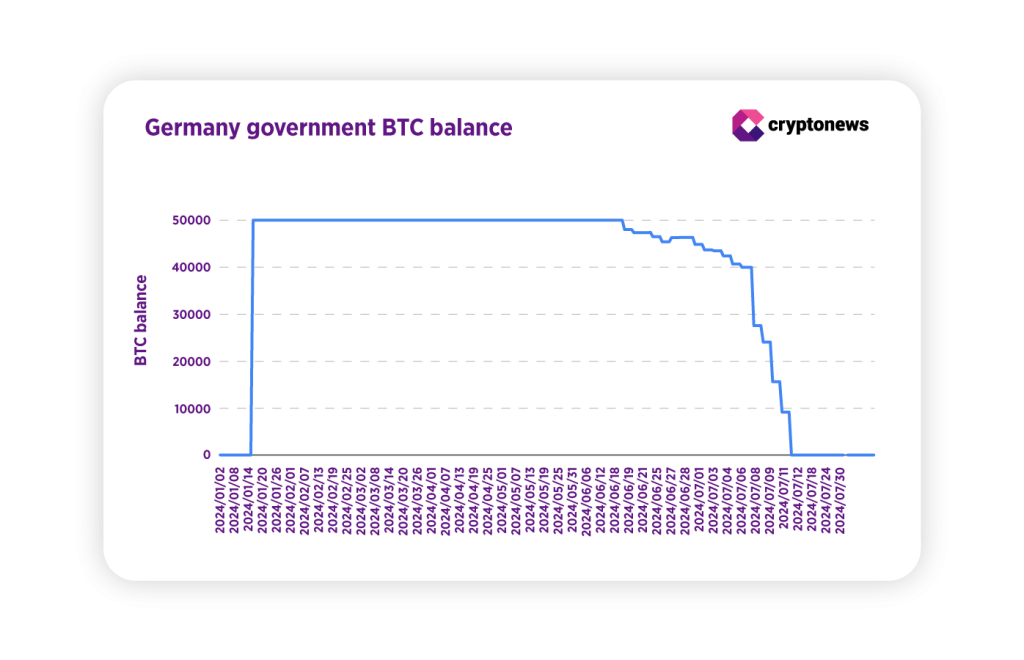
Germany was ranked as the fourth-largest government holder of Bitcoin in January 2024. It had seized 50,000 BTC, worth approximately $2.2 billion at the time, from the operators of Movie2K, a movie piracy network.

However, by July 12, 2024, the German government, through its Federal Criminal Police Office (BKA), had sold a total of 49,858 BTC for approximately $2.89 billion, at an average sale price of $57,900 per BTC. The decision to sell was not purely an investment move but was made in compliance with German law, which mandates the sale of seized assets prone to significant market volatility to prevent further losses.
Barely a year later, the price of BTC has more than doubled, surging above $122,000 on August 11, 2025. Had the government kept the seized Bitcoin, its value would be approximately $6.06 billion, representing a missed profit of $3.17 billion compared to the average sale proceeds. This would place Germany among the world’s four largest government holders.

German lawmaker Joana Cotar argued in a July 4 letter to members of the German government that Bitcoin should have been held as a strategic reserve, stating:

Meanwhile, the United States has taken a different approach to managing its Bitcoin holdings. The U.S. government holds approximately 198,022 BTC, valued at over $24 billion, primarily acquired through seizures. Earlier this year, it established a Strategic Bitcoin Reserve with no announced plans to sell.

Is Germany Still Interested in Crypto?

Although Germany has slipped from its rank as the fourth-largest government Bitcoin holder and missed the chance to earn an additional $3 billion, the country is actively supporting crypto adoption and regulation.

Following the approval of the Markets in Crypto Assets (MiCA) regulation, crypto assets have become legal in Germany. However, exchanges are required to obtain necessary licenses from the Federal Financial Supervisory Authority (BaFin) to operate in the country.

Crypto users in Germany were projected to reach 27.32 million, with GenZ and millennials accounting for up to 50%. Institutional adoption is also rising, with Deutsche Bank reportedly planning to launch a digital assets custody service in 2026. Revenue from the German crypto market is expected to reach $2.5 billion in 2025 and about $2.9 billion by the end of 2026, with a compound annual growth rate (CAGR) of 16.33%.

Germany is also creating a favourable tax policy for long-term crypto holders. Gains from crypto are tax-free if held for more than one year, while short-term gains (less than one year) are subject to progressive income tax of up to 45%.

The government is also working to improve its tax transparency through the Directive on Administrative Cooperation (DAC 8), which mandates crypto asset providers (CASPs) to report transaction details to tax authorities. This will take effect from January 1, 2026.

Closing Thoughts

With Bitcoin’s role in global markets continuing to grow and other countries reassessing their crypto strategies, Germany’s early Bitcoin liquidation and missed financial opportunity have become a case study in the importance of long-term planning for managing digital asset holdings.


Market Opportunity
Bitcoin Logo
Bitcoin Price(BTC)
$93,571.27
$93,571.27$93,571.27
+0.13%
USD
Bitcoin (BTC) Live Price Chart
Disclaimer: The articles reposted on this site are sourced from public platforms and are provided for informational purposes only. They do not necessarily reflect the views of MEXC. All rights remain with the original authors. If you believe any content infringes on third-party rights, please contact [email protected] for removal. MEXC makes no guarantees regarding the accuracy, completeness, or timeliness of the content and is not responsible for any actions taken based on the information provided. The content does not constitute financial, legal, or other professional advice, nor should it be considered a recommendation or endorsement by MEXC.

You May Also Like

The Channel Factories We’ve Been Waiting For

The Channel Factories We’ve Been Waiting For

The post The Channel Factories We’ve Been Waiting For appeared on BitcoinEthereumNews.com. Visions of future technology are often prescient about the broad strokes while flubbing the details. The tablets in “2001: A Space Odyssey” do indeed look like iPads, but you never see the astronauts paying for subscriptions or wasting hours on Candy Crush.  Channel factories are one vision that arose early in the history of the Lightning Network to address some challenges that Lightning has faced from the beginning. Despite having grown to become Bitcoin’s most successful layer-2 scaling solution, with instant and low-fee payments, Lightning’s scale is limited by its reliance on payment channels. Although Lightning shifts most transactions off-chain, each payment channel still requires an on-chain transaction to open and (usually) another to close. As adoption grows, pressure on the blockchain grows with it. The need for a more scalable approach to managing channels is clear. Channel factories were supposed to meet this need, but where are they? In 2025, subnetworks are emerging that revive the impetus of channel factories with some new details that vastly increase their potential. They are natively interoperable with Lightning and achieve greater scale by allowing a group of participants to open a shared multisig UTXO and create multiple bilateral channels, which reduces the number of on-chain transactions and improves capital efficiency. Achieving greater scale by reducing complexity, Ark and Spark perform the same function as traditional channel factories with new designs and additional capabilities based on shared UTXOs.  Channel Factories 101 Channel factories have been around since the inception of Lightning. A factory is a multiparty contract where multiple users (not just two, as in a Dryja-Poon channel) cooperatively lock funds in a single multisig UTXO. They can open, close and update channels off-chain without updating the blockchain for each operation. Only when participants leave or the factory dissolves is an on-chain transaction…
Share
BitcoinEthereumNews2025/09/18 00:09
Trading time: Tonight, the US GDP and the upcoming non-farm data will become the market focus. Institutions are bullish on BTC to $120,000 in the second quarter.

Trading time: Tonight, the US GDP and the upcoming non-farm data will become the market focus. Institutions are bullish on BTC to $120,000 in the second quarter.

Daily market key data review and trend analysis, produced by PANews.
Share
PANews2025/04/30 13:50
CEO Sandeep Nailwal Shared Highlights About RWA on Polygon

CEO Sandeep Nailwal Shared Highlights About RWA on Polygon

The post CEO Sandeep Nailwal Shared Highlights About RWA on Polygon appeared on BitcoinEthereumNews.com. Polygon CEO Sandeep Nailwal highlighted Polygon’s lead in global bonds, Spiko US T-Bill, and Spiko Euro T-Bill. Polygon published an X post to share that its roadmap to GigaGas was still scaling. Sentiments around POL price were last seen to be bearish. Polygon CEO Sandeep Nailwal shared key pointers from the Dune and RWA.xyz report. These pertain to highlights about RWA on Polygon. Simultaneously, Polygon underlined its roadmap towards GigaGas. Sentiments around POL price were last seen fumbling under bearish emotions. Polygon CEO Sandeep Nailwal on Polygon RWA CEO Sandeep Nailwal highlighted three key points from the Dune and RWA.xyz report. The Chief Executive of Polygon maintained that Polygon PoS was hosting RWA TVL worth $1.13 billion across 269 assets plus 2,900 holders. Nailwal confirmed from the report that RWA was happening on Polygon. The Dune and https://t.co/W6WSFlHoQF report on RWA is out and it shows that RWA is happening on Polygon. Here are a few highlights: – Leading in Global Bonds: Polygon holds 62% share of tokenized global bonds (driven by Spiko’s euro MMF and Cashlink euro issues) – Spiko U.S.… — Sandeep | CEO, Polygon Foundation (※,※) (@sandeepnailwal) September 17, 2025 The X post published by Polygon CEO Sandeep Nailwal underlined that the ecosystem was leading in global bonds by holding a 62% share of tokenized global bonds. He further highlighted that Polygon was leading with Spiko US T-Bill at approximately 29% share of TVL along with Ethereum, adding that the ecosystem had more than 50% share in the number of holders. Finally, Sandeep highlighted from the report that there was a strong adoption for Spiko Euro T-Bill with 38% share of TVL. He added that 68% of returns were on Polygon across all the chains. Polygon Roadmap to GigaGas In a different update from Polygon, the community…
Share
BitcoinEthereumNews2025/09/18 01:10



