

MARA Holdings Routes 1,317 BTC During Volatility-Driven Selloff
As Bitcoin briefly slipped toward the $60,000 area amid a sharp risk-off move, MARA Holdings routed 1,317 BTC, worth roughly $87.4 million, to several institutional trading venues.
The transfers unfolded alongside heavy pressure across mining equities and tightening liquidity conditions across crypto markets.
Rather than occurring during a quiet rebalancing window, the activity landed directly inside a volatility event, when price discovery was unstable and balance-sheet decisions mattered more than directional conviction.
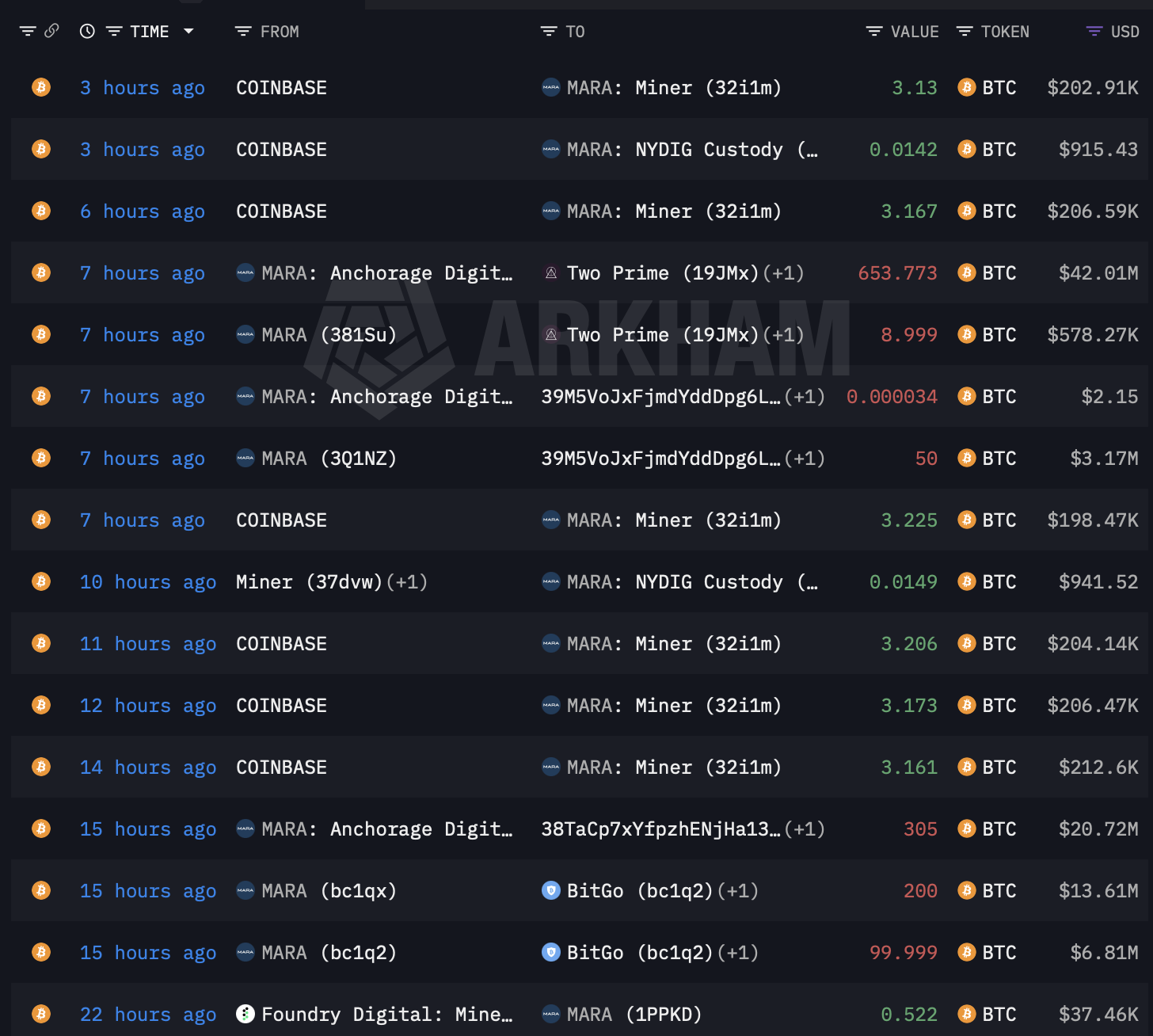 Source: https://intel.arkm.com/explorer/entity/mara-pool
Bitcoin’s Breakdown Sets the Backdrop
The transfers coincided with a rapid drawdown in Bitcoin, which fell nearly 13% in a single session and briefly traded near $60,000, its lowest level since October 2024. The move reflected accelerated risk reduction rather than a gradual structural shift, with selling pressure intensifying as liquidity thinned.
Mining equities moved in lockstep. MARA Holdings shares dropped 18.72% on February 5, closing at $6.73 on the Nasdaq, extending monthly losses to roughly 34.72%. Price behavior across miners suggested forced de-risking, as equity beta to spot Bitcoin expanded during the selloff.
How the BTC Was Routed and Why That Matters
On-chain data shows the 1,317 BTC was split across multiple institutional platforms, a pattern typically associated with structured treasury operations rather than a single execution decision.
- Two Prime received the largest share, approximately 660 BTC, valued near $43.4 million.
- BitGo-linked addresses received several tranches, including transfers of roughly 200 BTC and 99.99 BTC.
- Galaxy Digital also received allocations, reinforcing the institutional nature of the routing.
Despite the size of the transfer, MARA is still estimated to control more than 52,000 BTC in treasury holdings, limiting the immediate directional signal of the move and framing it as partial positioning rather than wholesale distribution.
Mining Economics Tighten as Sentiment Breaks Down
The broader mining environment has deteriorated alongside price. Daily miner revenue has dropped to approximately $32.62 million this week, down from more than $41 million just two weeks earlier, increasing sensitivity to short-term price swings and operational costs.
Sentiment indicators mirror that stress. Crypto fear gauges reached “Extreme Fear” levels not seen since the 2022 FTX collapse. At the same time, analysts have linked the downturn to a broader technology selloff, driven by concerns around AI valuations and weaker-than-expected U.S. labor data, reinforcing a synchronized risk-off backdrop.
What This Means if Volatility Persists
If Bitcoin stabilizes above the recent $60,000 low and volatility begins to compress, the MARA transfers may ultimately be viewed as liquidity management during a disorderly market phase rather than directional selling. Under those conditions, miner balance-sheet pressure would ease, and equity sensitivity to spot price could begin to normalize.
However, if price weakness extends and revenue compression continues, the probability of additional miner-led distribution increases. In that scenario, treasury movements would likely reflect operational necessity rather than strategic timing, with broader implications for sector-wide supply dynamics.
Where the Signal Actually Sits
The significance of MARA Holdings’ 1,317 BTC transfer lies less in the absolute size of the transaction and more in its execution window. Routed during a sharp volatility event, the move highlights how miner treasury decisions increasingly intersect with liquidity stress, equity market drawdowns, and near-term revenue constraints.
For now, the data points to balance-sheet defense rather than a clear shift in long-term positioning, with confirmation dependent on whether Bitcoin can move beyond the immediate liquidation phase and re-establish price stability.
The post MARA Holdings Routes 1,317 BTC During Volatility-Driven Selloff appeared first on ETHNews.


You May Also Like

Iran’s army chief warns of ‘total destruction’ for ground invasion

Best Music AI Websites For Songs And Soundtracks




