

Kevin Warsh Will Trigger Bitcoin Regime Shift, Jeff Park Says
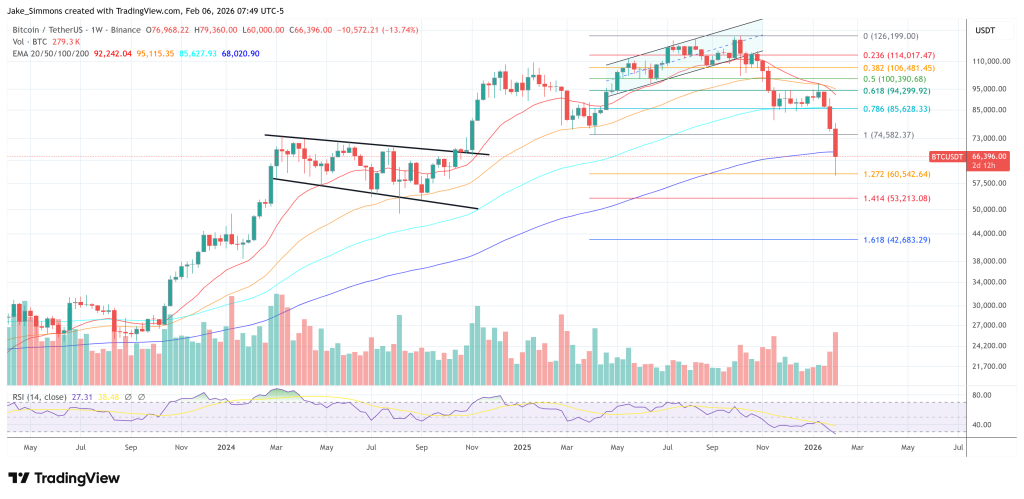
Bitcoin’s roughly 50% drawdown has less to do with cycle déjà vu than a deeper break in the market’s old playbook, according to Jeff Park, partner and CIO at ProCap Financial, who argues a prospective Kevin Warsh-led Federal Reserve could catalyze a regime shift in how Bitcoin trades.
In an conversation with Anthony Pompliano, Park said he believes Bitcoin has been in a bear market “for quite a bit,” and warned that the familiar reflexive framework, easier policy, more liquidity, higher BTC, has stopped doing the explanatory work it once did.
What Kevin Warsh Means For Bitcoin
Park’s starting point was a blunt claim: the assumed linkage between Bitcoin and global liquidity has “been broken for quite some time.” He pointed to what he described as steadily rising global liquidity through 2025, citing Michael Howell’s tracking and estimating the level at roughly $170 trillion, alongside broad-based strength in other asset classes.
“Asset prices have all gone up,” Park said, referencing a “frenzied rally” in metals and corporate credit spreads near all-time lows, before adding: “there actually is a lot of reasons to think that Bitcoin should have also already participated, but it didn’t.”
That divergence, he argued, is why investors should stop leaning on backward-looking heuristics that have become psychological crutches. In his telling, crypto markets have repeatedly assumed history would re-run—altcoin rallies after bitcoin rallies, a durable four-year cycle, and the idea that QE or lower rates reliably lift BTC. “It’s worth remembering that there’s things that are constantly changing about the world where everything looks a little bit different than the way you had modeled it before,” he said.
From there, Park reframed the debate around his “negative rho” versus “positive rho” Bitcoin framework. The former is the risk-asset version most investors recognize: rates down, risk up, Bitcoin up. The latter is the endgame: Bitcoin rising as rates rise, effectively challenging the notion of a stable “risk-free” rate by calling into question the credibility of the monetary order itself.
“This is the mythical elusive perfect holy grail of what Bitcoin is meant to be,” Park said of positive-rho Bitcoin. “What it’s undermining is the risk-free rate itself. In that world, what we’re saying is actually because the risk-free rate is not the risk-free rate. Because the dollar hegemony is not the dollar hegemony and we are no longer able to price the yield curve in the ways we’ve known that means we need something different… and bitcoin is that hedge.”
Park suggested the market may be inching toward that worldview as US policymaking becomes more explicitly about system repair, not incremental tweaks. He described the current US administration as attempting to “wrestle control of the economy away from the Federal Reserve” via deregulation, tax cuts, tariffs, and efforts to weaken the dollar, leaving the Fed “on their back foot” amid shifting “tectonic plates” across policy channels.
That’s where Park placed Warsh, a former Fed governor and, in Park’s telling, a rare combination of institutional fluency and technological conviction, as potentially pivotal. Park recounted an interaction from 2021 or 2022 in which Warsh expressed enthusiasm for Bitcoin while criticizing “phonies” who treat tech as “magic.” Warsh, Park said, “truly believed deep in his heart that this isn’t magic… that it actually is going to solve a lot of problems and bring efficiencies and Bitcoin is a core part of that cultural fabric.”
Crucially, Park emphasized Warsh is not an anti-institution wrecking ball. Instead, he portrayed Warsh as someone who understands why the Fed’s legitimacy has been challenged and how it might be rebuilt. One line, Park said, has “always stuck” with him: “inflation is a choice.” Park contrasted that with Fed communication that, in his view, sometimes treats inflation as something that merely happens due to tariffs or war, rather than an outcome of policy tools and mandates.
For Park, a Warsh appointment matters less because it guarantees easier policy and more because it could accelerate a rethink of Fed–Treasury coordination. He said he is “optimistic about the possibility of a new Fed Treasury accord that Bessant and Warsh can rewrite,” arguing the heart of the issue is the Triffin dilemma and the tension between the dollar’s external reserve role and internal saver role. “It’s not that we need fed independence,” Park said. “We actually need Fed interdependence with the Treasury.”
The irony, in Park’s framing, is that “more accommodative policies may in fact actually not be the catalyst” for Bitcoin’s next bull phase. Instead, he argued Bitcoin’s bid ultimately strengthens when the world feels less like “peacetime” and more like “wartime”, when industrial, military, and fiscal policy dominate, centralization pressures rise, and capital controls become more plausible. The people who “need Bitcoin,” he said, are not US investors with endless alternatives, but those facing constraint and censorship.
If Park is right, Warsh isn’t bullish for Bitcoin because he’ll deliver a familiar liquidity wave. He’s bullish because a Warsh-era Fed, paired with a Treasury aligned on system-level reform, could push markets toward the “positive rho” regime, where Bitcoin’s value proposition is less about riding stimulus and more about challenging the architecture that made stimulus necessary in the first place.
At press time, BTC traded at $66,396.


You May Also Like

US missionary who contracted Ebola is on his way to Germany

B2i Digital Named Official Marketing Partner for Centurion One Capital’s Miami Summit




