DavosWeb3’s latest roundtable in Davos introduces a declaration focused on responsible Web3 and AI development, highlighting real-world use cases, governance, andDavosWeb3’s latest roundtable in Davos introduces a declaration focused on responsible Web3 and AI development, highlighting real-world use cases, governance, and

DavosWeb3 2026 Unveils Declaration on Responsible Web3 and AI Development
For feedback or concerns regarding this content, please contact us at [email protected]
Pr Davos

Editor’s note: On the sidelines of the World Economic Forum in Davos, the second DavosWeb3 roundtable convened a small group of founders, investors, and ecosystem leaders for a focused discussion on how decentralized technologies are evolving beyond experimentation. Held at the Financial Times House, the gathering emphasized practical deployment, governance, and accountability, particularly where Web3 intersects with artificial intelligence, financial infrastructure, and digital identity. The launch of the Davos Declaration formalized this direction, outlining shared principles intended to guide the next phase of decentralized innovation.

Key points

  • The Davos Declaration outlines seven principles aimed at responsible Web3 and AI development.
  • Speakers focused on real-world use cases such as remittances, digital identity, and institutional-grade finance.
  • AI infrastructure, capital allocation, and decentralization were discussed through a long-term, execution-driven lens.
  • The roundtable format prioritized substance over visibility, contrasting with typical Davos programming.

Why this matters

As Web3 matures, conversations are shifting from speculative growth to infrastructure, governance, and measurable impact. Events like DavosWeb3 signal how builders and investors are aligning decentralized technology with existing financial systems, regulatory expectations, and AI development. For the global market and the MENA-adjacent innovation ecosystem, this reflects a broader move toward accountability and integration, positioning Web3 as foundational digital infrastructure rather than a standalone experiment.

What to watch next

  • How the Davos Declaration principles are adopted or referenced by Web3 projects and investors.
  • Follow-on collaborations or initiatives emerging from the DavosWeb3 network.
  • Practical deployments of decentralized identity, AI infrastructure, and fintech solutions discussed at the roundtable.

Disclosure: The content below is a press release provided by the company/PR representative. It is published for informational purposes.

Davos, Switzerland – February 4, 2026 – The second DavosWeb3 roundtable unfolded on January 21 at the Financial Times House, quietly carving out space for meaningful dialogue amid the World Economic Forum buzz. No flashy keynotes, just a focused group of builders, investors, and leaders exchanging grounded ideas on how decentralized tech can scale thoughtfully, especially as it intersects with AI.

The day culminated in the launch of the Davos Declaration, a clear-eyed pledge to seven core principles: Collaboration, Equitability, Transparency, Accountability, Inclusion, Decentralization, and Sustainability. Co-organizer Ajeet Khurana recited it, setting the tone for conversations that prioritized substance over speculation.

Speakers brought sharp, practical perspectives that reflected the event’s ethos:

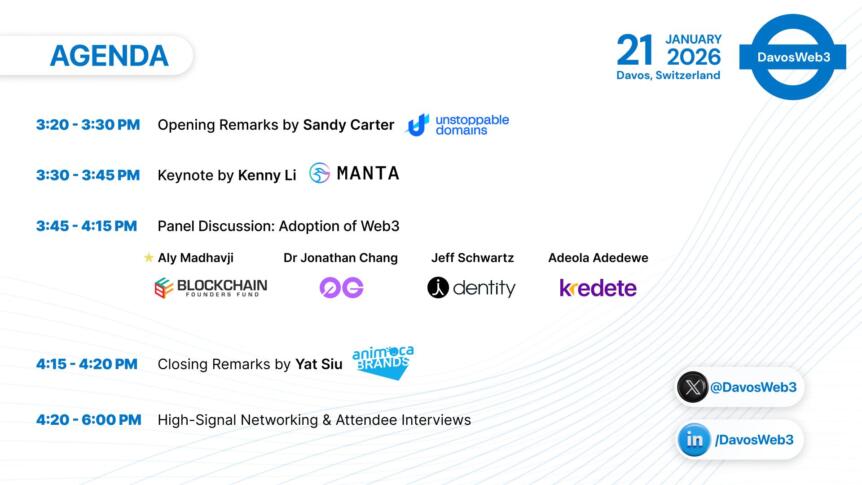
  • Adeola Adedewe (Kredete) spoke about transforming remittances into credit-building tools for underserved markets, closing massive gaps in emerging economies.
  • Aly Madhavji (Blockchain Founders Fund) stressed the power of patient, transparent capital to create durable impact across a portfolio of over 200 companies.
  • Dr. Jonathan Chang (0G Foundation) pushed for modular AI infrastructure treated as a transparent public good, with real accountability baked in.
  • Kenny Li (Manta Network) shared reflections on evolving beyond oversaturated infrastructure toward targeted, institutional-grade financial tooling after five years of building.
  • Jeffrey Schwartz (Dentity) highlighted how decentralized identity is already verifying the majority of U.S. notaries for mortgage processes privacy-preserving tech meeting real-world security needs.
  • Sandy Carter (Unstoppable Domains) opened by noting crypto’s mainstream arrival in Davos and introduced the .web3 domain as a foundation for true digital ownership.
  • Yat Siu (Animoca Brands) closed with a vision of gamified finance as the quickest path to universal financial literacy, backed by a massive portfolio and upcoming public-market steps.

“Great technology requires a greater conscience,” one of the organizers summed up capturing the day’s blend of ambition and principle.
Pr DavosPr Davos

The gathering reinforced that Web3 is maturing into essential infrastructure: less hype, more execution, more accountability. DavosWeb3 remains a rare spot for these kinds of high-signal exchanges.

Through partners like DroomDroom, we are bringing in-depth roundtable insights directly to the broader Web3 community.

About DavosWeb3

DavosWeb3 is the annual roundtable in Davos dedicated to thoughtful conversations on the future of decentralized technologies. More at davosweb3.com or @DavosWeb3 on X. Media inquiries: [email protected]

This article was originally published as DavosWeb3 2026 Unveils Declaration on Responsible Web3 and AI Development on Crypto Breaking News – your trusted source for crypto news, Bitcoin news, and blockchain updates.


Market Opportunity
Belong Logo
Belong Price(LONG)
$0.00155
$0.00155$0.00155
-0.25%
USD
Belong (LONG) Live Price Chart
Disclaimer: The articles reposted on this site are sourced from public platforms and are provided for informational purposes only. They do not necessarily reflect the views of MEXC. All rights remain with the original authors. If you believe any content infringes on third-party rights, please contact [email protected] for removal. MEXC makes no guarantees regarding the accuracy, completeness, or timeliness of the content and is not responsible for any actions taken based on the information provided. The content does not constitute financial, legal, or other professional advice, nor should it be considered a recommendation or endorsement by MEXC.

You May Also Like

Saudi Awwal Bank Adopts Chainlink Tools, LINK Near $23

Saudi Awwal Bank Adopts Chainlink Tools, LINK Near $23

The post Saudi Awwal Bank Adopts Chainlink Tools, LINK Near $23 appeared on BitcoinEthereumNews.com. SAB adopts Chainlink’s CCIP and CRE to expand tokenization and cross-border finance tools. SAB and Wamid target $2.32T Saudi capital markets with blockchain-based tokenization plans. LINK price falls 2.43% to $22.99 despite higher trading volume and steady liquidity ratios. Saudi Awwal Bank has added Chainlink’s Cross-Chain Interoperability Protocol (CCIP) and the Chainlink Runtime Environment (CRE) to its digital strategy. CCIP links assets and data across multiple blockchains, while CRE provides banks with a controlled framework to test and deploy new financial applications. The lender, with more than $100 billion in assets, is applying the tools to tokenized assets, cross-border settlement, and automated credit platforms. The move signals that Chainlink’s infrastructure is being adopted at scale inside regulated finance. Related: Chainlink’s Deal with SBI Is a Major Win, But Chart Shows LINK’s Battle at $27 Resistance Wamid Partnership Aims at $2.32 Trillion Markets In parallel, SAB signed an agreement with Wamid, a subsidiary of the Saudi Tadawul Group, to pilot tokenization of the Saudi Exchange’s $2.32 trillion capital markets. The focus is on equities and debt products, opening the door for blockchain-based issuance and settlement. SAB has already executed the world’s first Islamic repo on distributed ledger technology, in collaboration with Oumla earlier this year. That transaction gave regulators a template for compliant on-chain contracts. The Wamid deal builds directly on that precedent, shifting from single-instrument pilots toward broader capital markets integration. Saudi Blockchain Buildout Gains Pace Saudi institutions are building multiple layers of digital infrastructure. Oumla is working with Avalanche to develop the Kingdom’s first domestically hosted Layer 1 blockchain. SAB’s Chainlink adoption adds an interoperability and execution layer on top. Together, these projects are shaping a domestic framework for tokenization, with global connectivity added only where liquidity requires it. LINK Price and Liquidity Snapshot While institutional adoption progresses, Chainlink’s…
Share
BitcoinEthereumNews2025/09/18 08:49
Today’s NYT Pips Hints And Solutions For Thursday, September 18th

Today’s NYT Pips Hints And Solutions For Thursday, September 18th

The post Today’s NYT Pips Hints And Solutions For Thursday, September 18th appeared on BitcoinEthereumNews.com. It’s Thursday and I am incredibly sore and tired after really hitting the weights and the yoga mat hard this week. Sore is good! It takes pain to reduce pain, or at least that’s my experience with exercise. We must exercise our minds as well, and what better way to do that than with a fun puzzle game about placing dominoes in the correct tiles. Come along, my Pipsqueaks, let’s solve today’s Pips! Looking for Wednesday’s Pips? Read our guide right here. How To Play Pips In Pips, you have a grid of multicolored boxes. Each colored area represents a different “condition” that you have to achieve. You have a select number of dominoes that you have to spend filling in the grid. You must use every domino and achieve every condition properly to win. There are Easy, Medium and Difficult tiers. Here’s an example of a difficult tier Pips: Pips example Screenshot: Erik Kain As you can see, the grid has a bunch of symbols and numbers with each color. On the far left, the three purple squares must not equal one another (hence the equal sign crossed out). The two pink squares next to that must equal a total of 0. The zig-zagging blue squares all must equal one another. You click on dominoes to rotate them, and will need to since they have to be rotated to fit where they belong. Not shown on this grid are other conditions, such as “less than” or “greater than.” If there are multiple tiles with > or < signs, the total of those tiles must be greater or less than the listed number. It varies by grid. Blank spaces can have anything. The various possible conditions are: = All pips must equal one another in this group. ≠ All pips…
Share
BitcoinEthereumNews2025/09/18 08:59
How a 35-Year-Old Crypto Bro Help Pakistan Win Trump World

How a 35-Year-Old Crypto Bro Help Pakistan Win Trump World

The post How a 35-Year-Old Crypto Bro Help Pakistan Win Trump World appeared on BitcoinEthereumNews.com. Bloomberg said Bilal Bin Saqib helped Pakistan build ties
Share
BitcoinEthereumNews2026/03/31 08:55