

23% of Investors Forecast a Fed Rate Cut at the March FOMC
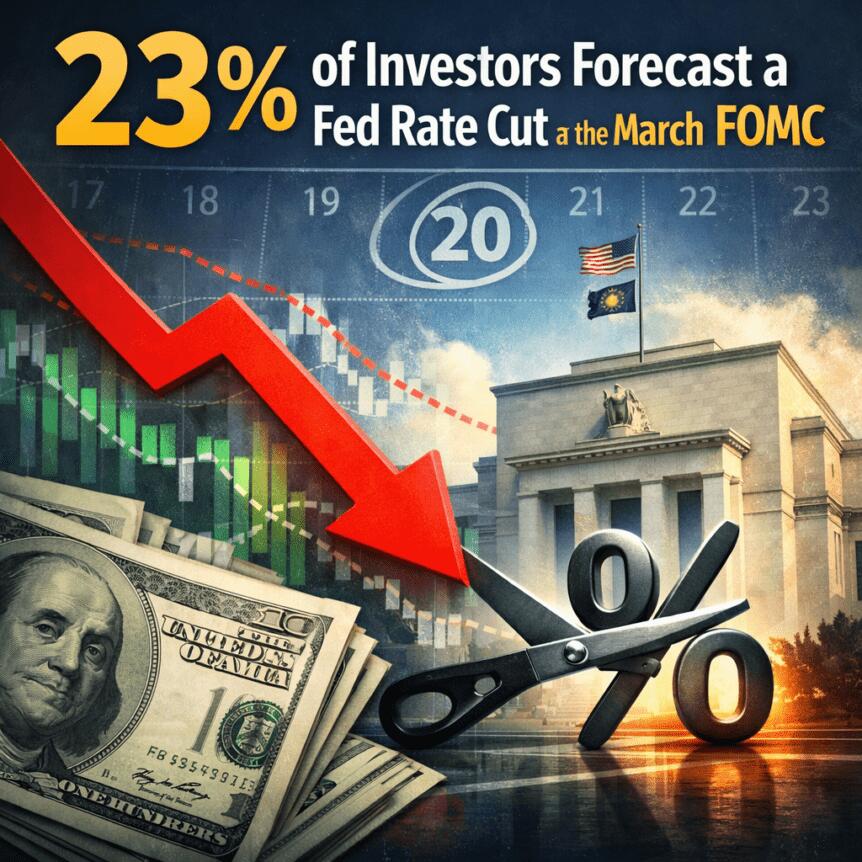
The shift in expectations for U.S. monetary policy is spreading through markets as traders digest the potential implications of a hawkish Fed chair nominee. With Fed watchers weighing the odds of a March rate cut, data from CME Group’s FedWatch tool shows the probability cresting at about 23%—up from roughly 18.4% late last week. The move signals a re-pricing of near-term easing, even as the broader consensus remains modest about the size of any forthcoming cuts. The spike comes as Donald Trump’s January nomination of Kevin Warsh to lead the Federal Reserve raises questions about how aggressively the central bank will continue to reduce accommodation, especially if the new chair advocates shrinking the balance sheet. Powell’s current term ends in May, a factor that injects political nuance into policy timing and market expectations.
Markets have traditionally responded to shifts in liquidity and rate expectations, and the current dynamic underscores how a single nomination can ripple through asset prices. In crypto markets, the relationship is nuanced: easing liquidity tends to support risk assets, while tighter conditions can constrain funding and access to capital. The debate over Warsh’s approach—especially his stance on the central bank’s balance sheet—has amplified concerns about financing conditions, which in turn can influence portfolios across equities, commodities, and digital assets. The linked data and commentary reflect a broader narrative in which policy trajectory and balance-sheet strategy are seen as primary drivers of liquidity in the months ahead.
Analysts have pointed to Warsh’s past views on the Fed’s balance sheet as a potential source of policy risk. He has argued that the balance sheet is “trillions larger than it needs to be,” a characterization that underscores the debate over whether a shrinking balance sheet could tighten financial conditions. If the new chair pursues a deliberate reduction in liquidity, markets may Face a period of heightened sensitivity to macro signals, with consequences for riskier assets that rely on easy financing. Krakken’s global economist Thomas Perfumo described Warsh’s nomination as sending a mixed macro signal to investors, suggesting that liquidity dynamics could shift without a clear, immediate direction. In this context, some observers caution that the Fed may pivot more slowly toward easing if balance-sheet normalization becomes a priority, complicating the trajectory of asset prices across markets.
The rhetoric around policy has also interacted with other market dynamics. Earlier in the year, concerns about hawkish bias contributed to declines in certain precious metals and other risk-sensitive assets, illustrating how policy expectations can ripple beyond equities into broader markets. Market participants have emphasized that the Fed’s policy stance will remain a focal point, with the potential to influence how crypto assets—especially those sensitive to liquidity and funding costs—behave in a volatile macro environment. The conversation around Warsh continues to evolve as investors monitor official statements, committee communications, and potential congressional signals that could shape policy timing and tone. For context, one of the linked pieces explores how Fed rate decisions can affect crypto holders, underscoring the linkage between traditional financial conditions and digital-asset markets.
Market reaction and policy expectations as Warsh nomination stirs caution
Bitcoin (CRYPTO: BTC) and other major digital assets could find themselves navigating a scenario in which the Fed’s balance-sheet strategy and rate path become more influential than in the recent past. The discussion around Warsh’s stance fills a gap in the market’s understanding of how aggressively the central bank will normalize policy, particularly if rate cuts are viewed as contingent on liquidity conditions rather than purely economic data. The scenario described by market analysts includes a tension between supportive financial conditions for risk assets and the prospect of a tighter funding environment if the balance sheet is reduced. The potential for a slower easing cycle or a longer period of higher rates could temper enthusiasm for speculative assets, even as demand from long-term investors remains a factor in broader market dynamics. This cross-asset sensitivity underscores why traders are watching Fed communications with heightened attention, recognizing that even modest shifts in the policy mix can alter capital flows and risk sentiment across markets.
As policymakers and markets await more clarity, the conversation around liquidity remains central. Warsh’s nomination has intensified worries about a “lower-liquidity environment” if policy steps move toward balance-sheet contraction. The fear is not limited to traditional markets; crypto-specific funding channels—such as margin lending, swaps, and decentralized finance—could feel the impact of tighter credit conditions if the central bank signals a cautious approach to balance-sheet normalization. The broader takeaway is that the policy pathway now carries an additional layer of uncertainty, with the potential to influence price discovery in both conventional and digital-asset markets. The YouTube commentary embedded above captures some of the real-time reactions and expert assessments shaping this narrative, illustrating how political developments dovetail with macroeconomic policy in a rapidly evolving environment.
In this context, market participants are recalibrating their expectations for how quickly the Fed might shift from tightening to easing, and how the new leadership could interpret the central bank’s own balance in the years ahead. The discussion also intersects with ongoing debates about crypto liquidity, funding rates, and the resilience of digital-asset markets in the face of tightening macro conditions. While some observers argue that a hawkish tilt would dampen risk appetite, others contend that a well-communicated framework and credible policy path could stabilize expectations and reduce volatility over time. The evolving discourse highlights the delicate balance between policy credibility and market confidence, a dynamic that will likely shape both traditional and crypto markets in the near term.
Analysts emphasize that the March FOMC meeting remains a pivotal moment for policy signaling. While a 25 basis-point cut remains a modest possibility, expectations of a larger cut or aggressive easing appear unlikely under the current dialogue surrounding balance-sheet management. As investors integrate these considerations, they are closely tracking the CME FedWatch data, official statements from the Fed, and the evolving commentary surrounding Warsh’s nomination. The implications are not limited to rate paths; they extend to liquidity, credit conditions, and the ability of market participants to access funding in a climate where policy choices carry more weight than was anticipated even a few months ago.
Why it matters
The intersection of Fed policy expectations and crypto markets matters for several reasons. First, liquidity remains a foundational driver of asset prices. If the Fed signals a path toward balance-sheet reduction or maintains a higher-for-longer rate stance, funding conditions could tighten, increasing the cost of capital and reducing speculative activity in risk-on segments, including digital assets. Second, the alignment—or misalignment—between policy signals and market expectations can create abrupt shifts in risk sentiment, potentially triggering faster moves in crypto prices than in traditional markets during periods of macro uncertainty. Third, the nomination of Warsh, which has become a focal point for market analysts, underscores how political dynamics can influence monetary policy and, by extension, the liquidity environment that crypto traders rely on for leverage and liquidity provision. Finally, the broader macro backdrop—ranging from inflation dynamics to credit conditions—continues to shape how investors allocate across asset classes and risk profiles, with crypto assets often sensitive to shifts in liquidity and market sentiment.
For traders and builders in the crypto space, these developments highlight the importance of robust risk management and hedging strategies that account for macro-driven volatility. The potential for a tighter policy regime means that on-chain liquidity provision, cross-asset funding costs, and risk premia across DeFi and centralized exchanges could experience heightened sensitivity to macro headlines. While policy uncertainty can compress near-term gains, it can also create opportunities for long-term participants who position themselves for resilience in evolving liquidity dynamics. As the Fed’s policy conversation progresses, the crypto ecosystem will continue to watch for signals that indicate whether liquidity will be favored or constrained in the months ahead.
What to watch next
- March FOMC decision and summary of the committee’s projections, including any changes to the rate path.
- Public statements or confirmations from Kevin Warsh regarding balance-sheet policy and duration of any normalization steps.
- Updates on liquidity indicators and market funding conditions, including crypto-specific funding metrics and DeFi activity.
- Market reactions to Fed communications, and any revisions to the CME FedWatch probability for March or subsequent meetings.
- Regulatory or policy signals that could influence liquidity, including broader macro trends and currency-market dynamics that affect cross-asset flows.
Sources & verification
- CME Group FedWatch tool data showing March rate-cut probabilities.
- Cointelegraph article: Kevin Warsh officially picked as Federal Reserve chair.
- Cointelegraph explainer: Impact of Fed interest rates on crypto holders.
- Cointelegraph coverage referencing Bitcoin and macro policy dynamics in relation to liquidity and risk sentiment.
This article was originally published as 23% of Investors Forecast a Fed Rate Cut at the March FOMC on Crypto Breaking News – your trusted source for crypto news, Bitcoin news, and blockchain updates.


You May Also Like
Australian Dollar Dips Below 0.7100 as Middle East Tensions Weigh on Risk Sentiment

Fed Governor Calls For Strong Stablecoin Oversight As CLARITY Act’s Final Text Gets Delayed




