Don’t guess the next clean-energy “ride.” Own the rail it runs on. EDMA turns rooftop output into auditable receipts (ETTs) and settles every conversion on $EDM. Built by PrimeHire (500 engineers, top 1%), audited by Cyberscope and Coinsult with zero critical vulnerabilities, the presale stands at 14,000 holders and $1.73M—with zero ads.Don’t guess the next clean-energy “ride.” Own the rail it runs on. EDMA turns rooftop output into auditable receipts (ETTs) and settles every conversion on $EDM. Built by PrimeHire (500 engineers, top 1%), audited by Cyberscope and Coinsult with zero critical vulnerabilities, the presale stands at 14,000 holders and $1.73M—with zero ads.

Own the Rail, Not the Ride: Why $EDM is the Crypto Building the Future of Energy.

Own the Rail, Not the Ride: Why $EDM is the Crypto Building the Future of Energy.

A meter tips past 10 kWh. Somewhere a family eats dinner; somewhere a dashboard lights up with verified supply. The two never meet. The market does. That’s EDMA’s promise in one breath: turn sunlight into a receipt you can trust, then make it liquid.

The platform play (a.k.a. uberization)

Uber didn’t win by buying taxis—it coordinated idle capacity and let demand settle instantly. EDMA does the same for clean energy. Instead of chasing one giant plant, it orchestrates the long tail so a million small parks can earn like one big one.

  • Mint: When a connected meter crosses a threshold (e.g., 10 kWh), EDMA mints an ETT (Energy Tracking Token)—a public, auditable receipt of who/when/how much.
  • Market: Inside EDMA, ETTs become value buyers already understand—renewable certificates (where rules allow), verified clean-energy purchases for ESG, or utility for participants.
  • Settle: No $EDM, no conversion. $EDM is the settlement token that turns proof into profit. More rooftops → more ETT → more demand for $EDM.
    (Utility perks live on CLE, a separate lane—proof and benefits never mix.)

Why this matters now

  • 30M+ homes already run rooftop solar.
  • Under EDMA’s model, that unlocks ~$45B/year across clean-energy tokens, RECs, and carbon markets.
  • The voluntary carbon market is tracking toward $50B by 2030,while demand for verified renewable supply exceeds available supply by more than 30%. That shortage forces corporations to pay premiums to meet ESG compliance — and EDMA is positioned to deliver the missing, verifiable supply.

EDMA bridges that gap with time-stamped, meter-based supply—and gives it a frictionless settlement rail.

Built to be trusted

EDMA is developed by PrimeHire500 engineers in the global top 1%—so the plumbing is industrial-grade: security, throughput, auditability, uptime. The complete smart-contract suite — token, vesting, and marketplace modules — has been independently audited by Cyberscope and Coinsult, with zero critical vulnerabilities.
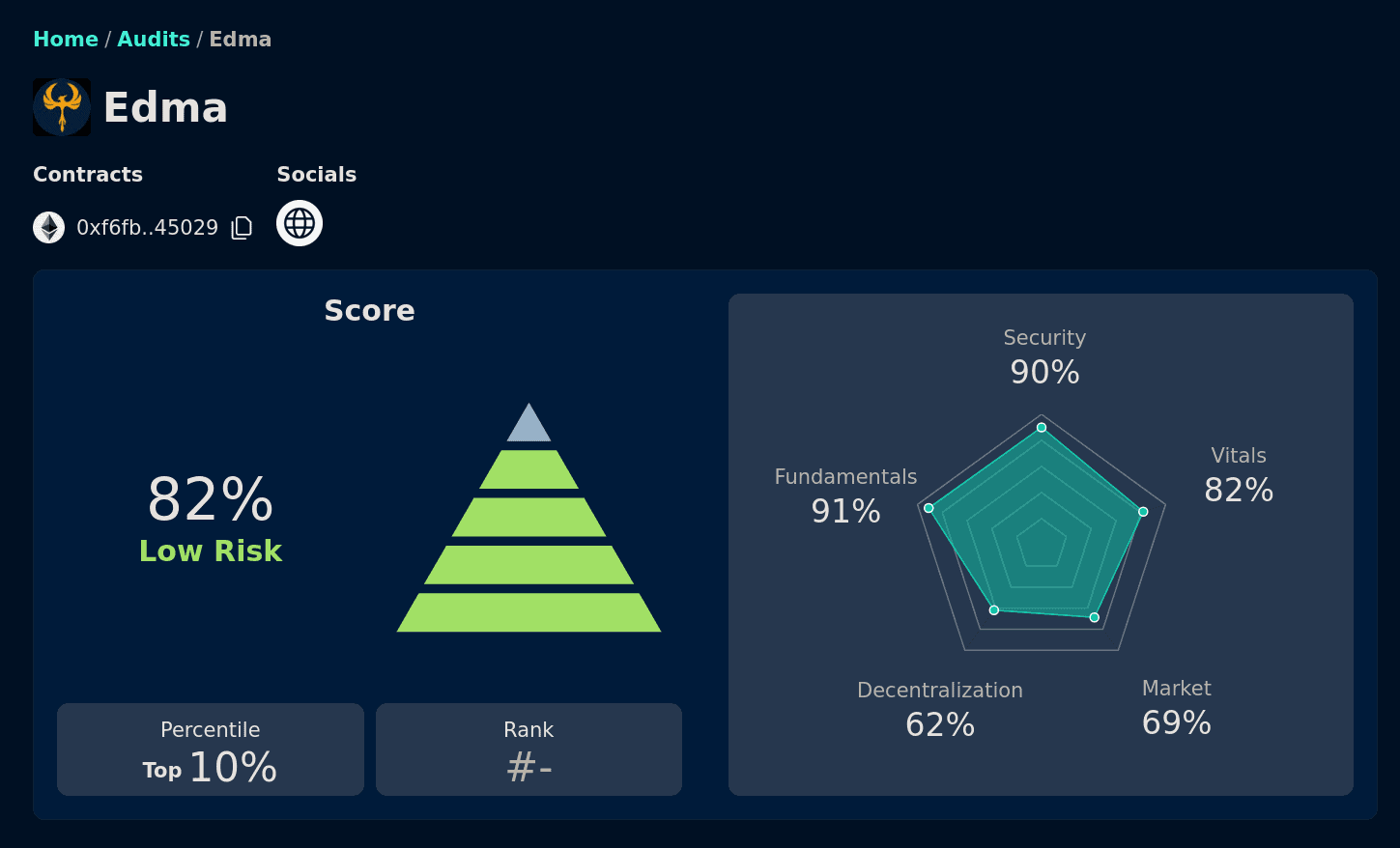
Edma’s security audit by Cyberscope shows a top 10% percentile security score.

Full reports are available at edma.app. If you want corporates and regulators on the same page, the chain has to read like a ledger, not a blog.

The holder’s angle

You don’t need panels to participate. Holding $EDM means owning the rail: every ETT conversion, every verified clean-energy purchase settles on your lane. It’s a simple flywheel: more rooftops mint → more ETT → more $EDM needed.
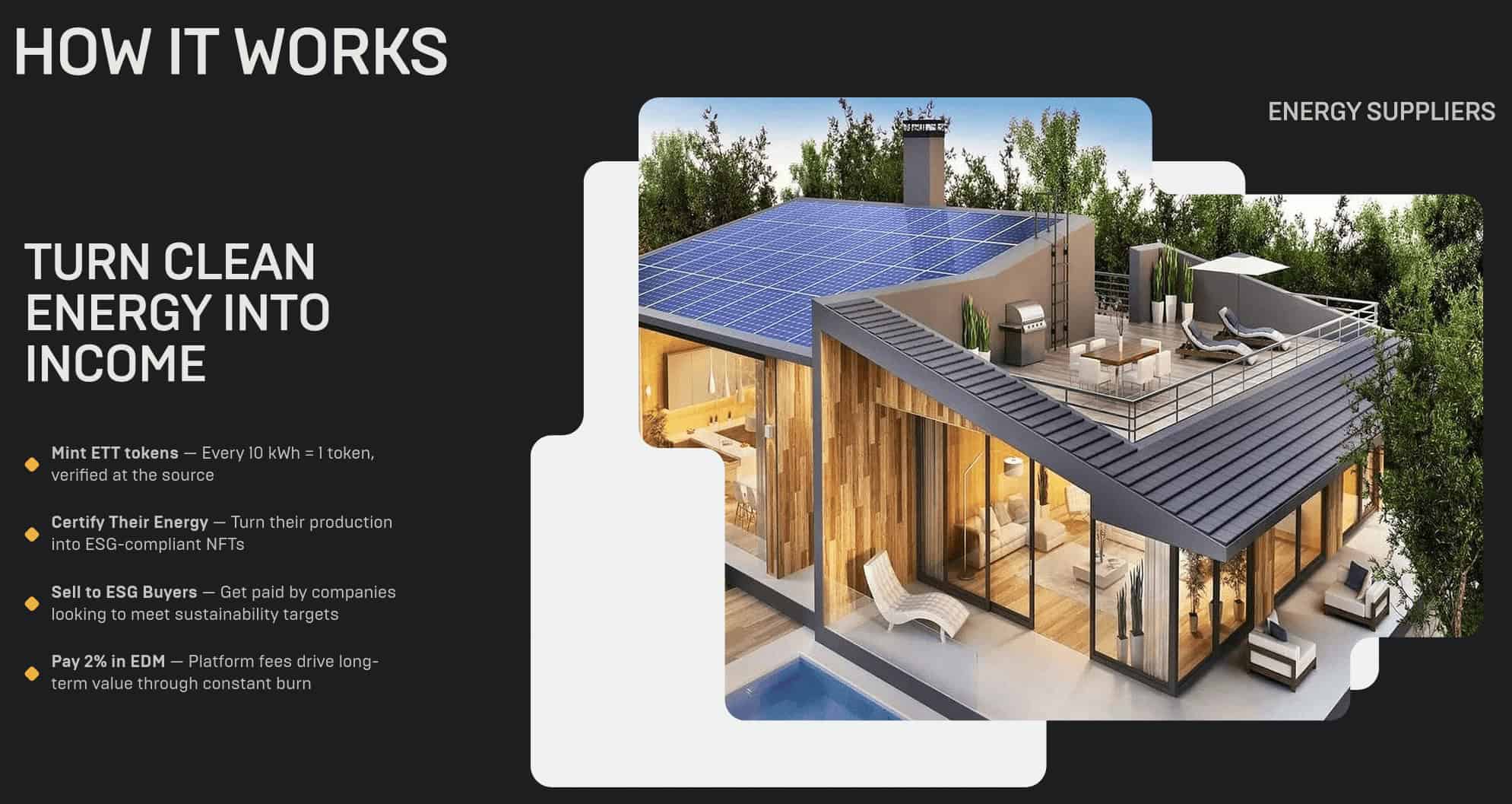
The project’s process involves token and NFT minting, sellable to energy suppliers.

Supply is capped at 500,000,000 $EDM, with a target supply of 100,000,000 $EDM. Each ETT trade burns 1% of the $EDM used and pays 1% to stakers. As supply decreases and the household community connects, demand concentrates.

30,000,000 wallets competing for 100 million tokens.

Utility drives usage; usage drives scarcity.

What the market is already saying

With $0 in ads, EDMA’s presale counts 14,000 holders and $1,730,000 committed. People don’t need a 40-page explainer. They need one sentence: the sun hits a roof, the meter proves it, the marketplace pays for it.

Presale terms

  • Now: $EDM = $0.1
  • Next stage: $0.18
  • Target listing: $0.50
  • No VC allocations—the upside is designed for the network that makes this real.

You can spend the next quarter guessing the next ride—or own the rail it runs on.

Presale is live at edma.app. Sunlight becomes income.

Market Opportunity
Threshold Logo
Threshold Price(T)
$0.010048
$0.010048$0.010048
+0.68%
USD
Threshold (T) Live Price Chart
Disclaimer: The articles reposted on this site are sourced from public platforms and are provided for informational purposes only. They do not necessarily reflect the views of MEXC. All rights remain with the original authors. If you believe any content infringes on third-party rights, please contact [email protected] for removal. MEXC makes no guarantees regarding the accuracy, completeness, or timeliness of the content and is not responsible for any actions taken based on the information provided. The content does not constitute financial, legal, or other professional advice, nor should it be considered a recommendation or endorsement by MEXC.

You May Also Like

The Channel Factories We’ve Been Waiting For

The Channel Factories We’ve Been Waiting For

The post The Channel Factories We’ve Been Waiting For appeared on BitcoinEthereumNews.com. Visions of future technology are often prescient about the broad strokes while flubbing the details. The tablets in “2001: A Space Odyssey” do indeed look like iPads, but you never see the astronauts paying for subscriptions or wasting hours on Candy Crush.  Channel factories are one vision that arose early in the history of the Lightning Network to address some challenges that Lightning has faced from the beginning. Despite having grown to become Bitcoin’s most successful layer-2 scaling solution, with instant and low-fee payments, Lightning’s scale is limited by its reliance on payment channels. Although Lightning shifts most transactions off-chain, each payment channel still requires an on-chain transaction to open and (usually) another to close. As adoption grows, pressure on the blockchain grows with it. The need for a more scalable approach to managing channels is clear. Channel factories were supposed to meet this need, but where are they? In 2025, subnetworks are emerging that revive the impetus of channel factories with some new details that vastly increase their potential. They are natively interoperable with Lightning and achieve greater scale by allowing a group of participants to open a shared multisig UTXO and create multiple bilateral channels, which reduces the number of on-chain transactions and improves capital efficiency. Achieving greater scale by reducing complexity, Ark and Spark perform the same function as traditional channel factories with new designs and additional capabilities based on shared UTXOs.  Channel Factories 101 Channel factories have been around since the inception of Lightning. A factory is a multiparty contract where multiple users (not just two, as in a Dryja-Poon channel) cooperatively lock funds in a single multisig UTXO. They can open, close and update channels off-chain without updating the blockchain for each operation. Only when participants leave or the factory dissolves is an on-chain transaction…
Share
BitcoinEthereumNews2025/09/18 00:09
Trading time: Tonight, the US GDP and the upcoming non-farm data will become the market focus. Institutions are bullish on BTC to $120,000 in the second quarter.

Trading time: Tonight, the US GDP and the upcoming non-farm data will become the market focus. Institutions are bullish on BTC to $120,000 in the second quarter.

Daily market key data review and trend analysis, produced by PANews.
Share
PANews2025/04/30 13:50
CEO Sandeep Nailwal Shared Highlights About RWA on Polygon

CEO Sandeep Nailwal Shared Highlights About RWA on Polygon

The post CEO Sandeep Nailwal Shared Highlights About RWA on Polygon appeared on BitcoinEthereumNews.com. Polygon CEO Sandeep Nailwal highlighted Polygon’s lead in global bonds, Spiko US T-Bill, and Spiko Euro T-Bill. Polygon published an X post to share that its roadmap to GigaGas was still scaling. Sentiments around POL price were last seen to be bearish. Polygon CEO Sandeep Nailwal shared key pointers from the Dune and RWA.xyz report. These pertain to highlights about RWA on Polygon. Simultaneously, Polygon underlined its roadmap towards GigaGas. Sentiments around POL price were last seen fumbling under bearish emotions. Polygon CEO Sandeep Nailwal on Polygon RWA CEO Sandeep Nailwal highlighted three key points from the Dune and RWA.xyz report. The Chief Executive of Polygon maintained that Polygon PoS was hosting RWA TVL worth $1.13 billion across 269 assets plus 2,900 holders. Nailwal confirmed from the report that RWA was happening on Polygon. The Dune and https://t.co/W6WSFlHoQF report on RWA is out and it shows that RWA is happening on Polygon. Here are a few highlights: – Leading in Global Bonds: Polygon holds 62% share of tokenized global bonds (driven by Spiko’s euro MMF and Cashlink euro issues) – Spiko U.S.… — Sandeep | CEO, Polygon Foundation (※,※) (@sandeepnailwal) September 17, 2025 The X post published by Polygon CEO Sandeep Nailwal underlined that the ecosystem was leading in global bonds by holding a 62% share of tokenized global bonds. He further highlighted that Polygon was leading with Spiko US T-Bill at approximately 29% share of TVL along with Ethereum, adding that the ecosystem had more than 50% share in the number of holders. Finally, Sandeep highlighted from the report that there was a strong adoption for Spiko Euro T-Bill with 38% share of TVL. He added that 68% of returns were on Polygon across all the chains. Polygon Roadmap to GigaGas In a different update from Polygon, the community…
Share
BitcoinEthereumNews2025/09/18 01:10