Ethereum price is testing a key demand zone as more than 220,000 ETH leaves exchanges, tightening liquid supply during a sharp market pullback. Ethereum was tradingEthereum price is testing a key demand zone as more than 220,000 ETH leaves exchanges, tightening liquid supply during a sharp market pullback. Ethereum was trading

Ethereum price prediction as exchange supply shrinks by 220K ETH

2026/02/11 15:15
3 min read

Ethereum price is testing a key demand zone as more than 220,000 ETH leaves exchanges, tightening liquid supply during a sharp market pullback.

Summary
  • Ethereum price prediction hinges heavily on ETH holding the $1,850 demand zone.
  • Exchange reserves have dropped by 220,000 ETH, while accumulating addresses now hold 27 million ETH, about 23% of supply.
  • Holding $1,850 could open a rebound toward $2,000–$2,100, while a breakdown risks a move toward $1,750.

Ethereum was trading at $1,975 at press time, down 4% in the past 24 hours. The broader trend remains under pressure. ETH has fallen 12% over the last seven days, 37% in the past month, and is now down 61% from its August 2025 high of $4,946.

Spot trading volume came in at $22 billion, down 11.30% over the past day. On the derivatives side, Coinglass data shows futures volume declining 14% to $47 billion, while open interest dropped 5% to $23 billion.

That combination suggests traders are closing positions rather than aggressively adding new leverage.

220K ETH leaves exchanges as long-term wallets grow

While price has struggled, on-chain behavior tells a different story.

According to a Feb. 10 analysis by CryptoQuant contributor Arab Chain, more than 220,000 Ethereum (ETH) has been withdrawn from exchanges in recent days, the largest net outflow since October. On Feb. 5, Binance alone recorded approximately 158,000 ETH in daily net outflows, the highest since last August.

Large exchange withdrawals typically reduce immediate sell-side pressure. When ETH moves into private wallets or long-term storage, it becomes less accessible for quick liquidation.

This doesn’t guarantee upside, but it changes the supply dynamic. If demand stabilizes, a tighter float can amplify price reactions.

Additional data from analyst _OnChain shows that “accumulating addresses” — defined as wallets that have never recorded an outflow, hold at least 100 ETH, and are not linked to exchanges or miners — now control 27 million ETH, or roughly 23% of the circulating supply.

Historically, Ethereum has traded below the realized price of these accumulating addresses only twice in nine years: during the 2025 all-time low and again since January 2026. That context suggests long-term holders are less likely to sell near current levels.

Ethereum price prediction: Can $1,850 hold?

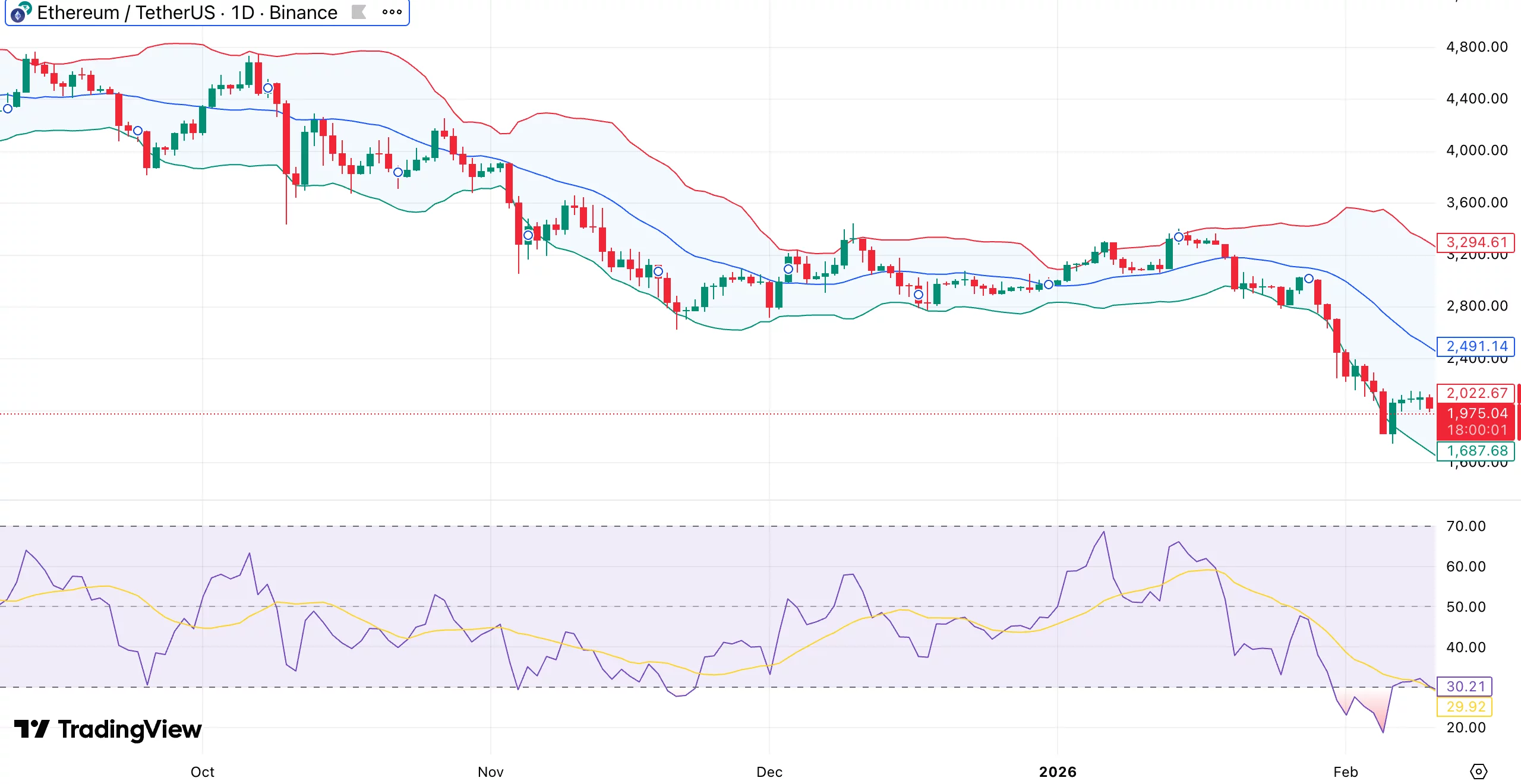
With lower highs and lower lows, Ethereum is still clearly in a downward trend. Selling pressure increased after the recent drop below the $3,200–$3,300 range, and the price moved closer to the $1,850 support zone.

During the sell-off, the 20-period Bollinger Bands widened considerably, suggesting increased volatility.
Ethereum price prediction as exchange supply shrinks by 220K ETH - 1

The price briefly touched the lower band around $1,690, as is often the case with large declines. The middle band, which is now at $2,490, is acting as resistance, while the upper band is situated near $3,290.

The relative strength index fell below 30, entering oversold territory, and currently hovers around 30–32. Momentum is weak, though the pace of the decline has slowed, and there’s no clear bullish divergence yet.

If the $1,850 support holds, Ethereum could stabilize and attempt a rebound toward $2,000–$2,100. A more sustained recovery would require a move above $2,490 to reclaim the middle band and signal a potential trend shift. For that to happen, RSI would need to climb above 40–45, and volume would need to expand on green candles.

If $1,850 fails, downside risk increases quickly. A break below that level could expose $1,750, followed by the lower Bollinger Band around $1,690. Continued declines in open interest and weak spot volume would reinforce a bearish continuation scenario.


Market Opportunity
Ethereum Logo
Ethereum Price(ETH)
$1,936.55
$1,936.55$1,936.55
-4.25%
USD
Ethereum (ETH) Live Price Chart
Disclaimer: The articles reposted on this site are sourced from public platforms and are provided for informational purposes only. They do not necessarily reflect the views of MEXC. All rights remain with the original authors. If you believe any content infringes on third-party rights, please contact [email protected] for removal. MEXC makes no guarantees regarding the accuracy, completeness, or timeliness of the content and is not responsible for any actions taken based on the information provided. The content does not constitute financial, legal, or other professional advice, nor should it be considered a recommendation or endorsement by MEXC.

You May Also Like

Taiko Makes Chainlink Data Streams Its Official Oracle

Taiko Makes Chainlink Data Streams Its Official Oracle

The post Taiko Makes Chainlink Data Streams Its Official Oracle appeared on BitcoinEthereumNews.com. Key Notes Taiko has officially integrated Chainlink Data Streams for its Layer 2 network. The integration provides developers with high-speed market data to build advanced DeFi applications. The move aims to improve security and attract institutional adoption by using Chainlink’s established infrastructure. Taiko, an Ethereum-based ETH $4 514 24h volatility: 0.4% Market cap: $545.57 B Vol. 24h: $28.23 B Layer 2 rollup, has announced the integration of Chainlink LINK $23.26 24h volatility: 1.7% Market cap: $15.75 B Vol. 24h: $787.15 M Data Streams. The development comes as the underlying Ethereum network continues to see significant on-chain activity, including large sales from ETH whales. The partnership establishes Chainlink as the official oracle infrastructure for the network. It is designed to provide developers on the Taiko platform with reliable and high-speed market data, essential for building a wide range of decentralized finance (DeFi) applications, from complex derivatives platforms to more niche projects involving unique token governance models. According to the project’s official announcement on Sept. 17, the integration enables the creation of more advanced on-chain products that require high-quality, tamper-proof data to function securely. Taiko operates as a “based rollup,” which means it leverages Ethereum validators for transaction sequencing for strong decentralization. Boosting DeFi and Institutional Interest Oracles are fundamental services in the blockchain industry. They act as secure bridges that feed external, off-chain information to on-chain smart contracts. DeFi protocols, in particular, rely on oracles for accurate, real-time price feeds. Taiko leadership stated that using Chainlink’s infrastructure aligns with its goals. The team hopes the partnership will help attract institutional crypto investment and support the development of real-world applications, a goal that aligns with Chainlink’s broader mission to bring global data on-chain. Integrating real-world economic information is part of a broader industry trend. Just last week, Chainlink partnered with the Sei…
Share
BitcoinEthereumNews2025/09/18 03:34
Layer Brett Picked As The Best Crypto To Buy Now By Experts Over Pi Coin & VeChain

Layer Brett Picked As The Best Crypto To Buy Now By Experts Over Pi Coin & VeChain

While Pi Coin (PI) and VeChain (VET) have long been part of the conversation, crypto analysts and early-stage investors are […] The post Layer Brett Picked As The Best Crypto To Buy Now By Experts Over Pi Coin & VeChain appeared first on Coindoo.
Share
Coindoo2025/09/18 00:13
Why PEPE May Become the Most Important Meme Coin of This Cycle

Why PEPE May Become the Most Important Meme Coin of This Cycle

Pepe has moved back into focus during a period when the wider crypto market feels slow and uncertain. Conversation around PEPE price now centers on long-term relevance
Share
Captainaltcoin2026/02/11 16:00