The post 3 Top Cryptos To Invest Your $500 in 2026 appeared first on Coinpedia Fintech News Selecting the best crypto to invest in requires careful analysis of The post 3 Top Cryptos To Invest Your $500 in 2026 appeared first on Coinpedia Fintech News Selecting the best crypto to invest in requires careful analysis of

3 Top Cryptos To Invest Your $500 in 2026

2026/02/11 21:33
5 min read
shib-btc

The post 3 Top Cryptos To Invest Your $500 in 2026 appeared first on Coinpedia Fintech News

Selecting the best crypto to invest in requires careful analysis of utility, momentum, and future potential. While many assets fluctuate with market sentiment, a few stand out for specific reasons. Bitcoin faces renewed macroeconomic pressures, and Shiba Inu struggles with technical weakness. In contrast, Mutuum Finance (MUTM) presents a functional decentralized finance protocol with a final presale phase offering direct value. This makes MUTM a distinct candidate for capital allocation in 2026.

Bitcoin Confronts Significant Downside Pressure

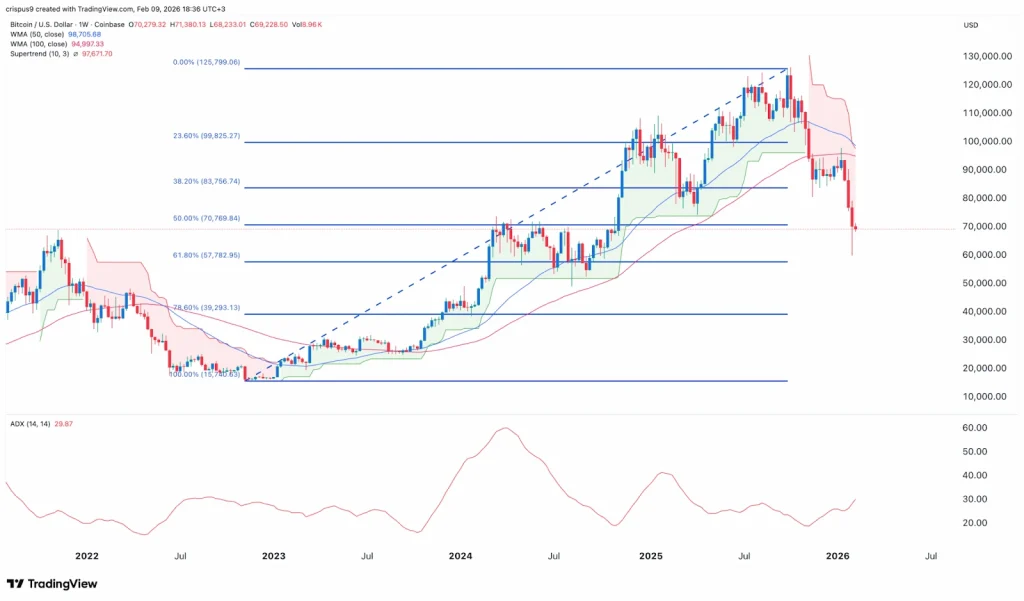
Bitcoin’s price action shows considerable strain, trading well below its all-time high. Analysts at Goldman Sachs warn of potential selling pressure in traditional markets, which often correlates with DeFi crypto market declines. Technical indicators suggest Bitcoin could test the $60,000 support level. 

This environment creates substantial risk for new capital. The coin’s primary narrative as a digital store of value offers little short-term yield or utility, making it a speculative hold during uncertain times. For an investor with $500, parking funds here now may lead to stagnant or diminishing value while waiting for a broad market recovery.
crispus-chart

Shiba Inu’s Bearish Pattern Problem

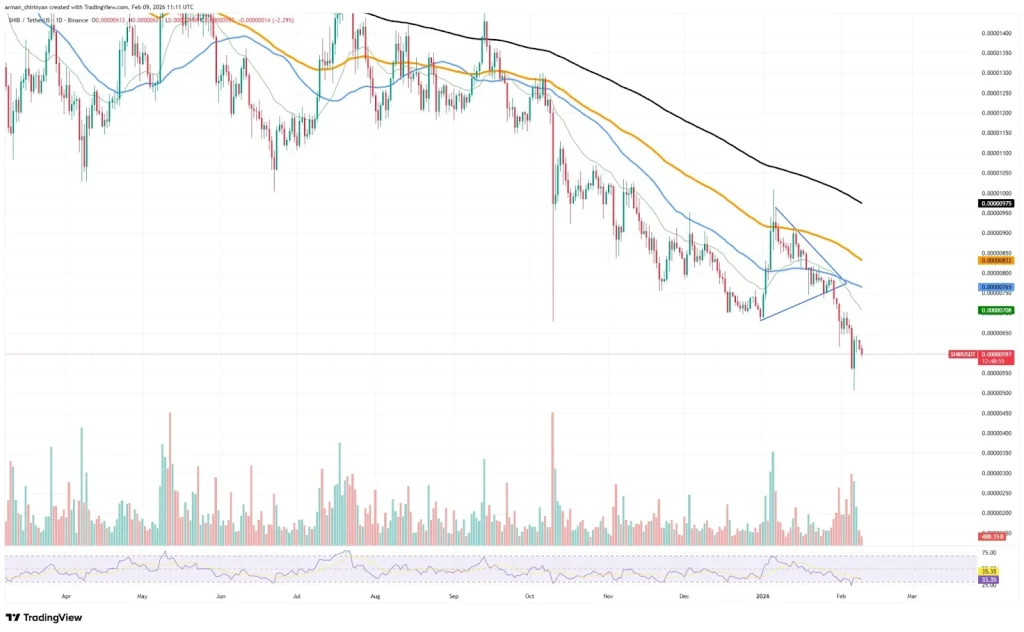
Shiba Inu is painting a troubling technical picture. It recently broke down from a consolidation structure, signaling continued bearish momentum. Unlike projects with underlying platforms, SHIB’s value is heavily reliant on community sentiment and meme culture, which are waning. 

The token lacks the inherent utility, revenue-sharing models, or staking yields that define more robust ecosystems. This makes it a highly volatile and speculative asset. Investing $500 here is a gamble on unpredictable social trends rather than on tangible technological progress or financial mechanics.
trading-view-chart

Mutuum Finance: A Functional DeFi Entry Point

Mutuum Finance separates itself with a live, testable protocol on the Sepolia testnet during its presale. The project has raised over $20,400,000 and attracted 18,980 holders. Currently in Phase 7, the MUTM token is priced at $0.04. This price has increased 300% from its Phase 1 price of $0.01. Phase 7 is selling out fast, nearly closing the window to acquire tokens before Phase 8 introduces a near 20% price increase to $0.045. 

The confirmed launch price is $0.06, positioning current buyers for an even bigger gain before launch. Furthermore, analysts project that the recent launch of the V1 protocol on the Sepolia testnet is a critical confidence builder, demonstrating that the lending and borrowing mechanics work. This technical milestone, combined with the project’s growing holder base of over 19,000 wallets, creates a foundation for future adoption, with potential for the price to reach the $1 range as adoption grows.

Profiting from the Presale Structure

The presale structure itself is a primary feature benefiting investors. With a fixed total supply of 4 billion tokens and 45.5% allocated to the presale, early participation secures tokens before exchange listings. Over 850 million tokens have already been sold. This diminishing supply against growing demand is a key value driver. 

For example, an investment of $500 at $0.04 acquires 12,500 MUTM tokens. At the $0.06 launch price, this holding is worth $750. If post-launch momentum pushes the price to $1, that same stake balloons to $12,500. This clear growth trajectory is unavailable with most tokens already on public markets.

Earning Through Protocol Participation

Beyond token appreciation, MUTM provides passive income avenues. The live lending protocol allows users to supply assets like ETH or USDT to earn yield,  projected between 10-15% APY. For instance, supplying $1,000 in assets could generate approximately $100-$150 in annual yield. 

Additionally, the protocol employs a buy-and-distribute model, using a portion of fees to purchase MUTM tokens and distribute them to users who stake their mtTokens. This creates a dividend-like reward system for them, directly linking platform success to investor returns.

Incentives and Security Enhance Value

Immediate investor incentives increase the attractiveness. A 24-hour leaderboard awards a $500 MUTM bonus daily to the top contributor. A separate $100,000 giveaway is ongoing, set to distribute $10,000 to each of ten winners. These programs add potential windfalls.

Crucially, the underlying smart contracts have been through a thorough audit by Halborn Security, mitigating a major risk that plagues new projects. This combination of incentives, security, and utility builds a strong case for sustainable growth.

A Compelling Case for Early Investment

Mutuum Finance presents a multifaceted opportunity centered on a working product. The presale phase offers a discounted entry before exchange listings. The protocol’s utility promises ongoing yield, and its tokenomics are designed to reward early participants. For an investor considering where to deploy $500, MUTM offers a structured path for growth based on execution, not just speculation. This stands in contrast to the broader market’s uncertainty, making MUTM the best crypto to invest in.

For more information about Mutuum Finance (MUTM) visit the links below:

Website: https://mutuum.com/ 

Linktree: https://linktr.ee/mutuumfinance 

Disclaimer: The articles reposted on this site are sourced from public platforms and are provided for informational purposes only. They do not necessarily reflect the views of MEXC. All rights remain with the original authors. If you believe any content infringes on third-party rights, please contact [email protected] for removal. MEXC makes no guarantees regarding the accuracy, completeness, or timeliness of the content and is not responsible for any actions taken based on the information provided. The content does not constitute financial, legal, or other professional advice, nor should it be considered a recommendation or endorsement by MEXC.

You May Also Like

The Channel Factories We’ve Been Waiting For

The Channel Factories We’ve Been Waiting For

The post The Channel Factories We’ve Been Waiting For appeared on BitcoinEthereumNews.com. Visions of future technology are often prescient about the broad strokes while flubbing the details. The tablets in “2001: A Space Odyssey” do indeed look like iPads, but you never see the astronauts paying for subscriptions or wasting hours on Candy Crush.  Channel factories are one vision that arose early in the history of the Lightning Network to address some challenges that Lightning has faced from the beginning. Despite having grown to become Bitcoin’s most successful layer-2 scaling solution, with instant and low-fee payments, Lightning’s scale is limited by its reliance on payment channels. Although Lightning shifts most transactions off-chain, each payment channel still requires an on-chain transaction to open and (usually) another to close. As adoption grows, pressure on the blockchain grows with it. The need for a more scalable approach to managing channels is clear. Channel factories were supposed to meet this need, but where are they? In 2025, subnetworks are emerging that revive the impetus of channel factories with some new details that vastly increase their potential. They are natively interoperable with Lightning and achieve greater scale by allowing a group of participants to open a shared multisig UTXO and create multiple bilateral channels, which reduces the number of on-chain transactions and improves capital efficiency. Achieving greater scale by reducing complexity, Ark and Spark perform the same function as traditional channel factories with new designs and additional capabilities based on shared UTXOs.  Channel Factories 101 Channel factories have been around since the inception of Lightning. A factory is a multiparty contract where multiple users (not just two, as in a Dryja-Poon channel) cooperatively lock funds in a single multisig UTXO. They can open, close and update channels off-chain without updating the blockchain for each operation. Only when participants leave or the factory dissolves is an on-chain transaction…
Share
BitcoinEthereumNews2025/09/18 00:09
Ethereum unveils roadmap focusing on scaling, interoperability, and security at Japan Dev Conference

Ethereum unveils roadmap focusing on scaling, interoperability, and security at Japan Dev Conference

The post Ethereum unveils roadmap focusing on scaling, interoperability, and security at Japan Dev Conference appeared on BitcoinEthereumNews.com. Key Takeaways Ethereum’s new roadmap was presented by Vitalik Buterin at the Japan Dev Conference. Short-term priorities include Layer 1 scaling and raising gas limits to enhance transaction throughput. Vitalik Buterin presented Ethereum’s development roadmap at the Japan Dev Conference today, outlining the blockchain platform’s priorities across multiple timeframes. The short-term goals focus on scaling solutions and increasing Layer 1 gas limits to improve transaction capacity. Mid-term objectives target enhanced cross-Layer 2 interoperability and faster network responsiveness to create a more seamless user experience across different scaling solutions. The long-term vision emphasizes building a secure, simple, quantum-resistant, and formally verified minimalist Ethereum network. This approach aims to future-proof the platform against emerging technological threats while maintaining its core functionality. The roadmap presentation comes as Ethereum continues to compete with other blockchain platforms for market share in the smart contract and decentralized application space. Source: https://cryptobriefing.com/ethereum-roadmap-scaling-interoperability-security-japan/
Share
BitcoinEthereumNews2025/09/18 00:25
UK crypto holders brace for FCA’s expanded regulatory reach

UK crypto holders brace for FCA’s expanded regulatory reach

The post UK crypto holders brace for FCA’s expanded regulatory reach appeared on BitcoinEthereumNews.com. British crypto holders may soon face a very different landscape as the Financial Conduct Authority (FCA) moves to expand its regulatory reach in the industry. A new consultation paper outlines how the watchdog intends to apply its rulebook to crypto firms, shaping everything from asset safeguarding to trading platform operation. According to the financial regulator, these proposals would translate into clearer protections for retail investors and stricter oversight of crypto firms. UK FCA plans Until now, UK crypto users mostly encountered the FCA through rules on promotions and anti-money laundering checks. The consultation paper goes much further. It proposes direct oversight of stablecoin issuers, custodians, and crypto-asset trading platforms (CATPs). For investors, that means the wallets, exchanges, and coins they rely on could soon be subject to the same governance and resilience standards as traditional financial institutions. The regulator has also clarified that firms need official authorization before serving customers. This condition should, in theory, reduce the risk of sudden platform failures or unclear accountability. David Geale, the FCA’s executive director of payments and digital finance, said the proposals are designed to strike a balance between innovation and protection. He explained: “We want to develop a sustainable and competitive crypto sector – balancing innovation, market integrity and trust.” Geale noted that while the rules will not eliminate investment risks, they will create consistent standards, helping consumers understand what to expect from registered firms. Why does this matter for crypto holders? The UK regulatory framework shift would provide safer custody of assets, better disclosure of risks, and clearer recourse if something goes wrong. However, the regulator was also frank in its submission, arguing that no rulebook can eliminate the volatility or inherent risks of holding digital assets. Instead, the focus is on ensuring that when consumers choose to invest, they do…
Share
BitcoinEthereumNews2025/09/17 23:52