Google’s Pixel 10 maintains a familiar design but focuses on AI-powered features
The Pixel line’s improvements are increasingly driven by AI. Pixel 10 is the tenth iteration in nine years, yet its exterior remains largely familiar. That restrained look is by choice, executives say, because the real changes sit in the software.
Rick Osterloh, who runs both Google’s hardware and Android efforts, says year-over-year gains are on the order of 30%.
“If you look at any year at a time, maybe that’s not revolutionary change,” he said, as reported by Bloomberg. “But if you look at three years back, that is a huge difference.”
He called Pixel 10 a “super strong release” in a “mature category.” The lineup spans the $800 Pixel 10, $1,000 Pixel 10 Pro, $1,200 Pro XL, and $1,800 Pixel 10 Pro Fold.
Apple’s phones have kept a similar shape for years, though redesigned Pro models are due this year, including a foldable planned for 2026 and a new look expected for the iPhone’s 20th anniversary in 2027.
Design chief Ivy Ross says larger visual changes arrive on a two-to-three-year rhythm. The company is finalizing 2026 phones and has begun work on 2027.
“The revolution is going to end up being in the interface,” Osterloh said, pointing to watches, glasses, and other gear.
Osterloh casts this period as an opening for Pixel. “It is up to us to make it count in mobile over the next couple years, where I think it’s pretty clear we have a definitive lead,” he said. “If you’re using Android, you’re going to be on the vanguard of where AI is going.”
Pixel holds 3% U.S. share while Google focuses on steady growth
Canalys estimates put Google’s U.S. Q2 shipments near 800,000 units, about a 3% share. Osterloh acknowledges Pixel isn’t likely to be a “giant player,” but argues that steady innovation and “building a good business” are what matter.
Devices and services chief Shakil Barkat adds that the “growth rate is great” and Google is “selling a decent amount.” As Android boss, Osterloh also applauds rivals’ successes. He praised Samsung’s latest foldable for its thin profile. “If there’s an Android partner that’s successful, that’s wonderful for us.”
Google insists its hardware effort is long-term. “Google does not do anything for a tactical short-term period,” Barkat said. Ross says the initial aim was to build reference products that showed “the best of what Google has to offer,” serving as a “muse” for partners.
Her team, now numbering in the hundreds, covers hardware, materials, colors, packaging, and interface design. The studio includes a model shop with production-grade tools and custom paint booths. Visitors often say, “Whoa, this is a factory.” Battery life still dictates many choices. “It’s really a dance,” Ross said, with trade-offs until the team has “explored every possible way of solving the problem.”
Google lays groundwork for AI hardware future, keeping phone at the center
Looking ahead, Google sees two paths that could bring AI hardware to more people with glasses and foldables. Barkat imagines display-free glasses paired with a pocketable foldable for heavy tasks.
Whether Google ships glasses again is “TBD,” Osterloh said, but teams are working on tiny displays and Android XR partners are building devices. Even if glasses go mainstream, phones stay vital.
“Perhaps you can get by with a smaller phone if you have a display that you’re wearing,” Osterloh said. But, Barkat added, “The phone does too many things too well to get dethroned that easily.”
After leaning on third parties for the first Tensor in 2021, Google’s fifth-generation Tensor in the Pixel 10 is built in-house with Taiwan Semiconductor Manufacturing Co. on a 3-nanometer process. Osterloh says the move will unlock new AI features as highlighted in a Cryptopolitan report.
The bigger test, though, is persuading mainstream buyers that Google’s devices matter. The groundwork is laid; now Google has to turn AI buzz into broad appeal.
Get seen where it counts. Advertise in Cryptopolitan Research and reach crypto’s sharpest investors and builders.


You May Also Like
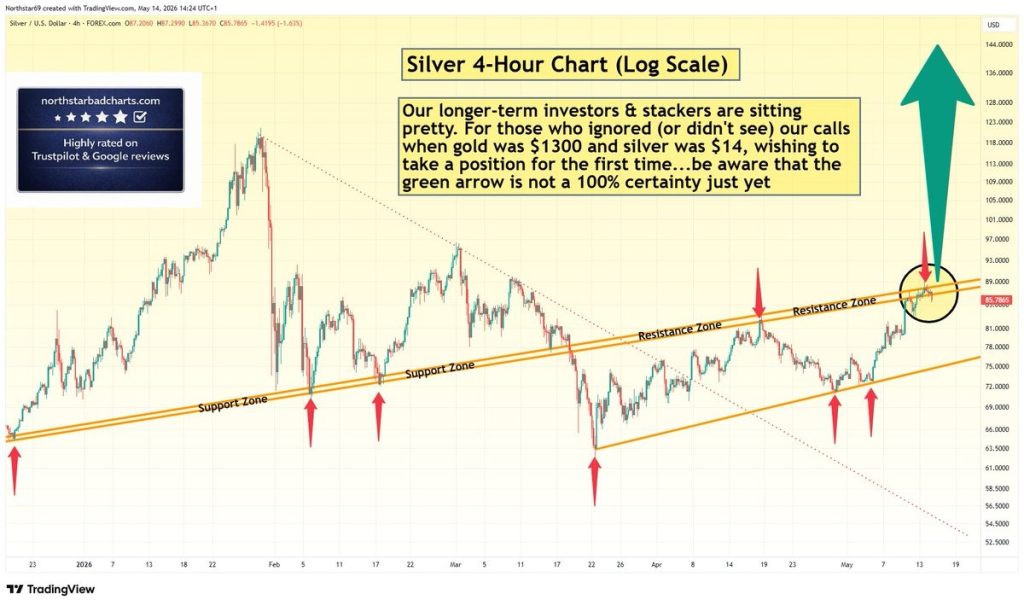
Silver Price Warning: Green Arrow Setup Is Not Confirmed – Wait for Clear Signal

Facebook spotlights African cinema in 6th ‘Made by Africa, loved by the world’ campaign