By Bill Qian This article is a companion piece to "How to Protect Wealth in War." Let’s discuss the following questions: First, what exactly is wealth storage; second, why has gold become the winner in modern times; and third, why Bitcoin will be the better “gold” in the 21st century and beyond. For the past 5,000 years, competition for the "best store of value" has persisted. Gold, thanks to its scarcity and millennia-old consensus on value, has gradually become the king of wealth storage. Meanwhile, Bitcoin is slowly undermining and challenging gold's market dominance, and in the process, it is bringing our generation an opportunity for epic wealth creation and transfer. The History of Money To compare gold and Bitcoin, let’s first talk about the largest category in the category: money. Money has three core functions: a medium of exchange, a unit of account, and a store of value. From shells and copper coins to modern fiat currencies like the US dollar and the euro, these two functions have evolved over time. Gold, silver, land, and blue-chip stocks have long served as the mainstream store of value. In monetary history, the US dollar during the Bretton Woods era was one of the few currencies to simultaneously fulfill the three functions of medium of exchange, unit of account, and store of wealth. However, this was a unique case, not a common one. Furthermore, the dollar's trifecta of functions gradually disintegrated after Nixon's 1971 televised address. Some might ask, "Why then do so many people in emerging markets want to use and save in US dollars, even though data shows a continuous depreciation of the dollar?" I believe the answer is: they have no better alternatives; their own currencies are even worse. This topic brings us to the topic of stablecoins, which we'll discuss in the next issue. How did gold become the “gold” it is today? A good store of wealth must meet five characteristics: scarcity, durability, portability, divisibility, and social consensus. Silver, land, and diamonds struggle to outperform gold on these five metrics. So, after tens of thousands of years, gold finally won the consensus and minds of mankind and became almost the only target for wealth storage. What are the limitations of gold? Storing gold requires expensive safe deposit boxes, insurance, and sometimes even transportation costs, and the larger the amount, the higher the cost. During World War II, the gold stored in the safes of the Bank of Paris was directly looted by the German army. The biggest lesson I learned from this incident is that what's safe in the bank is not safe at all. 2. In extreme times, the cost of converting gold into cash is high. Similar situations occurred during World War II. Whether trading in Shanghai, Paris, or Amsterdam, gold often comes at a steep discount, often 30-50% below the spot price. Discounts are even greater in high-risk environments. Even worse, trading gold in conflict zones often carries serious personal risks. Once others know you are holding gold bars, you could be robbed or even murdered at any time. 3. Governments can further undermine the reliability of gold holdings through confiscation and price controls. For example, in 1933, the United States required citizens to surrender most of their gold at a fixed price below market value, or face severe penalties. Note: At the time, the US government required all citizens to surrender their gold at a fixed price of $20.67 per troy ounce. Subsequently, with the passage of the Gold Reserve Act in 1934, the government revalued the official price of gold to $35 per troy ounce. This meant that the value of gold held by all citizens decreased by approximately 41% in just one year. The US confiscation of over 2,600 tons of gold directly altered monetary policy and laid the groundwork for the final end of the gold standard in 1971. All of this took place in the 20th century in the United States, arguably the world's most revered beacon of private property. 4. In addition, in today's digital economy, the limitations of gold's lack of "digitalization" are also obvious. For example, you cannot send a kilogram of gold to your friend or to another address through any electronic wallet. “In 2009, Bitcoin appeared! What is it?” Bitcoin, created in 2009 by the pseudonymous Satoshi Nakamoto, is the first decentralized digital currency. It runs on a global, public, and open computer network (commonly known as a blockchain, a name I've always found puzzling)—a shared digital ledger that anyone can participate in and verify. New bitcoins are generated through "mining": computers solve complex mathematical puzzles to package transactions into new "blocks" and add them to the blockchain. Miners are rewarded with newly generated bitcoins. This process ensures the security and smooth operation of the entire system.By Bill Qian This article is a companion piece to "How to Protect Wealth in War." Let’s discuss the following questions: First, what exactly is wealth storage; second, why has gold become the winner in modern times; and third, why Bitcoin will be the better “gold” in the 21st century and beyond. For the past 5,000 years, competition for the "best store of value" has persisted. Gold, thanks to its scarcity and millennia-old consensus on value, has gradually become the king of wealth storage. Meanwhile, Bitcoin is slowly undermining and challenging gold's market dominance, and in the process, it is bringing our generation an opportunity for epic wealth creation and transfer. The History of Money To compare gold and Bitcoin, let’s first talk about the largest category in the category: money. Money has three core functions: a medium of exchange, a unit of account, and a store of value. From shells and copper coins to modern fiat currencies like the US dollar and the euro, these two functions have evolved over time. Gold, silver, land, and blue-chip stocks have long served as the mainstream store of value. In monetary history, the US dollar during the Bretton Woods era was one of the few currencies to simultaneously fulfill the three functions of medium of exchange, unit of account, and store of wealth. However, this was a unique case, not a common one. Furthermore, the dollar's trifecta of functions gradually disintegrated after Nixon's 1971 televised address. Some might ask, "Why then do so many people in emerging markets want to use and save in US dollars, even though data shows a continuous depreciation of the dollar?" I believe the answer is: they have no better alternatives; their own currencies are even worse. This topic brings us to the topic of stablecoins, which we'll discuss in the next issue. How did gold become the “gold” it is today? A good store of wealth must meet five characteristics: scarcity, durability, portability, divisibility, and social consensus. Silver, land, and diamonds struggle to outperform gold on these five metrics. So, after tens of thousands of years, gold finally won the consensus and minds of mankind and became almost the only target for wealth storage. What are the limitations of gold? Storing gold requires expensive safe deposit boxes, insurance, and sometimes even transportation costs, and the larger the amount, the higher the cost. During World War II, the gold stored in the safes of the Bank of Paris was directly looted by the German army. The biggest lesson I learned from this incident is that what's safe in the bank is not safe at all. 2. In extreme times, the cost of converting gold into cash is high. Similar situations occurred during World War II. Whether trading in Shanghai, Paris, or Amsterdam, gold often comes at a steep discount, often 30-50% below the spot price. Discounts are even greater in high-risk environments. Even worse, trading gold in conflict zones often carries serious personal risks. Once others know you are holding gold bars, you could be robbed or even murdered at any time. 3. Governments can further undermine the reliability of gold holdings through confiscation and price controls. For example, in 1933, the United States required citizens to surrender most of their gold at a fixed price below market value, or face severe penalties. Note: At the time, the US government required all citizens to surrender their gold at a fixed price of $20.67 per troy ounce. Subsequently, with the passage of the Gold Reserve Act in 1934, the government revalued the official price of gold to $35 per troy ounce. This meant that the value of gold held by all citizens decreased by approximately 41% in just one year. The US confiscation of over 2,600 tons of gold directly altered monetary policy and laid the groundwork for the final end of the gold standard in 1971. All of this took place in the 20th century in the United States, arguably the world's most revered beacon of private property. 4. In addition, in today's digital economy, the limitations of gold's lack of "digitalization" are also obvious. For example, you cannot send a kilogram of gold to your friend or to another address through any electronic wallet. “In 2009, Bitcoin appeared! What is it?” Bitcoin, created in 2009 by the pseudonymous Satoshi Nakamoto, is the first decentralized digital currency. It runs on a global, public, and open computer network (commonly known as a blockchain, a name I've always found puzzling)—a shared digital ledger that anyone can participate in and verify. New bitcoins are generated through "mining": computers solve complex mathematical puzzles to package transactions into new "blocks" and add them to the blockchain. Miners are rewarded with newly generated bitcoins. This process ensures the security and smooth operation of the entire system.

Beyond Consensus and Mind: Why Bitcoin is a Better "Gold"

2025/08/22 08:00

By Bill Qian

This article is a companion piece to "How to Protect Wealth in War."

Let’s discuss the following questions: First, what exactly is wealth storage; second, why has gold become the winner in modern times; and third, why Bitcoin will be the better “gold” in the 21st century and beyond.

For the past 5,000 years, competition for the "best store of value" has persisted. Gold, thanks to its scarcity and millennia-old consensus on value, has gradually become the king of wealth storage. Meanwhile, Bitcoin is slowly undermining and challenging gold's market dominance, and in the process, it is bringing our generation an opportunity for epic wealth creation and transfer.

The History of Money

To compare gold and Bitcoin, let’s first talk about the largest category in the category: money.

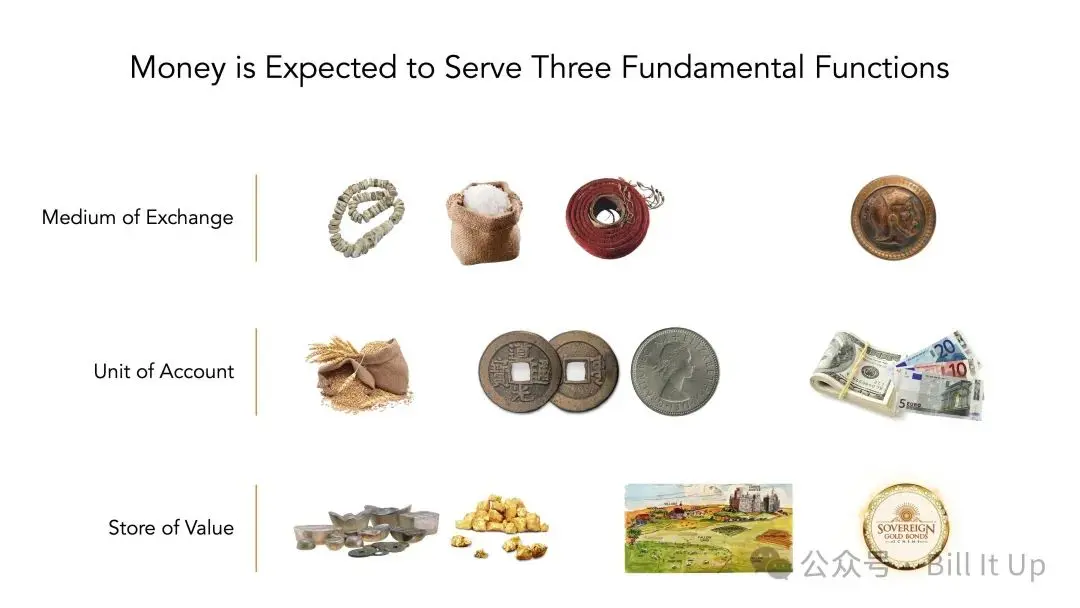
Money has three core functions: a medium of exchange, a unit of account, and a store of value. From shells and copper coins to modern fiat currencies like the US dollar and the euro, these two functions have evolved over time. Gold, silver, land, and blue-chip stocks have long served as the mainstream store of value.

In monetary history, the US dollar during the Bretton Woods era was one of the few currencies to simultaneously fulfill the three functions of medium of exchange, unit of account, and store of wealth. However, this was a unique case, not a common one. Furthermore, the dollar's trifecta of functions gradually disintegrated after Nixon's 1971 televised address. Some might ask, "Why then do so many people in emerging markets want to use and save in US dollars, even though data shows a continuous depreciation of the dollar?" I believe the answer is: they have no better alternatives; their own currencies are even worse. This topic brings us to the topic of stablecoins, which we'll discuss in the next issue.
How did gold become the “gold” it is today?

A good store of wealth must meet five characteristics: scarcity, durability, portability, divisibility, and social consensus. Silver, land, and diamonds struggle to outperform gold on these five metrics.

So, after tens of thousands of years, gold finally won the consensus and minds of mankind and became almost the only target for wealth storage.

What are the limitations of gold?

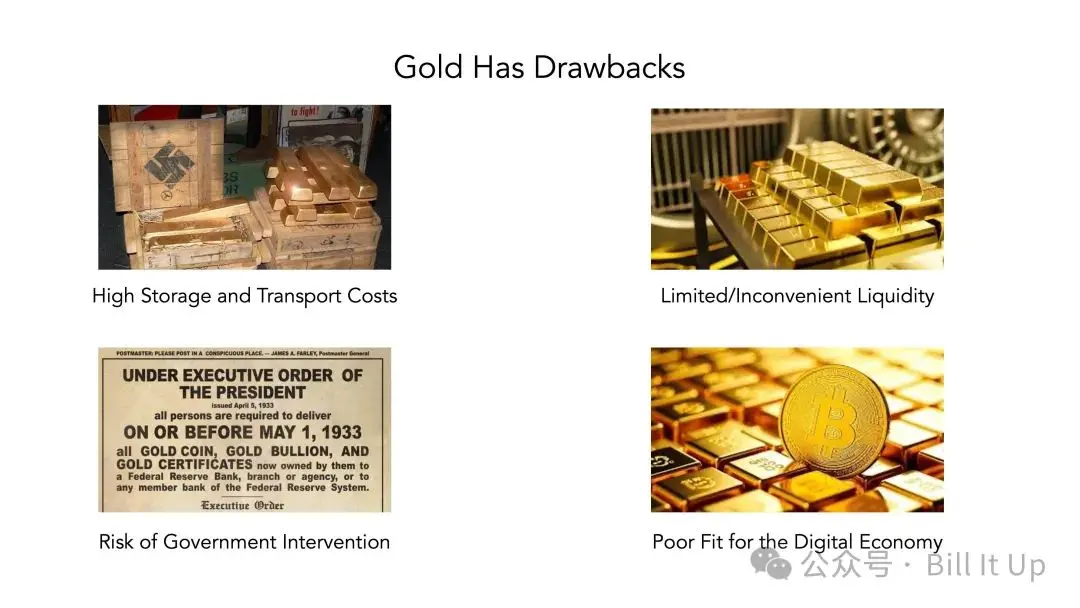
Storing gold requires expensive safe deposit boxes, insurance, and sometimes even transportation costs, and the larger the amount, the higher the cost. During World War II, the gold stored in the safes of the Bank of Paris was directly looted by the German army. The biggest lesson I learned from this incident is that what's safe in the bank is not safe at all.

2. In extreme times, the cost of converting gold into cash is high. Similar situations occurred during World War II. Whether trading in Shanghai, Paris, or Amsterdam, gold often comes at a steep discount, often 30-50% below the spot price. Discounts are even greater in high-risk environments. Even worse, trading gold in conflict zones often carries serious personal risks. Once others know you are holding gold bars, you could be robbed or even murdered at any time.

3. Governments can further undermine the reliability of gold holdings through confiscation and price controls. For example, in 1933, the United States required citizens to surrender most of their gold at a fixed price below market value, or face severe penalties. Note: At the time, the US government required all citizens to surrender their gold at a fixed price of $20.67 per troy ounce. Subsequently, with the passage of the Gold Reserve Act in 1934, the government revalued the official price of gold to $35 per troy ounce. This meant that the value of gold held by all citizens decreased by approximately 41% in just one year. The US confiscation of over 2,600 tons of gold directly altered monetary policy and laid the groundwork for the final end of the gold standard in 1971. All of this took place in the 20th century in the United States, arguably the world's most revered beacon of private property.

4. In addition, in today's digital economy, the limitations of gold's lack of "digitalization" are also obvious. For example, you cannot send a kilogram of gold to your friend or to another address through any electronic wallet.
“In 2009, Bitcoin appeared! What is it?”

Bitcoin, created in 2009 by the pseudonymous Satoshi Nakamoto, is the first decentralized digital currency. It runs on a global, public, and open computer network (commonly known as a blockchain, a name I've always found puzzling)—a shared digital ledger that anyone can participate in and verify. New bitcoins are generated through "mining": computers solve complex mathematical puzzles to package transactions into new "blocks" and add them to the blockchain. Miners are rewarded with newly generated bitcoins. This process ensures the security and smooth operation of the entire system.


Market Opportunity
Safe Road Club Logo
Safe Road Club Price(SRC)
$0.001785
$0.001785$0.001785
-0.16%
USD
Safe Road Club (SRC) Live Price Chart
Disclaimer: The articles reposted on this site are sourced from public platforms and are provided for informational purposes only. They do not necessarily reflect the views of MEXC. All rights remain with the original authors. If you believe any content infringes on third-party rights, please contact [email protected] for removal. MEXC makes no guarantees regarding the accuracy, completeness, or timeliness of the content and is not responsible for any actions taken based on the information provided. The content does not constitute financial, legal, or other professional advice, nor should it be considered a recommendation or endorsement by MEXC.

You May Also Like

Bitcoin Has Taken Gold’s Role In Today’s World, Eric Trump Says

Bitcoin Has Taken Gold’s Role In Today’s World, Eric Trump Says

Eric Trump on Tuesday described Bitcoin as a “modern-day gold,” calling it a liquid store of value that can act as a hedge to real estate and other assets. Related Reading: XRP’s Biggest Rally Yet? Analyst Projects $20+ In October 2025 According to reports, the remark came during a TV appearance on CNBC’s Squawk Box, tied to the launch of American Bitcoin, the mining and treasury firm he helped start. Company Holdings And Strategy Based on public filings and company summaries, American Bitcoin has accumulated 2,443 BTC on its balance sheet. That stash has been valued in the low hundreds of millions of dollars at recent spot prices. The firm mixes large-scale mining with the goal of holding Bitcoin as a strategic reserve, which it says will help it grow both production and asset holdings over time. Eric Trump’s comments were direct. He told viewers that institutions are treating Bitcoin more like a store of value than a fringe idea, and he warned firms that resist blockchain adoption. The tone was strong at times, and the line about Bitcoin being a modern equivalent of gold was used to frame American Bitcoin’s role as both miner and holder.   Eric Trump has said: bitcoin is modern-day gold — unusual_whales (@unusual_whales) September 16, 2025 How The Company Went Public American Bitcoin moved toward a public listing via an all-stock merger with Gryphon Digital Mining earlier this year, a deal that kept most of the original shareholders in control and positioned the new entity for a Nasdaq debut. Reports show that mining partner Hut 8 holds a large ownership stake, leaving the Trump family and other backers with a minority share. The listing brought fresh attention and capital to the firm as it began trading under the ticker ABTC. Market watchers say the firm’s public debut highlights two trends: mining companies are trying to grow by both producing and holding Bitcoin, and political ties are bringing more headlines to crypto firms. Some analysts point out that holding large amounts of Bitcoin on the balance sheet exposes a company to price swings, while supporters argue it aligns incentives between miners and investors. Related Reading: Ethereum Bulls Target $8,500 With Big Money Backing The Move – Details Reaction And Possible Risks Based on coverage of the launch, investors have reacted with both enthusiasm and caution. Supporters praise the prospect of a US-based miner that aims to be transparent and aggressive about building a reserve. Critics point to governance questions, possible conflicts tied to high-profile backers, and the usual risks of a volatile asset being held on corporate balance sheets. Eric Trump’s remark that Bitcoin has taken gold’s role in today’s world reflects both his belief in its value and American Bitcoin’s strategy of mining and holding. Whether that view sticks will depend on how investors and institutions respond in the months ahead. Featured image from Meta, chart from TradingView
Share
NewsBTC2025/09/18 06:00
NZD/USD holds losses below 0.5750 ahead of China trade data

NZD/USD holds losses below 0.5750 ahead of China trade data

The post NZD/USD holds losses below 0.5750 ahead of China trade data appeared on BitcoinEthereumNews.com. NZD/USD extends its losses for the second successive day
Share
BitcoinEthereumNews2026/01/14 09:54
Regulatory Heat and Investor Buzz: Chainlink and Hyperliquid Gain Momentum as BullZilla Leads the Best 1000x Crypto Presales in 2025

Regulatory Heat and Investor Buzz: Chainlink and Hyperliquid Gain Momentum as BullZilla Leads the Best 1000x Crypto Presales in 2025

Could a regulatory crackdown spark the next wave of growth for early-stage tokens? That’s the question traders are asking after New York’s Department of Financial Services (NYDFS) directed banks to implement advanced blockchain analytics to monitor digital asset activity. As traditional banks deepen their involvement in crypto, this move signals a new era of oversight [...] The post Regulatory Heat and Investor Buzz: Chainlink and Hyperliquid Gain Momentum as BullZilla Leads the Best 1000x Crypto Presales in 2025 appeared first on Blockonomi.
Share
Blockonomi2025/09/19 10:15