

How Low Can ASTER Price Go If Bitcoin Dips By Another 30%?
Pressure across the crypto market has intensified in 2026, and ASTER price now sits inside a broader environment shaped by Bitcoin weakness.
BTC price once traded near its all-time high around $126,000, yet it now holds close to $67,000. That decline of more than 40% has fueled growing concern that the bear phase may not be finished.
Some analysts still expect deeper downside before any lasting recovery appears. This raises a direct question about how far ASTER price could fall if Bitcoin drops another 30% toward the $45,000 region.
Correlation Between ASTER Price And Bitcoin Price Shows Amplified Volatility
Market behavior shows a clear relationship between ASTER and BTC. ASTER launched on major exchanges in September and initially moved higher despite weak broader conditions. Over time, price action began to align more closely with Bitcoin direction.
Data since February 6 shows BTC gained about 13% with only two strong bullish sessions om the daily chart, yet ASTER climbed roughly 80% within the same period with 5 green days. Upside participation therefore, appears stronger for ASTER whenever BTC stabilizes or rebounds.
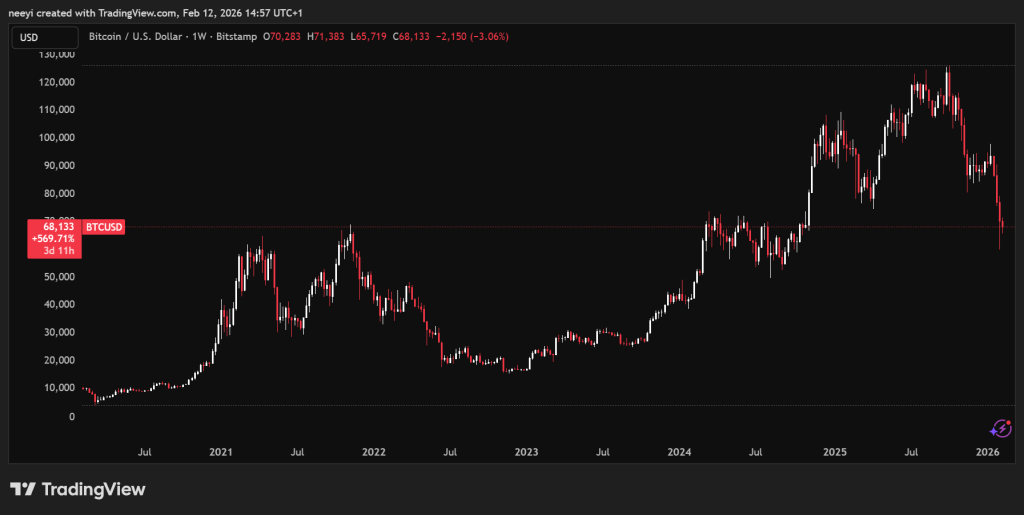 BTC Price Chart
Downside moves show a similar pattern with greater intensity. From the October 6 high to the February 6 low, BTC dropped close to 50%. ASTER declined around 80% during the same window. January weakness tells a related story.
ASTER lost about 37% from its January high to low, whereas Bitcoin fell near 22%. These comparisons indicate that ASTER tends to follow BTC direction but with amplified magnitude. When Bitcoin falls, ASTER often declines faster. When Bitcoin rises, ASTER usually advances more sharply.
Estimated ASTER Price If Bitcoin Falls Toward $45,000
A 30% BTC decline from current levels would extend the existing bearish structure. Historical downside ratios suggest ASTER could experience a deeper percentage loss relative to Bitcoin.
Prior drawdowns show ASTER falling roughly 1.5 to 2 times the BTC decline during stress periods. Applying a similar relationship to a 30% BTC drop implies a possible ASTER decline between about 45% and 60%.
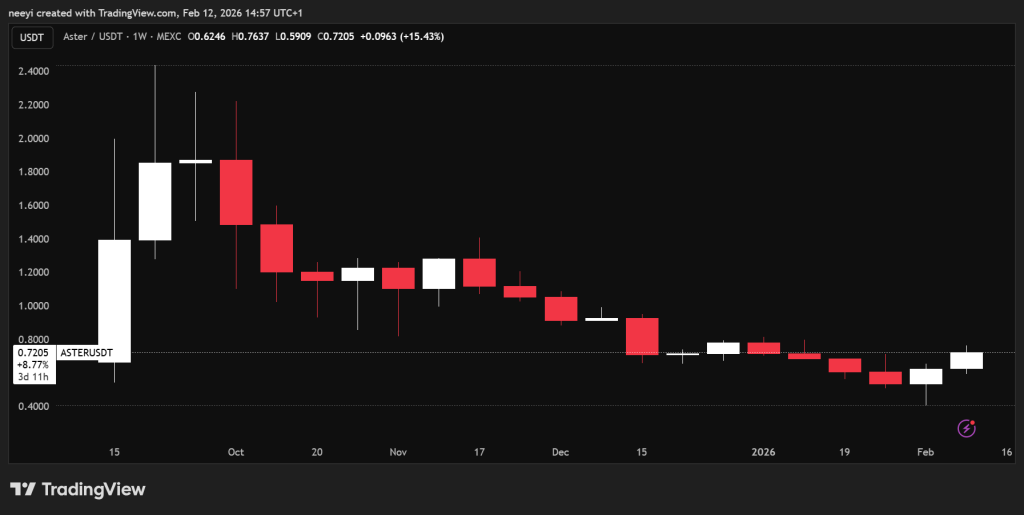 ASTER Price Chart
From the current ASTER price near $0.72, that range would place potential downside roughly between $0.29 and $0.40. Such levels remain hypothetical but they illustrate how correlation with BTC can magnify volatility during market stress.
Fundamental Developments Could Influence ASTER Price Despite Bitcoin Weakness
Correlation does not remove the influence of project-specific catalysts. Aster Chain launched as a Layer 1 network during the first quarter of 2026 with improvements in scalability, security, and transaction speed that support decentralized exchange activity.
Integration of tokenized real-world assets and perpetual trading expands utility beyond traditional DeFi structures. Staking, governance participation, and fee based buybacks strengthen token involvement across the ecosystem.
Institutionally focused features, such as customizable compliance tools and high-leverage trading, aim to attract professional liquidity. Regulatory clarity across major regions could further shape participation levels, either enabling expansion or limiting access. Competitive pressure from other blockchain platforms also remains a key variable that may influence adoption speed.
Read Also: Analyst Warns of Upcoming Crypto Storm as Bitcoin and Silver Show New Weakness
Market cycles often shift capital between Bitcoin and selected altcoins during extreme phases. Even if BTC continues to weaken, narrative changes or ecosystem growth can alter price behavior for specific tokens. If ASTER benefits from such, then we could see a price spike to $1 even if Bitcoin price goes lower.
Subscribe to our YouTube channel for daily crypto updates, market insights, and expert analysis.
The post How Low Can ASTER Price Go If Bitcoin Dips By Another 30%? appeared first on CaptainAltcoin.


You May Also Like

GMatrixs Partners With InsightX To Advance GameFi User Experiences With AI-Powered Web3 Prediction Market Ecosystem

Micron Crosses $1 Trillion Market Cap as AI Demand Reshapes Memory Sector

'Kangaroo court': Expert alarmed as Trump administration adopts new deportation tactics



