When we launched our first product, I felt like we had crossed a finish line that cost us blood. The tech team was drowning in bugs, improvements, feedback, and a roadmap piling up on top of us. And there I was, with an idea, but without knowing how to code. What if I build the first version myself, even if I don’t know how to program? I did it. In 2 weeks and I’ll tell you how.When we launched our first product, I felt like we had crossed a finish line that cost us blood. The tech team was drowning in bugs, improvements, feedback, and a roadmap piling up on top of us. And there I was, with an idea, but without knowing how to code. What if I build the first version myself, even if I don’t know how to program? I did it. In 2 weeks and I’ll tell you how.

I Didn’t Know How to Code. But I Knew What We Needed: An MVP

5 min read

When we launched our first product, I felt like we had crossed a finish line that cost us blood. There was something alive—out in the stores, in users’ hands. But reality doesn’t let you breathe for long.

Our real workhorse was the next step and we didn’t have the luxury to do it “later, but better.”

The tech team was drowning in bugs, improvements, feedback, and a roadmap piling up on top of us. The heaviest weight wasn’t outside pressure—it was looking at the backlog, realizing how much depended on our small team, and feeling stuck.

All this while AI was moving at a ridiculous pace. And there I was, with an idea, but without knowing how to code.

Until I asked myself:

What if I just do it? What if I build the first version of the product myself, even if I don’t know how to program?

Spoiler: I did it. In 2 weeks and I’ll tell you how. Because if you’re in a similar situation, this might unlock you.

From Failing a “Hello, World” to Cloning a Repo

For context: I’m not a developer. Years ago, I tried to do a simple “Hello, World!” and failed miserably.

But this time was different. I had a concrete need and when you have a real need, no-code tools stop being “toys” to become your only way forward.

I stumbled upon a free mini-course by Ariel Mathov on LinkedIn where he explained Cursor. I watched two full lessons. That was enough to download the app, open it, and freeze…

Cursor gave me three options: clone repo, open project, or connect via SSH. I didn’t understand any of it, but that’s where the adventure began.
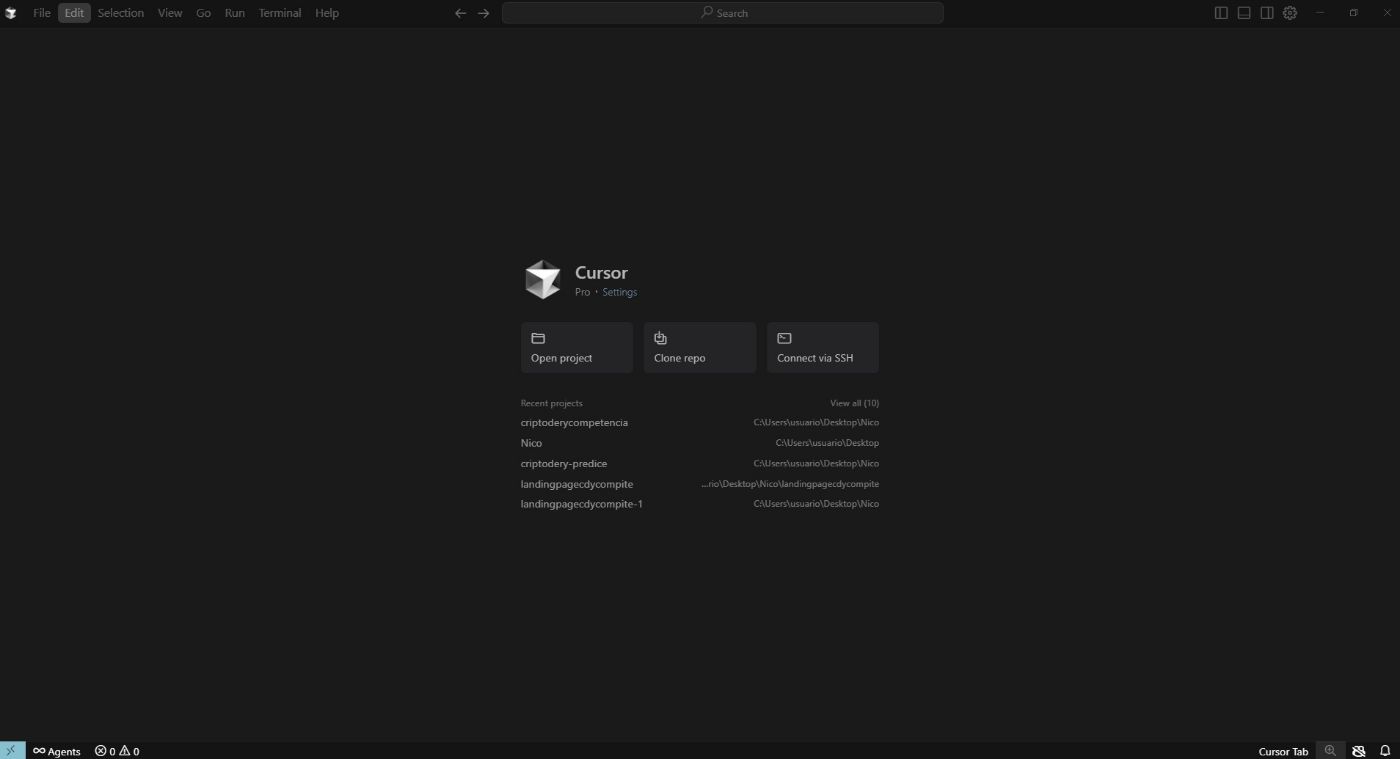
Cursor, GitHub and My First “Hello Agent”

I realized I needed a GitHub project to move forward. So, without fully understanding what I was doing, I cloned a repo, opened it in Cursor, and wrote my first message to the AI chat:

Hello, friend.

Cursor’s AI replied instantly. It asked me what I wanted to build. I said:

“I want to validate an idea in two weeks. Ask me whatever you need.”

It threw 50 questions at me I couldn’t answer, so I just typed: “==Yes, I want all that== 😳.”

And the show began.

Seeing Code Without Understanding It (But Trusting It Works)

Line after line, the AI agent started building with Next.js + TypeScript. It explained what it was doing:

“We’re generating a robust and scalable environment so you can test your product quickly.”

I stared at the screen like it was The Matrix. I didn’t understand a thing—but it didn’t matter.

A Note of Respect

Let me be clear: I’m not a developer, and I don’t intend to be. I have enormous respect for my colleagues who are. This article isn’t about “replacing” anyone—it’s about how AI today lets small teams unblock things faster. For me, it was a way to move forward when time was crushing us, knowing the development team could later audit, refine, and clean up what I had started—while they focused on putting out other fires.

So I listed out the features I needed—things like authentication, flows, and results tracking. The AI spun it all up in minutes.

I ran npm run dev and opened localhost:3000. And there it was: a functioning app. Some errors, sure—but it worked. It had an interface, a full flow, and even animations.

From Skeleton to Experience

I had the basic structure working but what was missing was real-time interaction between users. The AI suggested using Firebase so I opened an account, set up a database, and suddenly had a working foundation for storing and syncing information.

The rest was about iterating on what I did know: adjusting UX, adding design, writing questions by level. The tech stuff, I kept resolving with AI prompts:

“This doesn’t look right.” → “Fixed.” \n “Can you center this?” → “Done.”

In two weeks, we had a functional MVP—clean, aesthetic, and aligned with the product we wanted to validate.

What You Can Do Right Now

If you’re in a situation like mine—with a product that can’t wait or a tech team overwhelmed—try this:

\

  • ==Define your ideal flow==. You don’t need to code, but you do need clarity on what you want your product to do. I didn’t at first, and I ended up redoing everything twice. \n

  • ==Write prompts as if you were talking to a developer friend==. Use whatever technical terms you know; if you don’t know many, that’s fine—AI will figure it out, though it might take longer. For precision, you can even use another AI to translate your idea into “developer language.” \n

  • ==Choose tools that play nicely together==. For me: Cursor + GitHub + Firebase + Vercel. \n

  • ==Allow yourself to do things badly==. The first version won’t be perfect—but it will be functional. And that’s enough to test.

    \

  • ==Stay in touch with your developer== so they can review and refine what you build.

What I Learned: Nobody’s Too Far From Building

I didn’t become a developer. I didn’t learn TypeScript. I didn’t fully understand how Firebase stores data.

But over time, I got curious and started grasping some development logic. More importantly: I validated an idea, I had a demo to show, and I discovered I don’t need to know everything to build something that works.

If you know what you want, can explain it out loud, and are patient with an AI, you can create more than you think.

\n

Market Opportunity
Threshold Logo
Threshold Price(T)
$0,00782
$0,00782$0,00782
+%1,43
USD
Threshold (T) Live Price Chart
Disclaimer: The articles reposted on this site are sourced from public platforms and are provided for informational purposes only. They do not necessarily reflect the views of MEXC. All rights remain with the original authors. If you believe any content infringes on third-party rights, please contact [email protected] for removal. MEXC makes no guarantees regarding the accuracy, completeness, or timeliness of the content and is not responsible for any actions taken based on the information provided. The content does not constitute financial, legal, or other professional advice, nor should it be considered a recommendation or endorsement by MEXC.

You May Also Like

Shocking OpenVPP Partnership Claim Draws Urgent Scrutiny

Shocking OpenVPP Partnership Claim Draws Urgent Scrutiny

The post Shocking OpenVPP Partnership Claim Draws Urgent Scrutiny appeared on BitcoinEthereumNews.com. The cryptocurrency world is buzzing with a recent controversy surrounding a bold OpenVPP partnership claim. This week, OpenVPP (OVPP) announced what it presented as a significant collaboration with the U.S. government in the innovative field of energy tokenization. However, this claim quickly drew the sharp eye of on-chain analyst ZachXBT, who highlighted a swift and official rebuttal that has sent ripples through the digital asset community. What Sparked the OpenVPP Partnership Claim Controversy? The core of the issue revolves around OpenVPP’s assertion of a U.S. government partnership. This kind of collaboration would typically be a monumental endorsement for any private cryptocurrency project, especially given the current regulatory climate. Such a partnership could signify a new era of mainstream adoption and legitimacy for energy tokenization initiatives. OpenVPP initially claimed cooperation with the U.S. government. This alleged partnership was said to be in the domain of energy tokenization. The announcement generated considerable interest and discussion online. ZachXBT, known for his diligent on-chain investigations, was quick to flag the development. He brought attention to the fact that U.S. Securities and Exchange Commission (SEC) Commissioner Hester Peirce had directly addressed the OpenVPP partnership claim. Her response, delivered within hours, was unequivocal and starkly contradicted OpenVPP’s narrative. How Did Regulatory Authorities Respond to the OpenVPP Partnership Claim? Commissioner Hester Peirce’s statement was a crucial turning point in this unfolding story. She clearly stated that the SEC, as an agency, does not engage in partnerships with private cryptocurrency projects. This response effectively dismantled the credibility of OpenVPP’s initial announcement regarding their supposed government collaboration. Peirce’s swift clarification underscores a fundamental principle of regulatory bodies: maintaining impartiality and avoiding endorsements of private entities. Her statement serves as a vital reminder to the crypto community about the official stance of government agencies concerning private ventures. Moreover, ZachXBT’s analysis…
Share
BitcoinEthereumNews2025/09/18 02:13
United States Building Permits Change dipped from previous -2.8% to -3.7% in August

United States Building Permits Change dipped from previous -2.8% to -3.7% in August

The post United States Building Permits Change dipped from previous -2.8% to -3.7% in August appeared on BitcoinEthereumNews.com. Information on these pages contains forward-looking statements that involve risks and uncertainties. Markets and instruments profiled on this page are for informational purposes only and should not in any way come across as a recommendation to buy or sell in these assets. You should do your own thorough research before making any investment decisions. FXStreet does not in any way guarantee that this information is free from mistakes, errors, or material misstatements. It also does not guarantee that this information is of a timely nature. Investing in Open Markets involves a great deal of risk, including the loss of all or a portion of your investment, as well as emotional distress. All risks, losses and costs associated with investing, including total loss of principal, are your responsibility. The views and opinions expressed in this article are those of the authors and do not necessarily reflect the official policy or position of FXStreet nor its advertisers. The author will not be held responsible for information that is found at the end of links posted on this page. If not otherwise explicitly mentioned in the body of the article, at the time of writing, the author has no position in any stock mentioned in this article and no business relationship with any company mentioned. The author has not received compensation for writing this article, other than from FXStreet. FXStreet and the author do not provide personalized recommendations. The author makes no representations as to the accuracy, completeness, or suitability of this information. FXStreet and the author will not be liable for any errors, omissions or any losses, injuries or damages arising from this information and its display or use. Errors and omissions excepted. The author and FXStreet are not registered investment advisors and nothing in this article is intended…
Share
BitcoinEthereumNews2025/09/18 02:20
CME Group to launch Solana and XRP futures options in October

CME Group to launch Solana and XRP futures options in October

The post CME Group to launch Solana and XRP futures options in October appeared on BitcoinEthereumNews.com. CME Group is preparing to launch options on SOL and XRP futures next month, giving traders new ways to manage exposure to the two assets.  The contracts are set to go live on October 13, pending regulatory approval, and will come in both standard and micro sizes with expiries offered daily, monthly and quarterly. The new listings mark a major step for CME, which first brought bitcoin futures to market in 2017 and added ether contracts in 2021. Solana and XRP futures have quickly gained traction since their debut earlier this year. CME says more than 540,000 Solana contracts (worth about $22.3 billion), and 370,000 XRP contracts (worth $16.2 billion), have already been traded. Both products hit record trading activity and open interest in August. Market makers including Cumberland and FalconX plan to support the new contracts, arguing that institutional investors want hedging tools beyond bitcoin and ether. CME’s move also highlights the growing demand for regulated ways to access a broader set of digital assets. The launch, which still needs the green light from regulators, follows the end of XRP’s years-long legal fight with the US Securities and Exchange Commission. A federal court ruling in 2023 found that institutional sales of XRP violated securities laws, but programmatic exchange sales did not. The case officially closed in August 2025 after Ripple agreed to pay a $125 million fine, removing one of the biggest uncertainties hanging over the token. This is a developing story. This article was generated with the assistance of AI and reviewed by editor Jeffrey Albus before publication. Get the news in your inbox. Explore Blockworks newsletters: Source: https://blockworks.co/news/cme-group-solana-xrp-futures
Share
BitcoinEthereumNews2025/09/17 23:55