

Tired of Converting Hours to Years? Here’s a Two-in-One Tool That’ll Save Your Sanity
\ As a developer or sysadmin, you’ve probably faced this reporting nightmare: you’re staring at a huge integer representing a system's uptime, say 87,600 hours, and your brain instantly blanks. How do you translate that into something a manager or client can actually understand?
Your first instinct might be to write a quick conversion script. But what if there was a better way?
That's where hourstoyears.com comes in. It's a dead-simple, blazing-fast web app that does exactly what it says on the tin, saving you from writing yet another boilerplate function. It’s the kind of tool that’s so simple, you wonder why you didn't have it all along.
A Tool Built for Pragmatists
At first glance, hourstoyears.com might seem like a gimmick. But for anyone who lives in a world of uptime metrics, project hours, or long-term data analysis, it’s a quiet hero.
- You Save Precious Seconds: Why write
total_hours / 8760when you can just type a number into a browser? This tool eliminates the micro-friction of context switching, allowing you to stay in your flow. - It’s Precision-First: The site provides an exact conversion down to the decimal point. You don’t have to worry about rounding errors in your own scripts or using outdated conversion factors.
The Hidden Gem: A Powerful Date Calculator
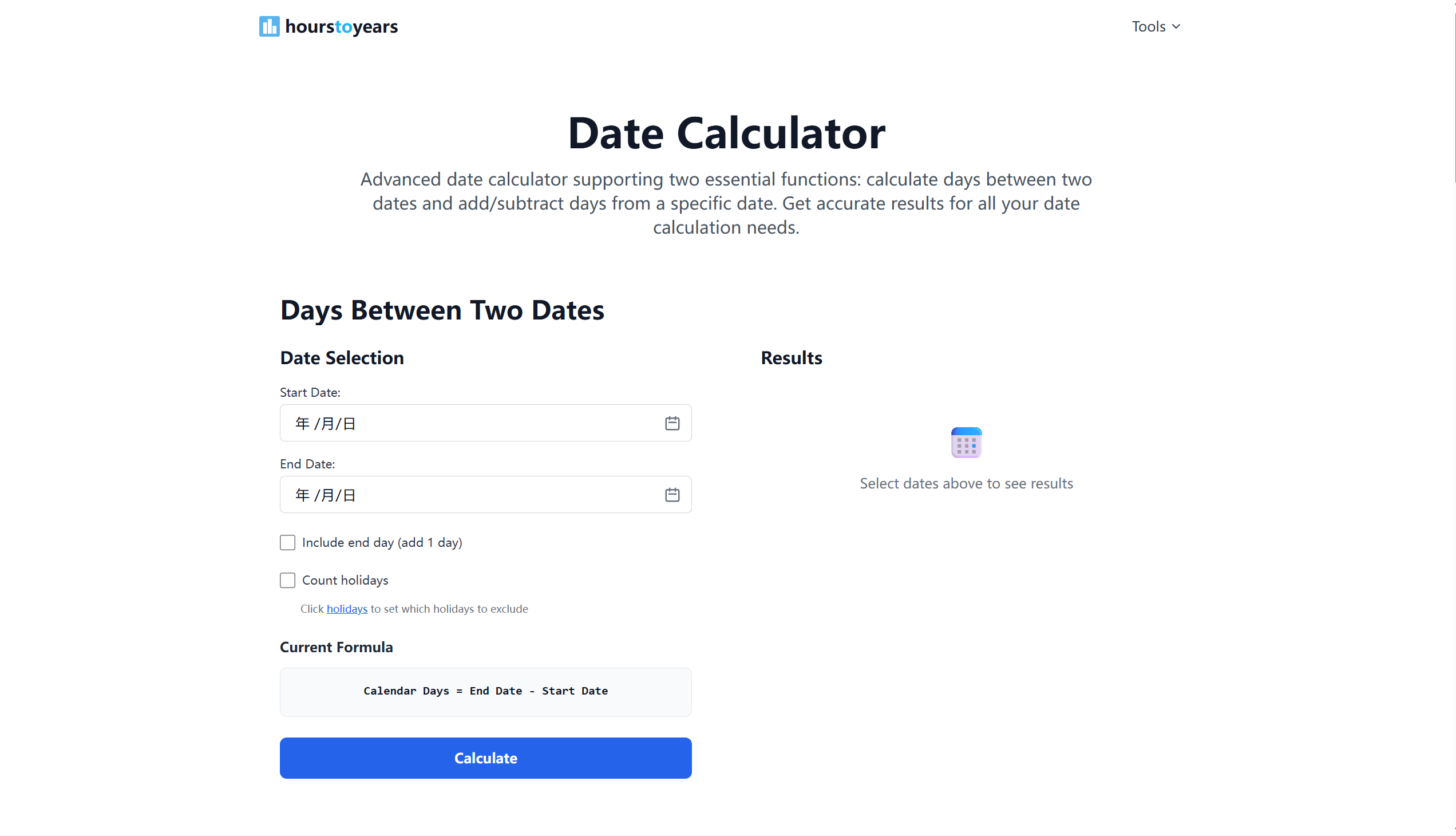
After you’ve converted your hours, you’ll find another useful tool hiding in plain sight: a Date Calculator. This feature lets you instantly figure out the exact duration between two specific dates. This is perfect for the kind of date math that usually requires a lot of double-checking.
For example, you can calculate the number of days a project has been running, how many months are left until a deadline, or the exact duration between two historical events in your dataset. It’s a simple feature that saves you from writing quick-and-dirty date difference functions.
The Use Cases Are Everywhere
\
- For DevOps and SysAdmins: When reporting on system reliability, you can instantly turn a massive hour count into a human-readable number of years. It’s much more impressive to say a server has been up for "10 years" than for "87,600 hours."
- For Project Managers: If your project is estimated at a colossal 20,000 hours, you can use the tool to quickly translate that into a more realistic timeline. This helps you communicate a clear schedule to stakeholders and teammates. You can also use the Date Calculator to quickly verify a project’s timeline between start and end dates.
- For Data Scientists: When analyzing long-term datasets, this tool can help you quickly make sense of time stamps and provide a more intuitive context for your findings.
This isn’t about building complex software; it’s about appreciating elegant simplicity. In a world full of bloated apps, hourstoyears is a clean, efficient, and reliable solution to a common problem. It does two things, and it does them perfectly.
If you’re the kind of person who appreciates a well-designed tool, bookmark this one. It might just save you a minute—or a thousand hours.


You May Also Like

Solana Foundation to Help Secure DeFi Protocols Following $285 Million Drift Hack

LDO Price Prediction: Neutral Consolidation Targets $0.33 Resistance Retest by Mid-April




