Bitcoin’s quantum-security discussion just gained a concrete new artifact in the code-and-spec pipeline: an updated draft of BIP-360 has been merged into the officialBitcoin’s quantum-security discussion just gained a concrete new artifact in the code-and-spec pipeline: an updated draft of BIP-360 has been merged into the official

Bitcoin Developers Kick Off Quantum-Safety Track With BIP-360

2026/02/13 20:30
4 min read
For feedback or concerns regarding this content, please contact us at [email protected]

Bitcoin’s quantum-security discussion just gained a concrete new artifact in the code-and-spec pipeline: an updated draft of BIP-360 has been merged into the official Bitcoin Improvement Proposals repository, proposing a Taproot-adjacent output type designed to limit exposure to future quantum key-recovery attacks.

The change matters less because it “solves” quantum risk today, and more because it formalizes a specific, opt-in path that preserves Taproot’s script-tree functionality while removing the spending route considered most problematic under a quantum-threat model.

Bitcoin Devs Make First Formal Quantum-Resistance Move

Anduro, a research-focused platform incubated by Marathon Digital (MARA), said on X that the merged update “introduces Pay-to-Merkle-Root (P2MR), a proposed new output type that omits Taproot’s quantum-vulnerable key-path spend while preserving compatibility with Tapscript and script trees.”

In BIP terms, the proposal is scoped as “Consensus (soft fork)” and defines P2MR as a new SegWit v2 output that commits directly to the Merkle root of a script tree, rather than to a tweaked public key as in Pay-to-Taproot (P2TR). The practical implication is straightforward: P2MR outputs can only be spent via script-path logic; the key-path spend is removed entirely.

The BIP’s abstract frames the goal in terms of minimizing changes while providing an option set for users who want additional protection:

“This document proposes a new output type: Pay-to-Merkle-Root (P2MR), via a soft fork. P2MR outputs operate with nearly the same functionality as P2TR (Pay-to-Taproot) outputs, but with the key path spend removed.” It adds that the intended protection is against “long exposure attacks by Cryptographically Relevant Quantum Computers (CRQCs),” as well as “future cryptanalytic approaches that may compromise the elliptic curve cryptography (ECC) used by Bitcoin.”

A key element of the BIP is definitional discipline: it distinguishes “long exposure” attacks (where public keys are available on-chain for extended periods) from “short exposure” attacks, which would target public keys revealed briefly in the mempool during an unconfirmed spend.

The document is explicit that P2MR is not a complete quantum shield. “It is worth noting that proposed P2MR outputs are only resistant to ‘long exposure attacks’ on elliptic curve cryptography; that is, attacks on keys exposed for time periods longer than needed to confirm a spending transaction,” the BIP states.

“Protection against more sophisticated quantum attacks, including protection against private key recovery from public keys exposed in the mempool while a transaction is waiting to be confirmed (a.k.a. ‘short exposure attacks’), may require the introduction of post-quantum signatures in Bitcoin.” The authors add they “intend to offer a separate proposal for this purpose upon further research.”

That split is also why the proposal emphasizes tapscript compatibility. It positions P2MR as a script-tree output type that could, if Bitcoin ever adopts post-quantum signature opcodes, provide a cleaner upgrade runway than older script mechanisms that don’t support tapscript’s evolution path.

Anduro highlighted that the change is designed as a soft fork and “does not affect existing Taproot outputs.” P2MR would be a new output type (with bech32m addresses starting with bc1z) rather than a retrofit of existing bc1p Taproot UTXOs.

The proposal also doesn’t pretend the swap is free. By removing key-path spends, P2MR gives up Taproot’s most compact witness path (a single Schnorr signature). The BIP estimates that a minimal P2MR spend witness is 37 bytes larger than a Taproot key-path spend, though it can be smaller than an equivalent Taproot script-path spend because P2MR’s control block omits an internal public key.

Privacy shifts too. Because every spend is script-path, P2MR users necessarily reveal they are spending from a script tree—something Taproot key-path spends can avoid signaling.

Anduro said the update also “addresses criticism about Bitcoin devs not taking the quantum threat seriously,” and noted the addition of Isabel Foxen Duke as co-author to make the BIP clearer “to the general public, not just the Bitcoin developer community.”

BIP-360 remains in “Draft” status. But its merge into the canonical repository is still a meaningful process marker: it moves the quantum-safety conversation from abstract worry and mailing-list hypotheticals toward a specific consensus change proposal that wallets, libraries, and reviewers can now analyze line-by-line.

If the debate has a next phase, it’s likely to center on whether “prepared not scared” opt-ins like P2MR are sufficient groundwork or whether Bitcoin will eventually need to grapple directly with post-quantum signatures and the operational realities of migrating value at scale.

At press time, BTC traded at $66,558.
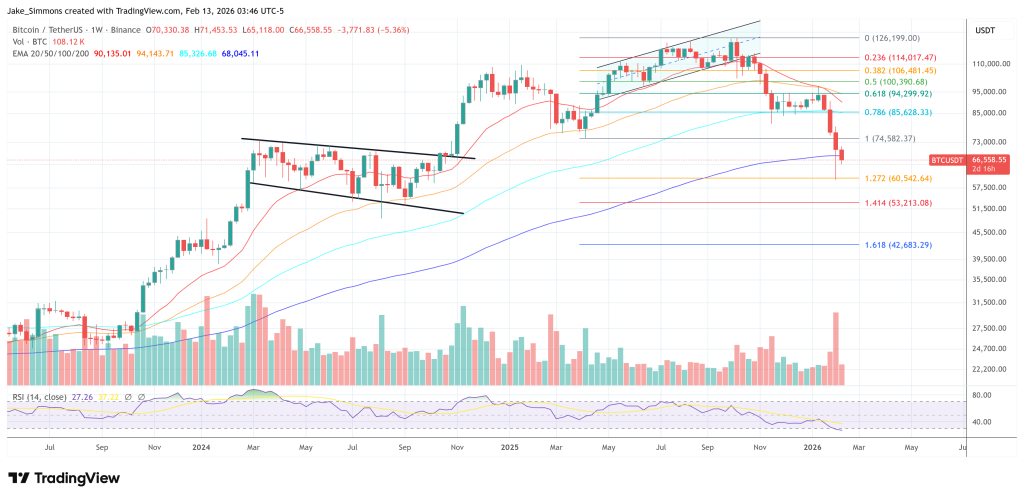
Bitcoin price chart
Market Opportunity
QUANTUM Logo
QUANTUM Price(QUANTUM)
$0.002693
$0.002693$0.002693
-0.48%
USD
QUANTUM (QUANTUM) Live Price Chart
Disclaimer: The articles reposted on this site are sourced from public platforms and are provided for informational purposes only. They do not necessarily reflect the views of MEXC. All rights remain with the original authors. If you believe any content infringes on third-party rights, please contact [email protected] for removal. MEXC makes no guarantees regarding the accuracy, completeness, or timeliness of the content and is not responsible for any actions taken based on the information provided. The content does not constitute financial, legal, or other professional advice, nor should it be considered a recommendation or endorsement by MEXC.

You May Also Like

SEC decisions scrutinized as senator seeks records on crypto enforcement rollbacks

SEC decisions scrutinized as senator seeks records on crypto enforcement rollbacks

The post SEC decisions scrutinized as senator seeks records on crypto enforcement rollbacks appeared on BitcoinEthereumNews.com. U.S. securities regulators have
Share
BitcoinEthereumNews2026/03/31 08:08
Crypto Supercycle in 2025? DeepSeek Ranks the Best Altcoins to Buy Right Now

Crypto Supercycle in 2025? DeepSeek Ranks the Best Altcoins to Buy Right Now

The post Crypto Supercycle in 2025? DeepSeek Ranks the Best Altcoins to Buy Right Now appeared on BitcoinEthereumNews.com. Crypto Supercycle in 2025? DeepSeek Ranks the Best Altcoins to Buy Right Now Sign Up for Our Newsletter! For updates and exclusive offers enter your email. As a crypto writer, Krishi splits his time between decoding the chaos of the markets and writing about it in a way that doesn’t put you to sleep. He’s been at it for nearly two years in the crypto trenches. Yes, he regrets missing the magnificent rallies that came before that (who doesn’t!), but he’s more than ready to put his money where his words are. Before diving headfirst into crypto, Krishi spent over five years writing for some of the biggest names in tech, including TechRadar, Tom’s Guide, and PC Gaming, covering everything from gadgets and cybersecurity to gaming and software. When he’s not scouring and writing about the latest happenings in crypto, Krishi trades the forex market while keeping crypto in his long-term HODL plans. He’s a Bitcoin believer, though he never lets that bias creep into his writing. This website uses cookies. By continuing to use this website you are giving consent to cookies being used. Visit our Privacy Center or Cookie Policy. I Agree Source: https://bitcoinist.com/crypto-supercycle-2025-best-altcoins-to-buy-now-deepseek/

Share
BitcoinEthereumNews2025/09/18 01:45
Cashing In On University Patents Means Giving Up On Our Innovation Future

Cashing In On University Patents Means Giving Up On Our Innovation Future

The post Cashing In On University Patents Means Giving Up On Our Innovation Future appeared on BitcoinEthereumNews.com. “It’s a raid on American innovation that would deliver pennies to the Treasury while kneecapping the very engine of our economic and medical progress,” writes Pipes. Getty Images Washington is addicted to taxing success. Now, Commerce Secretary Howard Lutnick is floating a plan to skim half the patent earnings from inventions developed at universities with federal funding. It’s being sold as a way to shore up programs like Social Security. In reality, it’s a raid on American innovation that would deliver pennies to the Treasury while kneecapping the very engine of our economic and medical progress. Yes, taxpayer dollars support early-stage research. But the real payoff comes later—in the jobs created, cures discovered, and industries launched when universities and private industry turn those discoveries into real products. By comparison, the sums at stake in patent licensing are trivial. Universities collectively earn only about $3.6 billion annually in patent income—less than the federal government spends on Social Security in a single day. Even confiscating half would barely register against a $6 trillion federal budget. And yet the damage from such a policy would be anything but trivial. The true return on taxpayer investment isn’t in licensing checks sent to Washington, but in the downstream economic activity that federally supported research unleashes. Thanks to the bipartisan Bayh-Dole Act of 1980, universities and private industry have powerful incentives to translate early-stage discoveries into real-world products. Before Bayh-Dole, the government hoarded patents from federally funded research, and fewer than 5% were ever licensed. Once universities could own and license their own inventions, innovation exploded. The result has been one of the best returns on investment in government history. Since 1996, university research has added nearly $2 trillion to U.S. industrial output, supported 6.5 million jobs, and launched more than 19,000 startups. Those companies pay…
Share
BitcoinEthereumNews2025/09/18 03:26