Organisations around Cardano, Avalanche, Sui and IOTA have filed a joint response to the UK Financial Conduct Authority’s CP25/40 consultation, arguing that theOrganisations around Cardano, Avalanche, Sui and IOTA have filed a joint response to the UK Financial Conduct Authority’s CP25/40 consultation, arguing that the

Cardano, Avalanche, Sui And IOTA Submit Joint UK Crypto Rules Response

2026/02/13 23:30
4 min read

Organisations around Cardano, Avalanche, Sui and IOTA have filed a joint response to the UK Financial Conduct Authority’s CP25/40 consultation, arguing that the rulebook should draw hard lines around “custody and control” and avoid sweeping non-custodial crypto activity into regimes designed for intermediaries.

The submission, led by the IOTA Foundation alongside the Sui Foundation, Cardano Foundation and the Avalanche Policy Coalition, is a targeted push on two areas the group says are most exposed to “scope, proportionality and technical interpretation” problems: staking and decentralized finance.

In a post on X, IOTA framed the core message as a scoping exercise as much as a policy one: “focus on custody & control, keep it proportionate, and support non-custodial, decentralized innovation for UK.”

Cardano, Avalanche, Sui And IOTA Warn Against Overregulation

The open letter expands that into a broader architecture: “A consistent theme across our feedback on both staking and decentralized finance is the importance of clearly distinguishing between infrastructure functions and intermediary functions. We recommend that regulatory obligations remain focused on entities that exercise custody, discretion, or commercial intermediation, while preserving the neutrality of public blockchain infrastructure.”

The letter adds that developers and infrastructure providers should be exempted: “[They] deliver software development, validation, communications, or other protocol-level services without controlling client assets or exercising unilateral decision-making are performing infrastructure roles rather than financial intermediation, and warrant a proportionate and differentiated regulatory treatment.”

That distinction matters, the group argues, because staking and DeFi aren’t single business models. They sit on a spectrum from fully custodial services where a firm safeguards assets and intermediates execution to protocol-native activity where users retain control of keys and assets.

On staking, IOTA’s X thread distilled the policy ask into a binary: “regulation must clearly distinguish custodial vs non-custodial/models.” It adds that custodial staking “where firms safeguard assets” warrants “appropriate retail disclosures, consent + record-keeping,” while “non-custodial/protocol-level staking (no control of user assets/keys) should not be swept into the same regime.”

The letter mirrors that framing and narrows it to where the risk sits: “Where staking is provided through a custodial arrangement, and the firm safeguards client assets and intermediates the staking process, we recommend applying the proposed requirements on information provision, key contractual terms, express prior consent for retail clients, and record-keeping.”

It then draws the line the signatories want the FCA to adopt: “For non-custodial and delegated staking arrangements, where firms do not control client assets or private keys, we recommend that such activities remain outside the scope of regulated staking activity, as this maintains proportionality and aligns regulatory obligations with the actual sources of risk.”

The second pressure point is the FCA’s concept of a “clear controlling person” in DeFi. IOTA’s post argues the term needs a “technical, objective definition,” warning that obligations should scale with “custody, discretion, and unilateral control; not with writing code, participating in governance, or providing neutral infrastructure.”

The open letter keeps the same structure: it accepts the FCA’s intent to capture cases where an identifiable party is “effectively carrying on regulated cryptoasset activities,” but pushes back on triggering regulatory status based on development and infrastructure. Instead, it urges the FCA to anchor expectations to “demonstrable, unilateral control over protocol operation, governance or economic outcomes,” particularly because DeFi “rel[ies] on self-custody, automated execution and open participation.”

IOTA positioned the argument as pro-scope, not anti-rules: “smarter scoping = better consumer protection where risk is real, plus legal certainty that keeps non-custodial innovation from being regulated out of existence.” The letter closes on the same trade-off: obligations tied to “custody, discretion and unilateral control” would, the group says, “strengthen legal certainty, enhance consumer protection where it is most needed, and reinforce the UK’s position as a jurisdiction that understands the architectural realities of decentralized technologies.”

At press time, Cardano traded at $0.264.
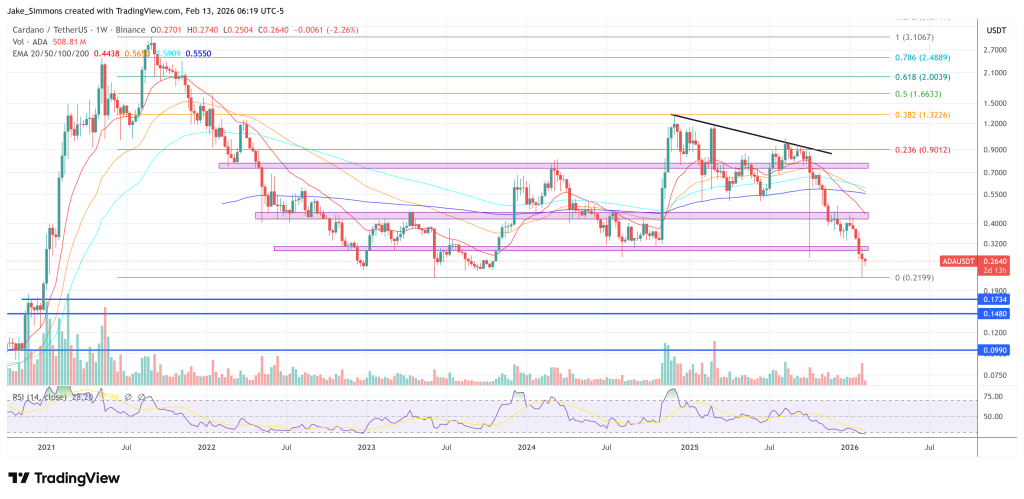
Cardano price chart
Market Opportunity
MIOTAC Logo
MIOTAC Price(IOTA)
$0.06864
$0.06864$0.06864
+1.07%
USD
MIOTAC (IOTA) Live Price Chart
Disclaimer: The articles reposted on this site are sourced from public platforms and are provided for informational purposes only. They do not necessarily reflect the views of MEXC. All rights remain with the original authors. If you believe any content infringes on third-party rights, please contact [email protected] for removal. MEXC makes no guarantees regarding the accuracy, completeness, or timeliness of the content and is not responsible for any actions taken based on the information provided. The content does not constitute financial, legal, or other professional advice, nor should it be considered a recommendation or endorsement by MEXC.
Tags:

You May Also Like

Solid growth outlook supports Ringgit – Standard Chartered

Solid growth outlook supports Ringgit – Standard Chartered

The post Solid growth outlook supports Ringgit – Standard Chartered appeared on BitcoinEthereumNews.com. Standard Chartered’s Edward Lee and Jonathan Koh highlight
Share
BitcoinEthereumNews2026/02/14 03:14
CME Group to launch options on XRP and SOL futures

CME Group to launch options on XRP and SOL futures

The post CME Group to launch options on XRP and SOL futures appeared on BitcoinEthereumNews.com. CME Group will offer options based on the derivative markets on Solana (SOL) and XRP. The new markets will open on October 13, after regulatory approval.  CME Group will expand its crypto products with options on the futures markets of Solana (SOL) and XRP. The futures market will start on October 13, after regulatory review and approval.  The options will allow the trading of MicroSol, XRP, and MicroXRP futures, with expiry dates available every business day, monthly, and quarterly. The new products will be added to the existing BTC and ETH options markets. ‘The launch of these options contracts builds on the significant growth and increasing liquidity we have seen across our suite of Solana and XRP futures,’ said Giovanni Vicioso, CME Group Global Head of Cryptocurrency Products. The options contracts will have two main sizes, tracking the futures contracts. The new market will be suitable for sophisticated institutional traders, as well as active individual traders. The addition of options markets singles out XRP and SOL as liquid enough to offer the potential to bet on a market direction.  The options on futures arrive a few months after the launch of SOL futures. Both SOL and XRP had peak volumes in August, though XRP activity has slowed down in September. XRP and SOL options to tap both institutions and active traders Crypto options are one of the indicators of market attitudes, with XRP and SOL receiving a new way to gauge sentiment. The contracts will be supported by the Cumberland team.  ‘As one of the biggest liquidity providers in the ecosystem, the Cumberland team is excited to support CME Group’s continued expansion of crypto offerings,’ said Roman Makarov, Head of Cumberland Options Trading at DRW. ‘The launch of options on Solana and XRP futures is the latest example of the…
Share
BitcoinEthereumNews2025/09/18 00:56
Pibble AI platform: Revolutionary AION Completes POSCO International POC with Stunning Success

Pibble AI platform: Revolutionary AION Completes POSCO International POC with Stunning Success

BitcoinWorld Pibble AI platform: Revolutionary AION Completes POSCO International POC with Stunning Success The world of trade is constantly evolving, with businesses seeking innovative solutions to enhance efficiency and accuracy. In this dynamic landscape, the Pibble AI platform AION has emerged as a groundbreaking force, recently completing a significant Proof-of-Concept (POC) with global trading giant POSCO International. This achievement signals a major leap forward in how artificial intelligence and blockchain technology can revolutionize B2B operations. What is the Pibble AI Platform AION and Its Recent Breakthrough? AION is an advanced AI trade solution developed by Caramel Bay, the innovative operator behind the Pibble (PIB) blockchain project. Its core mission is to streamline complex trade processes, which traditionally involve extensive manual labor and time-consuming documentation. The recent POC with POSCO International was a pivotal moment for the Pibble AI platform. It served as a real-world test, demonstrating AION’s capabilities in a demanding corporate environment. This collaboration showcased how cutting-edge technology can address practical business challenges, particularly in international trade. The results were truly impressive. The platform proved its ability to drastically cut down the time required for specific tasks. What once took hours of meticulous work can now be completed in mere minutes. Moreover, AION achieved an astonishing document accuracy rate of over 95%, setting a new benchmark for efficiency and reliability in trade operations. This high level of precision is crucial for reducing errors and associated costs in large-scale international transactions. Revolutionizing Trade: How the Pibble AI Platform Delivers Speed and Accuracy Imagine reducing hours of work to just minutes while simultaneously boosting accuracy. This isn’t a futuristic fantasy; it’s the tangible reality delivered by the Pibble AI platform AION. The successful POC with POSCO International vividly illustrates the transformative power of this technology. Key benefits highlighted during the POC include: Unprecedented Speed: Tasks that typically consumed significant human resources and time were executed with remarkable swiftness. This acceleration translates directly into faster transaction cycles and improved operational flow for businesses. Superior Accuracy: Achieving over 95% document accuracy is a monumental feat in an industry where even minor errors can lead to substantial financial losses and logistical nightmares. AION’s precision minimizes risks and enhances trust in digital documentation. Operational Efficiency: By automating and optimizing critical trade processes, the Pibble AI platform frees up human capital. Employees can then focus on more strategic tasks that require human intuition and decision-making, rather than repetitive data entry or verification. This efficiency isn’t just about saving time; it’s about creating a more robust, less error-prone system that can handle the complexities of global trade with ease. The implications for businesses involved in import/export, logistics, and supply chain management are profound. Beyond the POC: Pibble’s Vision for AI and Blockchain Integration The successful POC with POSCO International is just one step in Pibble’s ambitious journey. The company is dedicated to building validated platforms that leverage both blockchain and AI technologies, catering to a broad spectrum of needs. Pibble’s strategic focus encompasses: B2C Social Platforms: Developing consumer-facing applications that integrate blockchain for enhanced data security, content ownership, and user engagement. B2B Business Solutions: Expanding on successes like AION to offer robust, scalable solutions for various industries, addressing critical business challenges with AI-driven insights and blockchain transparency. The synergy between AI and blockchain is powerful. AI provides the intelligence for automation and optimization, while blockchain offers immutable records, transparency, and enhanced security. Together, they create a formidable foundation for future digital ecosystems. As the digital transformation accelerates, platforms like the Pibble AI platform are poised to play a crucial role in shaping how businesses operate and interact globally. Their commitment to innovation and practical application demonstrates a clear path forward for enterprise-grade blockchain and AI solutions. In conclusion, the successful POC of Pibble’s AION with POSCO International marks a significant milestone in the adoption of AI and blockchain in enterprise solutions. By dramatically reducing task times and achieving exceptional accuracy, the Pibble AI platform has demonstrated its potential to redefine efficiency in global trade. This achievement not only validates Caramel Bay’s vision but also paves the way for a future where intelligent, secure, and highly efficient digital platforms drive business success. It’s an exciting glimpse into the future of B2B innovation. Frequently Asked Questions (FAQs) Q1: What is the Pibble AI platform AION? AION is an advanced AI trade solution developed by Caramel Bay, the company behind the Pibble blockchain project. It’s designed to automate and optimize complex trade processes, reducing manual effort and improving accuracy. Q2: What was the significance of the POC with POSCO International? The Proof-of-Concept (POC) with POSCO International demonstrated AION’s real-world effectiveness. It showed that the Pibble AI platform could reduce tasks from hours to minutes and achieve over 95% document accuracy in a demanding corporate environment, validating its capabilities. Q3: How does AION achieve such high accuracy and speed? AION leverages sophisticated artificial intelligence algorithms to process and verify trade documentation. This AI-driven approach allows for rapid analysis and identification of discrepancies, leading to significant time savings and a dramatic reduction in human error. Q4: What is Pibble’s broader vision beyond B2B solutions? Pibble is committed to integrating blockchain and AI across various platforms. While AION focuses on B2B solutions, Pibble also develops B2C social platforms, aiming to enhance user experience, data security, and content ownership through these advanced technologies. Q5: Why is the combination of AI and blockchain important for trade? AI provides the intelligence for automation and optimization, making processes faster and more accurate. Blockchain, on the other hand, offers immutable records, transparency, and enhanced security, ensuring that trade data is reliable and tamper-proof. Together, they create a powerful, trustworthy, and efficient trade ecosystem. If you found this insight into Pibble’s groundbreaking achievements inspiring, consider sharing this article with your network! Help us spread the word about how AI and blockchain are transforming global trade. Your shares on social media platforms like X (Twitter), LinkedIn, and Facebook can help more people discover the future of business solutions. To learn more about the latest crypto market trends, explore our article on key developments shaping AI in crypto institutional adoption. This post Pibble AI platform: Revolutionary AION Completes POSCO International POC with Stunning Success first appeared on BitcoinWorld.
Share
Coinstats2025/09/18 19:45