Ethereum continues to struggle below the $2,000 level, reflecting persistent selling pressure and increasingly fragile market sentiment. The inability to reclaimEthereum continues to struggle below the $2,000 level, reflecting persistent selling pressure and increasingly fragile market sentiment. The inability to reclaim

Ethereum Derivatives Reset Raises Questions About Next Price Move: What Happens Next?

2026/02/14 06:30
4 min read

Ethereum continues to struggle below the $2,000 level, reflecting persistent selling pressure and increasingly fragile market sentiment. The inability to reclaim this psychological threshold has kept traders defensive, with volatility elevated and confidence weakened as negative sentiment spreads across the broader crypto market. While corrections are not unusual after strong cycles, the current environment shows clear signs of stress, with investors closely watching liquidity conditions and derivatives positioning for clues about the next directional move.

A recent CryptoQuant report provides additional context by highlighting a significant contraction in Ethereum futures open interest. Data tracking the 30-day change in net open interest across major trading platforms indicates that the derivatives market is undergoing a clear phase of deleveraging and risk readjustment. The decline appears concentrated on key exchanges such as Binance, Gate.io, OKX, and Bybit, pointing to a widespread outflow of capital from leveraged positions.

According to the figures, Binance alone recorded an approximate drop of 40 million ETH in open interest over the past month, while Gate.io saw a decline exceeding 20 million ETH. OKX posted a reduction of nearly 6.8 million ETH, with Bybit contributing roughly 8.5 million ETH, bringing the combined contraction across these platforms to around 75 million ETH.

Broad Deleveraging Suggests Ethereum Market Reset

The CryptoQuant report further notes that when additional platforms showing negative open interest readings are included — even those with comparatively smaller volumes — the total contraction across all exchanges exceeds 80 million ETH over the past 30 days. This confirms that the deleveraging trend is not isolated to a handful of major venues but represents a broader structural shift across the Ethereum derivatives ecosystem.

Ethereum Open Interest 30D | Source: CryptoQuant

Such a widespread decline in open interest typically indicates that traders, particularly those relying on leverage, are reducing exposure rather than initiating new speculative positions. This behavior may reflect caution following heightened volatility or pressure from recent price declines that triggered margin adjustments. Historically, similar environments tend to emerge during transitional market phases, when speculative momentum cools, and risk management becomes a priority.

From a structural standpoint, this type of contraction can function as a market “clean-up.” By gradually removing weaker leveraged positions, the likelihood of sudden liquidation cascades may diminish over time. While this does not guarantee an immediate recovery, flushing out excess leverage often stabilizes market conditions. In Ethereum’s case, the ongoing reset in derivatives positioning could help establish a firmer price base if broader liquidity conditions and investor sentiment begin to stabilize.

Ethereum Faces Structural Pressure Below Key Weekly Support

Ethereum’s weekly chart shows persistent downside pressure after losing the $2,000 level, a zone that previously acted as both psychological support and a technical pivot during prior consolidation phases. The recent breakdown places ETH below several major moving averages, which now function as overhead resistance rather than support, indicating weakening bullish momentum and a shift toward a more defensive market structure.
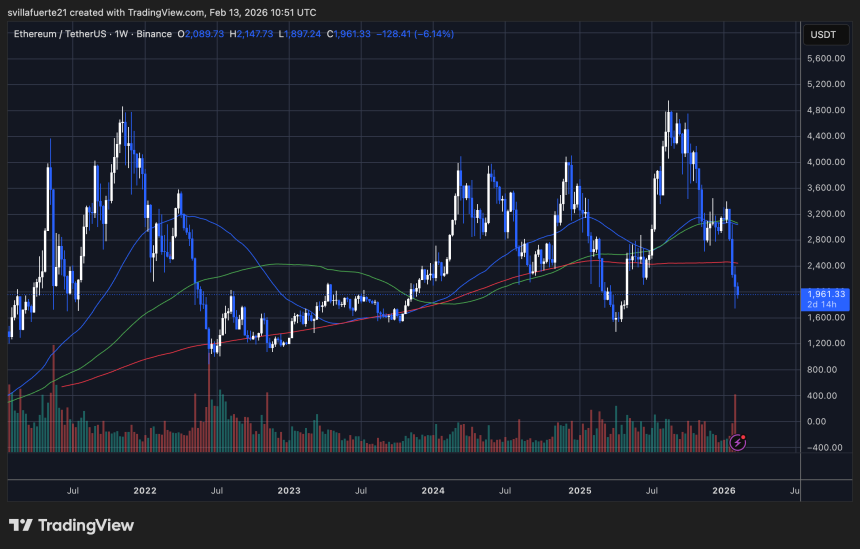
ETH testing critical demand level | Source: ETHUSDT chart on TradingView

Price action reflects a clear rejection from the $3,000–$3,500 region earlier in the cycle, followed by a sequence of lower highs. This pattern typically signals a corrective or transitional phase rather than a continuation of the prior bullish trend. The latest decline has also been accompanied by elevated trading volume, suggesting distribution and deleveraging rather than organic accumulation.

From a structural standpoint, the next meaningful support area appears near the $1,600–$1,700 range, where prior consolidation and demand previously emerged. Holding this zone would help maintain the broader long-term framework despite current weakness. A sustained break below it, however, could increase the probability of a deeper retracement phase.

Ethereum remains highly sensitive to macro liquidity conditions, derivatives positioning, and overall crypto market sentiment, with recovery dependent on renewed demand and stabilization above key technical levels.

Featured image from ChatGPT, chart from TradingView.com 

Market Opportunity
Ethereum Logo
Ethereum Price(ETH)
$2,051.87
$2,051.87$2,051.87
+0.81%
USD
Ethereum (ETH) Live Price Chart
Disclaimer: The articles reposted on this site are sourced from public platforms and are provided for informational purposes only. They do not necessarily reflect the views of MEXC. All rights remain with the original authors. If you believe any content infringes on third-party rights, please contact [email protected] for removal. MEXC makes no guarantees regarding the accuracy, completeness, or timeliness of the content and is not responsible for any actions taken based on the information provided. The content does not constitute financial, legal, or other professional advice, nor should it be considered a recommendation or endorsement by MEXC.

You May Also Like

Ethereum Foundation Leadership Update: Co-Director Tomasz Stańczak to Step Down

Ethereum Foundation Leadership Update: Co-Director Tomasz Stańczak to Step Down

The post Ethereum Foundation Leadership Update: Co-Director Tomasz Stańczak to Step Down appeared on BitcoinEthereumNews.com. Why StaÅ„czak is leaving Ethereum
Share
BitcoinEthereumNews2026/02/14 07:57
Circle Unveils Cross-Chain Transfer Protocol V2 on Stellar, Expanding USDC Interoperability

Circle Unveils Cross-Chain Transfer Protocol V2 on Stellar, Expanding USDC Interoperability

Circle announced that its Cross-Chain Transfer Protocol (CCTP) V2 is coming to the Stellar network, improving interoperability for USDC, the world’s leading regulated stablecoin. The upgrade will allow users to seamlessly transfer USDC between Stellar and more than 15 other blockchains, including Ethereum, Solana, and Base, unlocking deeper liquidity and wider use cases for the Stellar ecosystem. Seamless Cross-Chain Liquidity Historically, users faced challenges when moving USDC across different blockchains, often relying on custodial bridges or Circle accounts. Liquidity was fragmented, making it difficult to dynamically manage assets between ecosystems. With CCTP V2, Stellar becomes natively interoperable with every other CCTP-enabled blockchain. This integration allows USDC liquidity to flow freely, providing exchanges, wallets, and DeFi protocols with more efficient access. For decentralized exchanges (DEXs), this means better rates for traders, while centralized exchanges (CEXs) can consolidate liquidity rather than maintaining isolated pools. Programmable Transfers for Developers CCTP V2 isn’t just about liquidity—it also introduces programmability. Developers can embed cross-chain USDC transfers directly into their decentralized applications (dApps), enabling seamless integration with the Stellar network. Projects can even include metadata within transfers that can trigger autonomous actions on the destination chain via Hooks, opening up new possibilities for automation and innovation. By building on top of CCTP V2, developers can leverage Stellar’s strengths—fast, low-cost payments and robust offramping options—without having to design complex multi-chain liquidity strategies. This creates a unified development experience across chains and accelerates the adoption of cross-chain finance. Eliminating Bridge Risk with Native Transfers A key innovation of CCTP V2 is its 1:1 burning and minting process. Instead of relying on wrapped tokens or custodial intermediaries, USDC is burned on the source chain and minted natively on the destination chain. This model eliminates bridge risk, improves transaction security, and ensures settlement can occur in seconds. For users and businesses, this means simpler, safer, and faster movement of capital across chains. The efficiency of this model also boosts confidence for institutions that require predictable liquidity and compliance-grade infrastructure. Strengthening Stellar’s Global Payments Role The Stellar network already powers global payments with low fees, near-instant settlement, and a network of 475,000+ MoneyGram locations for fiat on- and off-ramps. With CCTP V2, Stellar extends its role in cross-border finance by linking directly to the broader multichain USDC ecosystem. This upgrade makes Stellar a hub for stablecoin liquidity while enabling new financial applications, from treasury management to cross-chain lending. As programmable money gains traction, CCTP V2 ensures Stellar remains at the forefront of innovation, bridging traditional payments with the multichain future
Share
CryptoNews2025/09/18 22:00
a16z's latest in-depth analysis of the AI ​​market: Is your company still operating at a loss?

a16z's latest in-depth analysis of the AI ​​market: Is your company still operating at a loss?

Author: Deep Thinking Circle Have you ever considered that the software industry might be undergoing a transformation even more dramatic than the shift from command
Share
PANews2026/02/14 08:12