

Ethereum Crash to $1,830? Traders Bet Big on February Drop as Market Tension Builds
Ethereum Traders on Kalshi Forecast Drop to $1,830 in February as Market Sentiment Softens
Ethereum is projected to decline to approximately $1,830 in February, according to trader positioning on Kalshi, a regulated prediction market platform where participants place bets on the likelihood of future events. The forecast, which reflects real-money sentiment among traders, has drawn attention across the cryptocurrency community as markets navigate a period of heightened volatility.
The data was initially highlighted by the X account Whale Insider and later cited by the Hokanews editorial team following independent review. While prediction market pricing does not guarantee price outcomes, it offers a window into how market participants are currently positioning themselves.
 |
| Source: XPost |
A Market-Based Forecast
Unlike traditional analyst projections, Kalshi operates as a federally regulated event contracts exchange in the United States, where users trade contracts tied to specific outcomes. In this case, traders are signaling increased probability that Ethereum’s price could slide toward the $1,830 level before the end of February.
Prediction markets aggregate sentiment by attaching financial incentives to forecasts. Participants who correctly anticipate outcomes profit, while those who misjudge market direction incur losses. As a result, pricing can reflect collective expectations shaped by real capital at risk.
However, analysts caution that such forecasts represent probabilities rather than certainties. Crypto markets remain highly sensitive to sudden developments, including macroeconomic announcements, regulatory changes, and unexpected institutional flows.
Ethereum’s Recent Performance
Ethereum, the second-largest cryptocurrency by market capitalization after Bitcoin, has experienced fluctuating price action in recent weeks. After periods of relative stability, renewed selling pressure has emerged amid broader uncertainty across digital assets.
Several factors may be influencing trader sentiment:
Shifts in macroeconomic outlook, including interest rate expectations
Volatility in global equity markets
Changes in liquidity conditions across crypto exchanges
Ongoing regulatory discussions in key jurisdictions
While Ethereum continues to anchor much of the decentralized finance and smart contract ecosystem, price momentum has softened compared to earlier bullish phases.
Why $1,830 Matters
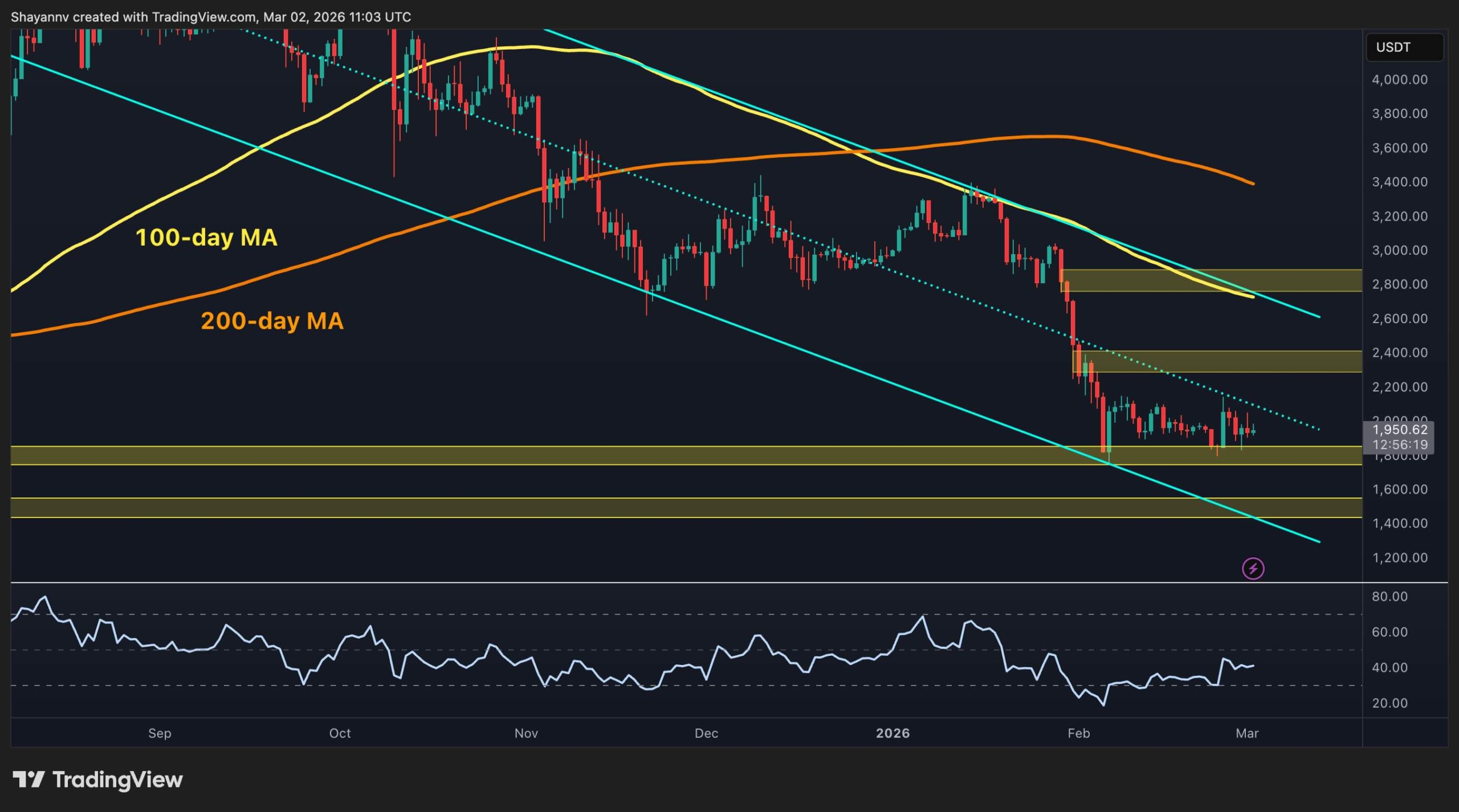
The $1,830 level is not arbitrary. Technical analysts often identify psychological and structural support zones based on historical trading patterns. A move toward that level could test investor confidence and trigger additional volatility.
If Ethereum were to approach $1,830, traders would closely monitor whether buyers step in to defend the level or whether selling accelerates further. Historically, sharp corrections have sometimes created entry opportunities for long-term investors, though timing such moves remains challenging.
The forecasted decline represents a notable deviation from recent highs, underscoring the degree of caution currently embedded in prediction market pricing.
Sentiment Versus Fundamentals
It is important to distinguish between short-term market sentiment and long-term network fundamentals.
Ethereum continues to dominate decentralized application activity, hosting a significant share of decentralized exchanges, lending protocols, and tokenized assets. Developer engagement remains robust, and layer-two scaling solutions have improved transaction efficiency.
Nevertheless, market prices often react more quickly to sentiment shifts than to underlying network metrics. When traders anticipate downside risk, volatility can intensify even if long-term adoption trends remain intact.
Whale Insider’s confirmation of the Kalshi forecast has amplified discussion across social platforms, though Hokanews notes that prediction markets should be viewed as one data point among many.
Macro Forces at Play
Cryptocurrency markets are increasingly intertwined with global financial conditions. Interest rate expectations, inflation data, and geopolitical developments can influence investor appetite for risk.
When yields on traditional assets rise, capital may rotate away from higher-volatility sectors, including digital assets. Conversely, signs of monetary easing or improved liquidity conditions can support renewed buying interest.
The February forecast emerges at a time when investors are weighing competing signals. While some anticipate stabilization, others remain wary of additional downside pressure.
Institutional Positioning
Institutional participation in Ethereum has grown steadily over recent years. Exchange-traded products, futures markets, and custody solutions have expanded access for professional investors.
However, institutional flows can fluctuate sharply in response to short-term risk assessments. If traders on regulated platforms such as Kalshi are pricing in a higher probability of decline, it may reflect broader caution among market participants.
At the same time, institutional investors often adopt longer time horizons than retail traders. Short-term prediction market positioning does not necessarily indicate long-term strategic withdrawal.
Historical Volatility Patterns
Ethereum has historically exhibited periods of sharp correction followed by recovery phases. During previous market cycles, double-digit percentage swings within weeks were not uncommon.
Such volatility is partly attributable to the asset’s dual identity as both a technology platform and a speculative instrument. News events affecting decentralized finance, non-fungible tokens, or regulatory frameworks can influence price direction rapidly.
The $1,830 forecast aligns with Ethereum’s historical pattern of testing key support levels during uncertain macro phases.
What Could Change the Outlook
Several developments could alter current market expectations:
Stronger-than-expected economic data that boosts risk appetite
Positive regulatory clarity in major markets
Institutional inflows into Ethereum-focused investment products
Upgrades or technical milestones within the Ethereum ecosystem
Conversely, negative macroeconomic surprises or renewed regulatory pressures could reinforce bearish positioning.
Market participants emphasize the importance of diversified analysis, combining on-chain metrics, derivatives positioning, liquidity data, and macro indicators rather than relying solely on prediction market probabilities.
Investor Considerations
For investors, prediction market forecasts can serve as sentiment gauges rather than trading signals. Elevated probability of downside may reflect hedging activity, short-term speculation, or broader caution.
Risk management remains critical in volatile markets. Price targets, whether bullish or bearish, are inherently uncertain. Strategic allocation decisions should account for individual risk tolerance and time horizon.
Hokanews notes that while the Kalshi forecast has attracted attention, Ethereum’s long-term trajectory will likely depend on broader adoption trends, technological development, and global financial conditions.
Conclusion
Traders on Kalshi are currently forecasting a potential decline in Ethereum’s price to around $1,830 in February, signaling cautious sentiment within prediction markets. The data, highlighted by Whale Insider and cited by Hokanews, underscores growing uncertainty in digital asset markets.
While the forecast reflects real-money positioning, it does not guarantee outcomes. Cryptocurrency markets remain highly dynamic, influenced by a complex interplay of macroeconomic forces, regulatory developments, and investor psychology.
As February unfolds, market participants will watch closely to see whether Ethereum stabilizes above key support levels or whether selling pressure intensifies in line with current prediction market expectations.
hokanews.com – Not Just Crypto News. It’s Crypto Culture.
Writer @Ethan
Ethan Collins is a passionate crypto journalist and blockchain enthusiast, always on the hunt for the latest trends shaking up the digital finance world. With a knack for turning complex blockchain developments into engaging, easy-to-understand stories, he keeps readers ahead of the curve in the fast-paced crypto universe. Whether it’s Bitcoin, Ethereum, or emerging altcoins, Ethan dives deep into the markets to uncover insights, rumors, and opportunities that matter to crypto fans everywhere.
Disclaimer:
The articles on HOKANEWS are here to keep you updated on the latest buzz in crypto, tech, and beyond—but they’re not financial advice. We’re sharing info, trends, and insights, not telling you to buy, sell, or invest. Always do your own homework before making any money moves.
HOKANEWS isn’t responsible for any losses, gains, or chaos that might happen if you act on what you read here. Investment decisions should come from your own research—and, ideally, guidance from a qualified financial advisor. Remember: crypto and tech move fast, info changes in a blink, and while we aim for accuracy, we can’t promise it’s 100% complete or up-to-date.
You May Also Like

XRPL Sidechain Proposal Targets Options Trading and Leverage
Will ETH Drop Below $1.8K Amid Escalating Macro Uncertainty?
