TLDR Bitcoin recovered above $70,000 after falling near $60,000 earlier in February, rising nearly 5% in 24 hours following cooler US inflation data US ConsumerTLDR Bitcoin recovered above $70,000 after falling near $60,000 earlier in February, rising nearly 5% in 24 hours following cooler US inflation data US Consumer

Bitcoin (BTC) Price: Reclaims $70K After Soft Inflation Data Sparks Rally

2026/02/14 20:24
3 min read

TLDR

  • Bitcoin recovered above $70,000 after falling near $60,000 earlier in February, rising nearly 5% in 24 hours following cooler US inflation data
  • US Consumer Price Index rose 2.4% year-over-year in January, below the expected 2.5%, boosting hopes for earlier interest rate cuts
  • $8.7 billion in bitcoin losses were realized last week, the second-largest loss event after the 3AC collapse in 2022
  • The Crypto Fear & Greed Index remains in “extreme fear” territory despite the price recovery, reflecting continued market anxiety
  • Bitcoin treasury companies saw unrealized losses drop from $21 billion to $16.9 billion as prices recovered

Bitcoin has climbed back above $70,000 after dropping near $60,000 earlier this month. The recovery marks a nearly 5% gain in the past 24 hours.
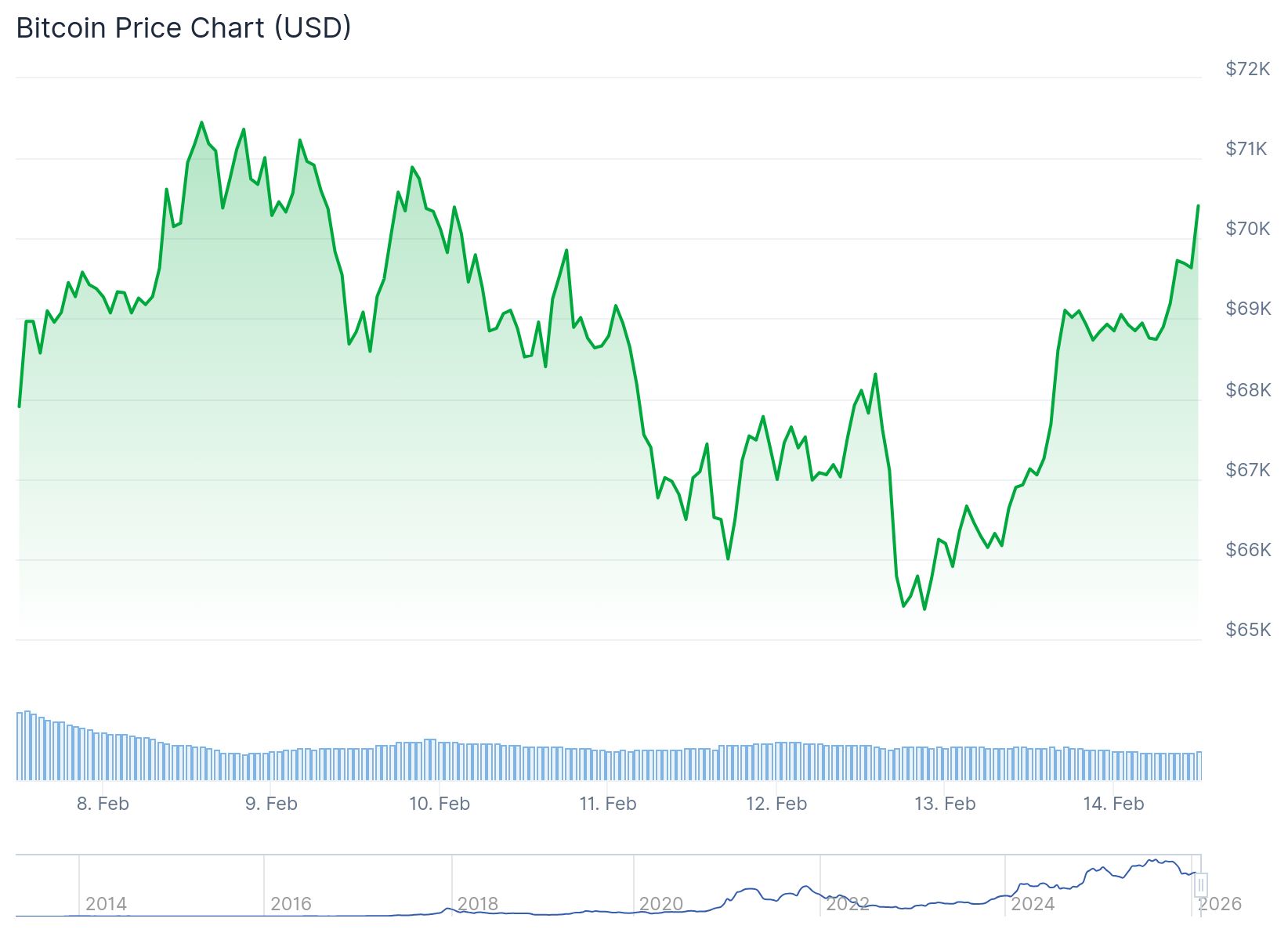
Bitcoin (BTC) PriceBitcoin (BTC) Price

The price movement followed January’s inflation report. The US Consumer Price Index rose 2.4% year-over-year. Economists had predicted 2.5%.

Lower inflation numbers raised hopes for interest rate cuts. Lower rates make cryptocurrencies and stocks more attractive to investors.

Traders on prediction market Kalshi now see a 26% chance of a rate cut in April. That’s up from 19% earlier this week. Polymarket odds jumped from 13% to 20%.

The broader CoinDesk 20 index rose 6.2% in the same period. This shows the recovery spread across multiple cryptocurrencies.

Market Fear Remains High

The Crypto Fear & Greed Index still shows “extreme fear” levels. These levels haven’t been this low since the FTX collapse in 2022.
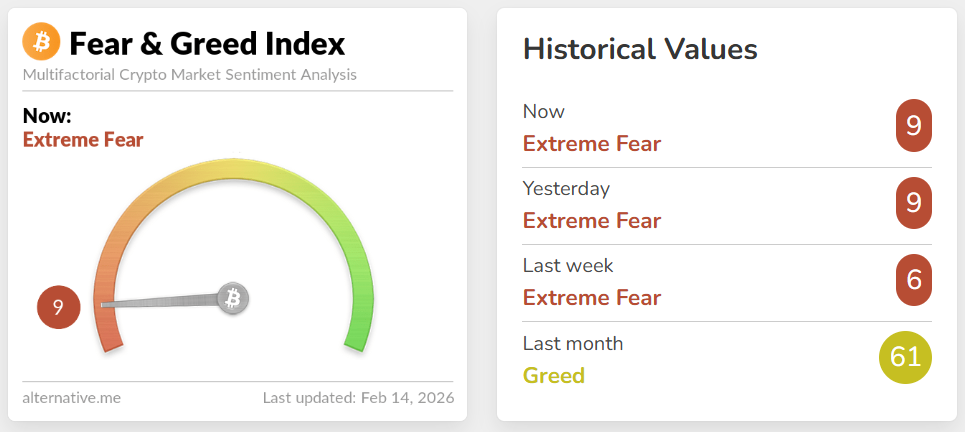
Source: Alternative.me

The index has stayed in extreme fear territory since early February. This shows investors remain nervous despite the price bounce.

Bitwise analysts reported $8.7 billion in bitcoin losses were realized last week. This ranks as the second-largest loss event ever recorded. Only the Three Arrows Capital collapse caused more losses.

Bitcoin treasury firms had over $21 billion in unrealized losses at one point. The recent recovery cut that number to $16.9 billion.

Supply Shifting Hands

The massive loss-taking could signal a capitulation event. This happens when weak investors sell to stronger holders.

Bitwise research noted that supply rotation from weaker to stronger hands often precedes market stabilization. However, this process takes time to complete.

Thinner weekend trading volumes helped support the current rally. Seller exhaustion also played a role in the recovery.

Danny Nelson from Bitwise told reporters that fear drives the market right now. Investors fear prices could drop lower.

This fear causes some to sell during rallies. They view price increases as exit opportunities rather than recovery signals.

The cryptocurrency has dropped 46% from its peak price. Bitcoin hit an all-time high of over $126,000 before the recent decline.

Bitcoin maintains a fixed supply of 21 million units. This scarcity differs from traditional currencies that governments can print without limit.

The blockchain celebrated its 17th birthday in January 2009. The network has never been hacked during its entire existence.

Prediction markets show rising expectations for Federal Reserve action. A 25 basis point cut in April seems increasingly possible to traders.

The post Bitcoin (BTC) Price: Reclaims $70K After Soft Inflation Data Sparks Rally appeared first on CoinCentral.


Market Opportunity
Bitcoin Logo
Bitcoin Price(BTC)
$69,746.03
$69,746.03$69,746.03
-0.04%
USD
Bitcoin (BTC) Live Price Chart
Disclaimer: The articles reposted on this site are sourced from public platforms and are provided for informational purposes only. They do not necessarily reflect the views of MEXC. All rights remain with the original authors. If you believe any content infringes on third-party rights, please contact [email protected] for removal. MEXC makes no guarantees regarding the accuracy, completeness, or timeliness of the content and is not responsible for any actions taken based on the information provided. The content does not constitute financial, legal, or other professional advice, nor should it be considered a recommendation or endorsement by MEXC.

You May Also Like

X Üst Düzey Yetkilisi, Platformda Kripto Paralar İçin Müjdeyi Verdi! Ancak Bazı Altcoinler İçin Kötü Haber Olabilir

X Üst Düzey Yetkilisi, Platformda Kripto Paralar İçin Müjdeyi Verdi! Ancak Bazı Altcoinler İçin Kötü Haber Olabilir

X Ürün Lideri ve Solana ekosistem danışmanı Nikita Bier, sosyal medya platformu X’te kripto para kullanımının artmasını desteklediğini ancak spam ve tacizi teşvik
Share
Coinstats2026/02/14 23:11
China Blocks Nvidia’s RTX Pro 6000D as Local Chips Rise

China Blocks Nvidia’s RTX Pro 6000D as Local Chips Rise

The post China Blocks Nvidia’s RTX Pro 6000D as Local Chips Rise appeared on BitcoinEthereumNews.com. China Blocks Nvidia’s RTX Pro 6000D as Local Chips Rise China’s internet regulator has ordered the country’s biggest technology firms, including Alibaba and ByteDance, to stop purchasing Nvidia’s RTX Pro 6000D GPUs. According to the Financial Times, the move shuts down the last major channel for mass supplies of American chips to the Chinese market. Why Beijing Halted Nvidia Purchases Chinese companies had planned to buy tens of thousands of RTX Pro 6000D accelerators and had already begun testing them in servers. But regulators intervened, halting the purchases and signaling stricter controls than earlier measures placed on Nvidia’s H20 chip. Image: Nvidia An audit compared Huawei and Cambricon processors, along with chips developed by Alibaba and Baidu, against Nvidia’s export-approved products. Regulators concluded that Chinese chips had reached performance levels comparable to the restricted U.S. models. This assessment pushed authorities to advise firms to rely more heavily on domestic processors, further tightening Nvidia’s already limited position in China. China’s Drive Toward Tech Independence The decision highlights Beijing’s focus on import substitution — developing self-sufficient chip production to reduce reliance on U.S. supplies. “The signal is now clear: all attention is focused on building a domestic ecosystem,” said a representative of a leading Chinese tech company. Nvidia had unveiled the RTX Pro 6000D in July 2025 during CEO Jensen Huang’s visit to Beijing, in an attempt to keep a foothold in China after Washington restricted exports of its most advanced chips. But momentum is shifting. Industry sources told the Financial Times that Chinese manufacturers plan to triple AI chip production next year to meet growing demand. They believe “domestic supply will now be sufficient without Nvidia.” What It Means for the Future With Huawei, Cambricon, Alibaba, and Baidu stepping up, China is positioning itself for long-term technological independence. Nvidia, meanwhile, faces…
Share
BitcoinEthereumNews2025/09/18 01:37
Musk's Grok gains on Gemini, ChatGPT, defying deepfake regulatory backlash

Musk's Grok gains on Gemini, ChatGPT, defying deepfake regulatory backlash

Elon Musk’s artificial intelligence business xAI is under pressure from regulators on many continents after its chatbot Grok created AI-generated, inappropriate
Share
Cryptopolitan2026/02/14 23:14