Crypto Payments to Human Trafficking Networks Jump 85% in 2025
TLDR
- Cryptocurrency payments to suspected human trafficking operations increased 85% in 2025, reaching hundreds of millions of dollars in transactions
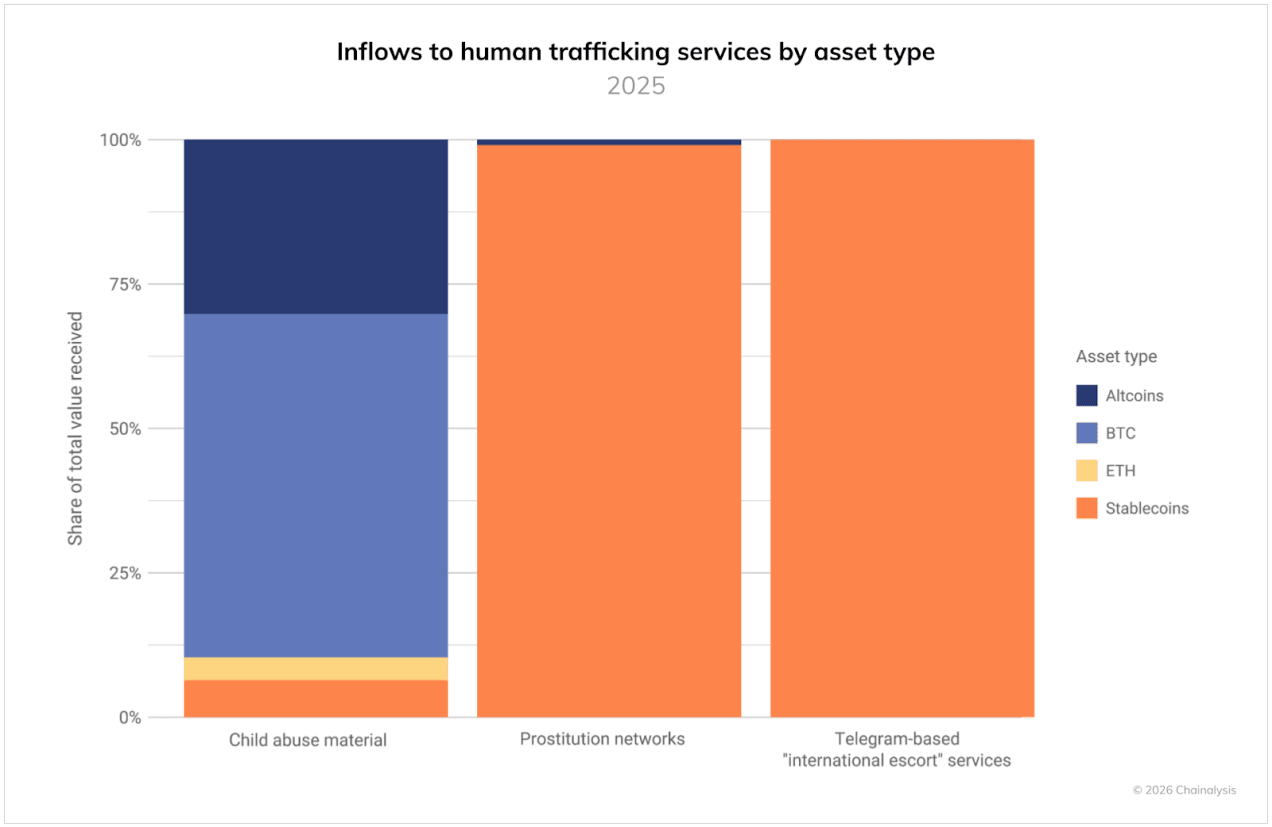
- Southeast Asia remains the primary hub for these activities, with operations spanning escort services, forced labor scams, and child abuse material
- Stablecoins have become the dominant payment method, with nearly half of escort service transactions exceeding $10,000
- Telegram serves as the main platform for recruiting victims, advertising services, and coordinating cryptocurrency payments
- Blockchain data shows customers sending payments from North America, South America, Europe, and Australia
Cryptocurrency transactions linked to suspected human trafficking syndicates jumped 85% in 2025, according to new data from blockchain analytics firm Chainalysis. The company identified hundreds of millions of dollars flowing through public blockchains to suspected criminal networks.
The U.S.-based firm traced most activity to Southeast Asia, where scam operations, illegal gambling platforms, and money laundering networks work together. Blockchain records show services concentrated in that region, but paying customers came from the Americas, Europe, and Australia.
Chainalysis broke down the crypto activity into three main categories. These include international escort and prostitution services, labor placement agents linked to scam compounds, and vendors selling child sexual abuse material.
 Source: Chainalysis
The company found criminals increasingly use Telegram to advertise services, recruit victims, and arrange payments. Tom McLouth, a Chainalysis intelligence analyst, said messaging apps allow these networks to scale faster and move money globally with less friction than older darknet forums.
Organized Networks Using Stablecoins for Quick Transactions
International escort services showed highly organized financial patterns in the blockchain data. Nearly half of all transactions exceeded $10,000, according to the report. Some operations advertised cross-border travel packages and multi-day services with VIP packages priced above $30,000.
These networks rely heavily on stablecoins and Chinese-language money laundering groups to convert crypto to cash quickly. The laundering networks operate through Chinese-language Telegram channels, processing an estimated $16.1 billion in illicit crypto flows in 2025.
Prostitution-related payments showed smaller transaction clusters, mostly between $1,000 and $10,000. The data patterns still suggested organized groups rather than independent operators.
Labor recruitment agents charged fees between $1,000 and $10,000 in cryptocurrency to place workers in scam compounds. Telegram posts advertised customer service or data entry jobs in Cambodia or Myanmar, promising high salaries and covered travel costs.
Victims were forced to conduct romance scams and fake cryptocurrency investment schemes targeting people abroad. Chainalysis found links between recruitment channels and wallets connected to illegal gambling platforms and money laundering services.
Scam Compounds Connected to Broader Criminal Networks
The scale of these operations came into focus when the U.S. Department of Justice seized $15 billion in bitcoin from a Cambodian scam center last year. The compound was running romance scams targeting victims worldwide.
Chainalysis analyzed Telegram conversations where recruiters discussed transporting workers across borders. They also coordinated forged documents and arranged payments to intermediaries.
McLouth noted enforcement efforts have increased since late 2025, especially around scam compounds. However, sexual exploitation and trafficking networks continue operating through alternative infrastructure.
Child sexual abuse material vendors operated under different payment structures. About half of related crypto transactions were below $100, reflecting subscription-based models in private chat groups or encrypted file-sharing channels.
These funds often moved from mainstream cryptocurrencies into privacy-focused assets like Monero. Payments also went to instant exchange services requiring no identity verification.
Chainalysis documented connections between CSAM subscription services and sadistic online extremism communities. These groups target minors through sextortion schemes, monetizing content through cryptocurrency payments.
In July 2025, Chainalysis helped identify one of the largest CSAM websites on the dark web. That single operation used over 5,800 cryptocurrency addresses and generated more than $530,000 in revenue since July 2022.
Chris Hughes of the Internet Watch Foundation reported 312,030 CSAM reports in 2025, the highest number recorded. Blockchain transactions connected to Southeast Asian and Chinese-language CSAM networks showed international reach, with activity detected in the U.S., UK, Spain, Australia, and Brazil.
The post Crypto Payments to Human Trafficking Networks Jump 85% in 2025 appeared first on CoinCentral.


You May Also Like

Turning Influence Into Impact: The CANDY KOL Program Where Creators Become Ecosystem Builders

Michael Saylor’s Strategy Transfers $30M in Bitcoin to Coinbase Prime

Macron pushes for trust to reopen Strait of Hormuz, impacting ceasefire odds