Ric Edelman says Bitcoin can reach $500,000 by the end of the decade and, unlike many headline-grabbing forecasts, he’s putting a simple allocation math behind Ric Edelman says Bitcoin can reach $500,000 by the end of the decade and, unlike many headline-grabbing forecasts, he’s putting a simple allocation math behind

Ric Edelman Says $500,000 Bitcoin Is ‘Simple Arithmetic’ By 2030

2026/02/16 18:30
3 min read

Ric Edelman says Bitcoin can reach $500,000 by the end of the decade and, unlike many headline-grabbing forecasts, he’s putting a simple allocation math behind it.

In a Feb. 15 interview with Altcoin Daily, the longtime financial adviser and founder of Edelman Financial (now managing roughly $330 billion, by his account) framed his target as the “conservative” case in a range of increasingly aggressive calls circulating in crypto. “I believe that Bitcoin can reach $500,000 by the end of the decade,” Edelman said. “And there are other predictions that are even more bold than mine… many are predicting a million. Others are predicting as much as two to 5 million in pricing.”

Why Edelman Calls $500,000 Bitcoin ‘Conservative’ By 2030

What he objects to, he said, is not optimism, it’s the lack of disclosed assumptions. “The problem I have with a lot of the predictions is that they are opaque. They haven’t explained why they believe what they’re saying,” Edelman said. “So I’ll be transparent and tell you how I get to 500,000 by 2030… this is not a straight line… it’s going to be very bumpy along the way.”

Edelman’s case rests on a broad-based shift in global portfolio construction, not a single catalyst. He argues Bitcoin still isn’t owned by the “average investor” worldwide but that adoption can expand through sovereign and institutional channels over time. He listed potential buyers across the capital stack: “government holdings, sovereign wealth funds and institutional holdings, endowments, pension funds, hedge funds, insurance companies, banks, brokerages, etc.”

From there, Edelman zooms out to the size of the global asset pool. He estimated the combined value of global stocks, bonds, real estate, gold, and cash at roughly $750 trillion. The key step is the portfolio slice: if diversified investors ultimately assign just 1% to Bitcoin, that implies about $7.5 trillion of inflows, which he says would translate into roughly $500,000 per coin when combined with Bitcoin’s existing value.

“It’s simple arithmetic,” Edelman said. “If you take the attitude… that everybody who owns a diversified portfolio ends up owning just 1% of their portfolio in Bitcoin — that’s inflows of $7.5 trillion… That plus the current value of Bitcoin translates to about $500,000 per coin. It’s really that simple.”

He added two reinforcing observations: that allocations are already happening, and that when they happen they may be larger than 1%. “We’re beginning to discover… more and more people are allocating,” he said. “And… they’re allocating closer to 5% of assets.”

While Edelman emphasized Bitcoin’s long-term adoption curve, he also argued the broader crypto stack matters, particularly Ethereum, which he tied to stablecoin growth. He called it “funny” that investors can be bearish on crypto prices while simultaneously bullish on stablecoins, given where much of that activity settles today.

“If you believe stablecoins are the winner, how can you not be a supporter of Ethereum? Because almost all the stablecoins are trading on Ethereum,” Edelman said. Pressed for a number, he suggested Ethereum could reach “between $4,000 and $10,000,” adding that a doubling would be “very easy to suggest” in his view.

At press time, BTC traded at $68,986.
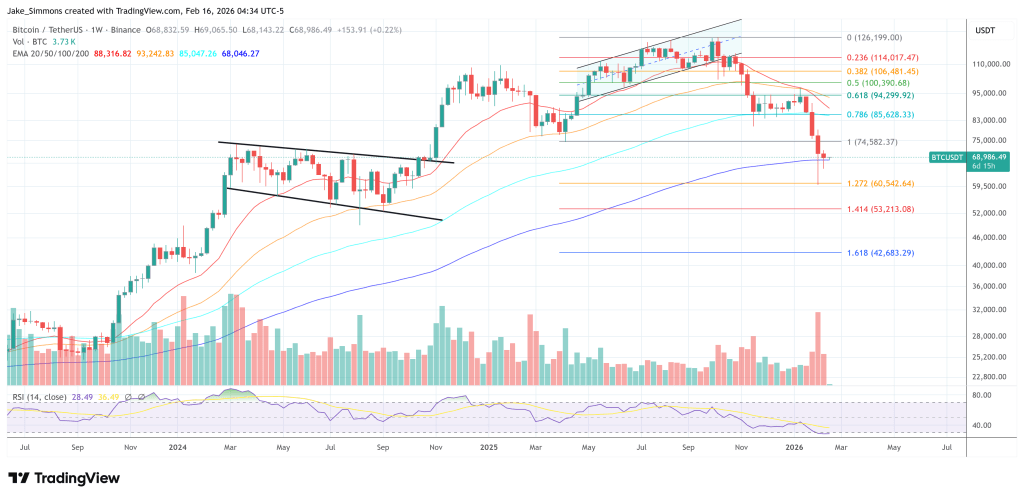
Bitcoin price chart
Market Opportunity
MATH Logo
MATH Price(MATH)
$0.02839
$0.02839$0.02839
-0.63%
USD
MATH (MATH) Live Price Chart
Disclaimer: The articles reposted on this site are sourced from public platforms and are provided for informational purposes only. They do not necessarily reflect the views of MEXC. All rights remain with the original authors. If you believe any content infringes on third-party rights, please contact [email protected] for removal. MEXC makes no guarantees regarding the accuracy, completeness, or timeliness of the content and is not responsible for any actions taken based on the information provided. The content does not constitute financial, legal, or other professional advice, nor should it be considered a recommendation or endorsement by MEXC.

You May Also Like

Rizz Network Lands $5M Capital Commitment from Nimbus Capital to Drive Next-Generation AI-DePIN Rizz Wireless Rollout

Rizz Network Lands $5M Capital Commitment from Nimbus Capital to Drive Next-Generation AI-DePIN Rizz Wireless Rollout

Rizz Network Inc. (“Rizz” or the “Company”), the issuer of RZTO, today announced that Nimbus Capital has entered into a strategic investment commitment in RZTO
Share
Cryptodaily2026/02/16 18:54
What is Play-to-Earn Gaming? Unlocking New Possibilities

What is Play-to-Earn Gaming? Unlocking New Possibilities

The post What is Play-to-Earn Gaming? Unlocking New Possibilities appeared on BitcoinEthereumNews.com. The Play-to-Earn (P2E) model is playing a key role in the advancement of the crypto industry. Users are able to earn crypto by playing games and get involved with global communities of gamers, creators, and developers. In this article, we’ll explore the functionalities of P2E gaming, its core features, potential risks, benefits, legal issues, and highlight some of the most impactful games shaping the Web3 gaming frontier.  What is Play-to-Earn Gaming? As its name implies, you gain rewards for playing the game. Players in Play-to-Earn games get involved with blockchain networks and can receive crypto assets or NFTs as prizes. The assets you acquire can be sold, traded or kept as an investment to see if their value rises. In Axie Infinity, players gathered and combated Axies, which are fantastical creatures. The game gave players SLP, a coin that works the same as money and could be traded for fiat currencies or other coins. Due to its success, it has grown into a more advanced and eco-friendly economy on current gaming platforms. How P2E Works? Most P2E gaming relies on Ethereum and Layer 2 networks, including Immutable, Ronin, and Base. Users are given both tokens and NFTs for accomplishing various game goals, such as: Completing missions or winning battles Trading or crafting in-game items Participating in tournaments or community events Staking assets or voting in DAOs The main difference between P2E games and traditional ones is that players can truly own what they earn in the game. Weapons, land, avatars, and resources on the Web3 game are tokenized, enabling you to trade or transfer them elsewhere. For example, users in Decentraland are able to purchase virtual land as NFTs, set up experiences and earn money from events or the services they provide. They are different from other items since they…
Share
BitcoinEthereumNews2025/09/19 21:33
Paris Saint-Germain Embraces BTC for Treasury Strategy

Paris Saint-Germain Embraces BTC for Treasury Strategy

Paris Saint-Germain confirms Bitcoin holdings in its treasury, adding BTC to the $4.6B club’s balance sheet. Paris Saint-Germain has confirmed that it holds Bitcoin
Share
LiveBitcoinNews2026/02/16 19:15