Digital Transformation in Financial Services Statistics 2026: Powerful Trends Now
Digital transformation in financial services has quickly shifted from an innovative concept to a crucial strategy for survival. In today’s rapidly evolving landscape, the financial services sector is embracing technologies like AI, blockchain, and cloud computing to remain competitive and meet changing customer expectations. The pace of transformation is remarkable, and the impact of these technologies will only continue to grow. Understanding the key trends is essential for navigating this digital revolution.
Editor’s Choice
- AI-driven financial services will reduce operational costs by 35%, powered by agentic AI automation.
- Blockchain technology will enable $397 billion in cross-border payments by improving transaction speed and security.
- 95% of financial institutions will adopt cloud computing, strengthening embedded finance capabilities.
- Financial institutions will increase cybersecurity spending to $240 billion globally to combat rising fraud risks.
- By 2026, 85% of financial institutions will offer DeFi products, accelerating the shift toward open financial systems.
- Data analytics in finance will improve fraud detection rates by 60%, leveraging advanced AI models.
- Open banking adoption will rise by 21%, driven by API integrations and growing transparency demands.
Recent Developments
- RegTech investments will grow by 16%, reaching $22.3 billion as compliance automation accelerates.
- 71% of banks will use digital identity verification solutions, prioritizing fraud prevention and real-time authentication.
- Embedded finance solutions will generate $2.6 trillion in B2B payments, driving major platform revenues.
- Green finance initiatives powered by digital tools will mobilize $1.3 trillion in external sustainability flows.
- 83% of financial institutions plan to increase cryptocurrency exposure, accelerating mainstream adoption.
- Quantum computing will unlock $400–600 billion in value for financial services through advances in risk modeling and encryption.
- AI-based decision systems will power over 50% of finance functions, enabling hyper-personalized innovation.
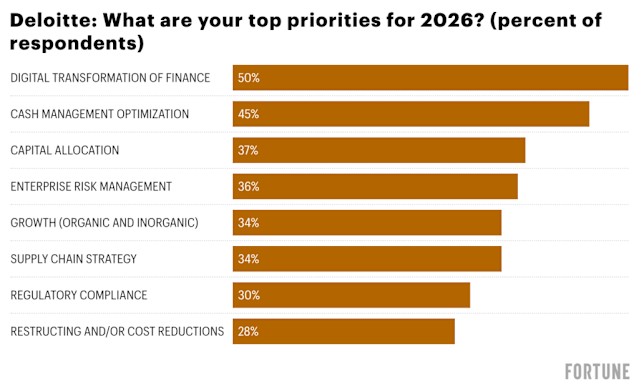
Top Corporate Priorities
- 50% of respondents rank digital transformation of finance as their top priority, highlighting the push toward automation, analytics, and modern financial systems.
- 45% prioritize cash management optimization, reflecting heightened focus on liquidity, working capital, and financial resilience.
- 37% emphasize capital allocation, signaling careful investment decisions amid uncertain economic conditions.
- 36% focus on enterprise risk management, underscoring concerns about volatility, cybersecurity, and operational risks.
- 34% target growth initiatives (organic and inorganic), including expansion, acquisitions, and new market entry.
- An equal 34% prioritize supply chain strategy, showing continued attention to resilience and efficiency improvements.
- 30% cite regulatory compliance as a key priority, indicating rising complexity in global regulations and reporting requirements.
- 28% highlight restructuring and cost reductions, pointing to ongoing efficiency drives and margin protection efforts.
 (Reference: Yahoo Finance)
Global Digital Transformation Spending by Region
- The USA leads in digital transformation spending with a market share of 35%, exceeding $1.2 trillion in investments.
- Western Europe holds the second position, accounting for 25% of global digital transformation expenditures.
- China contributes 18%, fueled by rapid digital infrastructure expansion and AI advancements.
- The Asia/Pacific region (excluding Japan and China) represents 12% of total spending, driven by emerging tech adoption.
- Japan maintains a share at 6%, focusing on mature AI and robotics initiatives.
- Other regions combined account for 4%, highlighting emerging market potential in Latin America and MEA.
The Rise of AI in Finance
- AI-driven chatbots will handle 80% of customer service interactions in financial institutions, significantly boosting efficiency.
- AI automation will save banks 20% in costs by streamlining back-office tasks and operations.
- AI-powered predictive analytics will increase loan approval accuracy to 94%, improving credit assessments.
- AI-driven fraud detection systems will reduce fraud-related losses by 60–90%, strengthening financial security.
- 90% of financial institutions will use AI to assess credit risk, optimizing approval processes.
- AI-powered algorithmic trading systems will grow into a $2.72 billion market, dominating high-frequency trading activity.
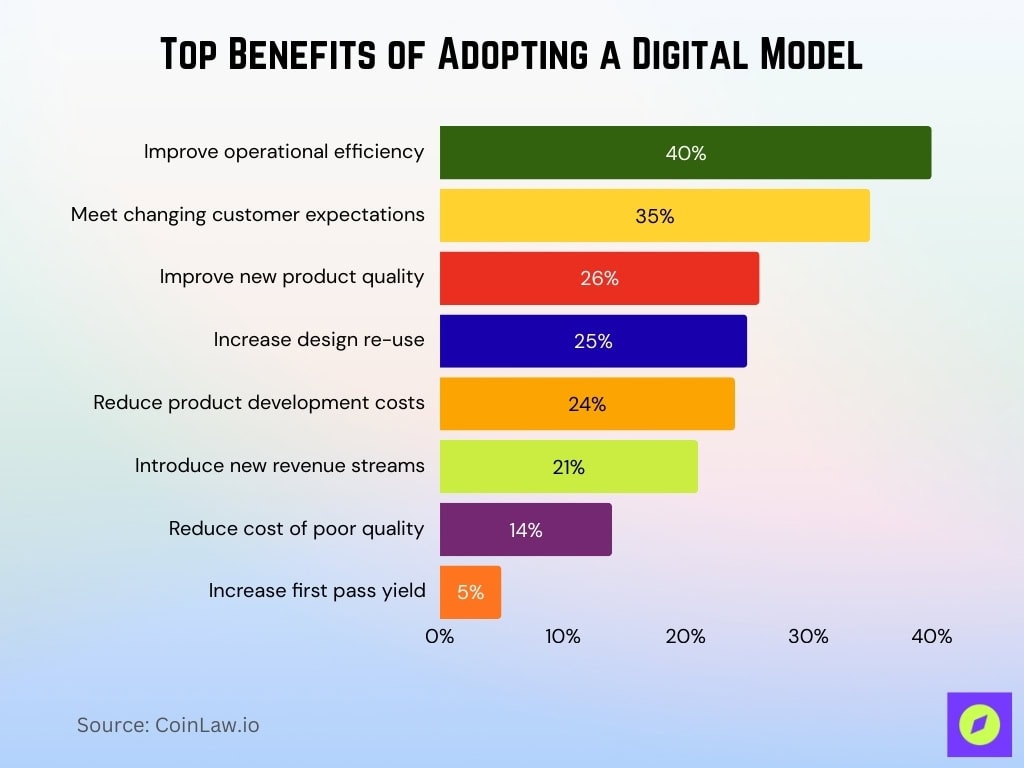
Top Benefits of Adopting a Digital Model
- 40% of respondents say digital adoption helps improve operational efficiency, making it the most significant benefit reported.
- 35% highlight the ability to meet changing customer expectations, emphasizing the importance of agility and personalization.
- 26% report improved new product quality, showing digital tools enhance design accuracy and performance.
- 25% note increased design re-use, which can accelerate development cycles and reduce redundancy.
- 24% say digital models help reduce product development costs, supporting leaner innovation processes.
- 21% indicate digital transformation enables new revenue streams, such as digital services and subscription models.
- 14% report a reduction in the cost of poor quality, reflecting fewer defects and rework.
- Only 5% cite improvements in first pass yield, suggesting this benefit is less immediate compared to others.
 (Reference: Market.us Scoop)
Standardizing the Use of the Cloud to Optimize Embedded Finance
- 85% of financial institutions globally are embracing multi-cloud and hybrid infrastructures to scale operations.
- 60% of all embedded finance offerings will be hosted on cloud platforms, enabling seamless integrations.
- Financial institutions adopting cloud technologies expect to reduce infrastructure costs by 20-30% through optimization.
- The global embedded finance market is projected to reach $155.96 billion, powered by cloud scalability.
- 85% of FinTech companies cite scalability and speed as primary reasons for migrating to the cloud.
- Cloud-based solutions are expected to drive a 25% increase in financial service innovations via AI integration.
- 78% of financial firms are developing cloud-first strategies to ensure regulatory compliance and security.
Digital Transformation Trends in Banking
- AI-driven solutions in banking will boost productivity by 27–35%, transforming front-office operations.
- Banks will adopt biometric authentication at a 90% rate to secure transactions amid rising fraud threats.
- Blockchain technology will generate $27 billion in cost savings for banks through smart contracts and faster settlements.
- Demand for real-time payment systems will grow by more than 50%, enabling instant consumer transactions.
- FinTech partnerships with traditional banks will capture 26% of SMB banking market revenues.
- Digital-only banks will secure 15–20% market share, driven by demand for digital convenience.
Impact of Clear Goals on Change Transformation Success
- Organizations with clear goals during change transformation achieve a success rate of 88%.
- In contrast, those without clear goals only reach a 13% success rate.
- Having clear goals makes success 6.8x more likely, transforming outcomes dramatically.
- Companies tracking KPIs with clear goals achieve 51% success versus 13% without monitoring.
- Clear targets double the likelihood of digital transformation success to 58% overall.
Challenges of the Shift from Traditional to Digital Banking
- 70% of banks are struggling to modernize outdated legacy systems, hindering digital transformation.
- 90% of financial institutions expect fraud and cyber attacks to worsen, posing systemic risks.
- 50% of consumers cite data privacy as their top concern in digital banking, eroding trust.
- Compliance costs related to digital transformation are expected to reach $59 billion amid new regulations.
- The tech talent gap affects 50-60% of financial institutions, slowing digital initiatives.
- 40% of traditional banks face operational disruptions during digital platform transitions.
- Digital fraud is projected to surge, with 90% of bankers anticipating heightened, sophisticated attacks.
C-Suite Leadership in Driving Digital Transformation
- 43% of executives plan to invest in AI and technology as their top priority for growth.
- 45% of global financial services CEOs prioritize AI-driven investments for revenue gains.
- 54% of technology executives rank AI and tech as primary investment over innovation.
- 59% of COOs/CSOs view AI as a top investment priority, aligning operations with digital goals.
- 95% of enterprise leaders plan sovereign AI platforms, demanding C-suite commitment.
- 41% of executives prioritize AI ROI measurement, led by 33% of CEOs.
Cybersecurity and Fraud Prevention in a Digital-First Financial Landscape
- Financial institutions will raise cybersecurity spending to $240 billion globally as digital threats escalate.
- 90% of financial institutions will adopt multi-factor authentication (MFA) for high-risk transactions.
- AI-powered fraud detection systems will reduce fraud losses by 60–90% and eliminate manual reviews in 80% of cases.
- 85% of financial institutions will use biometric security, making it standard for digital onboarding.
- Blockchain-based security systems will protect $110.2 billion worth of digital assets from cyberattacks.
- Banks will increase data encryption investments at a 15.13% CAGR, reaching $8.15 billion in banking software.
- AI-driven real-time monitoring and automation will improve incident response times by 75–99%.
Frequently Asked Questions (FAQs)
45% of global financial services CEOs view AI and digital investments as the top driver for resilience.
36% of financial services firms plan AI use cases to boost revenue via new models and services.
88% of banks plan to increase digital investments by 2025, extending into 2026 trends.
84% of banking customers would switch for timely, relevant financial advice via digital tools.
Conclusion
The digital transformation of financial services is no longer a choice but a necessity. Indeed, the technologies driving this shift, AI, blockchain, cloud computing, and more, are fundamentally reshaping the industry. As a result, financial institutions that prioritize digital innovation, robust security, and customer-centric services will continue to thrive. Conversely, those who fail to adapt may struggle to compete in this rapidly evolving landscape. Ultimately, with the pace of change accelerating, the future of finance appears both challenging and exciting, thereby presenting continuous opportunities for growth and innovation.
The post Digital Transformation in Financial Services Statistics 2026: Powerful Trends Now appeared first on CoinLaw.
You May Also Like

UK selects HSBC’s blockchain platform for digital bond pilot
![Will dogwifhat [WIF] break $1.29 or stay stuck in consolidation?](https://ambcrypto.com/wp-content/uploads/2025/09/Erastus-2025-09-17T121713.938-min.png)
Will dogwifhat [WIF] break $1.29 or stay stuck in consolidation?