Diversity In The Finance Industry Statistics 2026: Powerful Trends Uncovered
The finance industry is under the spotlight, not just for its economic contributions but for the pressing need to improve diversity and inclusion. For years, finance has been dominated by a largely homogenous workforce, particularly at the executive level. However, as businesses and stakeholders demand change, the financial sector is slowly starting to embrace a more diverse talent pool.
From gender diversity to representation across racial, ethnic, and age groups, efforts are being made to create a more inclusive financial ecosystem. This article explores the key statistics behind these developments, illustrating both progress and challenges.
Editor’s Choice
- Women comprise 47% of the global finance workforce but hold only 23% of executive roles, indicating persistent leadership gaps.
- Black employees account for about 12% of the overall U.S. private‑sector workforce, yet remain significantly underrepresented in senior finance roles, where they typically hold only 4–5% of upper‑management positions.
- Latinx individuals account for about 19% of the overall U.S. labor force, underscoring their growing importance for financial services talent pipelines.
- Only 0.9% of Fortune 500 board seats are held by openly LGBTQ+ individuals, underscoring the need for greater inclusivity in leadership.
- Regulators in major markets now expect diversity policies to cover age, ethnicity, disability, and sexual orientation, pushing more than 70% of large financial institutions to expand D&I criteria.
- Over 50% of listed firms in some markets have adopted LGBTQ+-inclusive board policies, signaling rapid progress in board-level diversity standards.
Recent Developments
- 42% of European financial services boardrooms are female, exceeding upcoming EU quotas.
- New board appointments in European financial services reached 50% female in recent years.
- 83% of employers maintain DEI initiatives, rising from 67% in 2023.
- AI-driven recruitment in organizations yields 35% more diverse candidate pools.
- Gender pay gap in banking, insurance, and finance stands at around 20–22%.
- US financial institutions scale back public DEI commitments amid political scrutiny.
- Goldman Sachs drops explicit race/gender criteria for board candidates.
Financial Services Market Growth Forecast
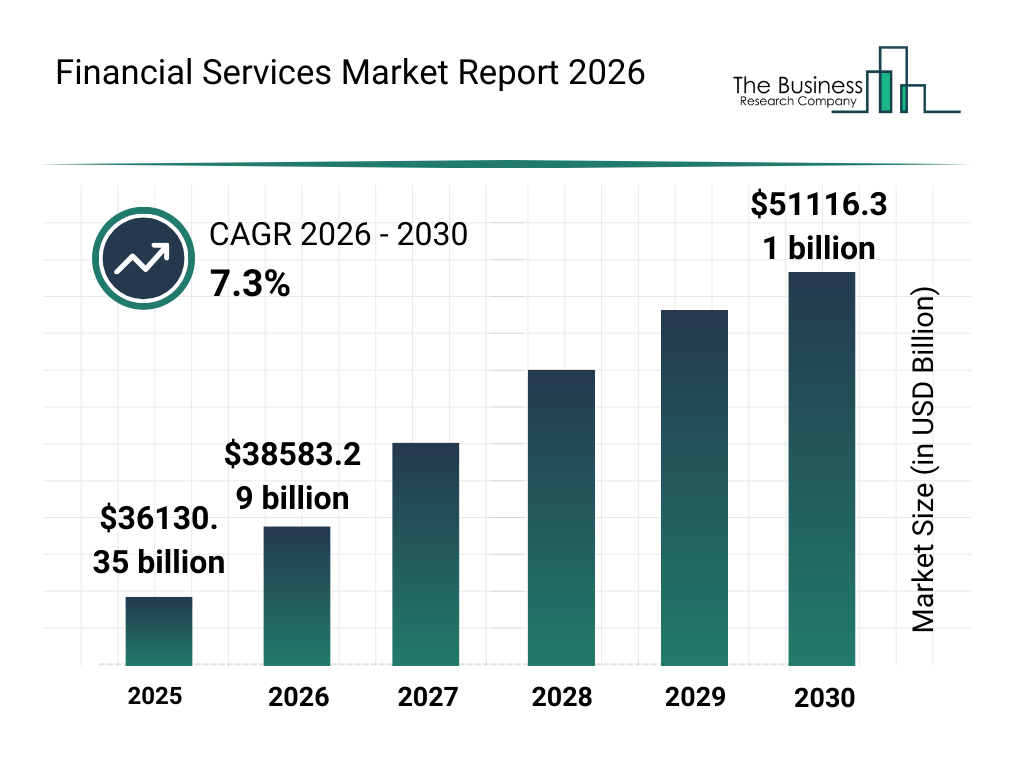
- The global financial services market will grow from $36,130.35 billion in 2025 to $51,116.31 billion by 2030, signaling strong long-term expansion.
- The market will reach approximately $38,583.29 billion in 2026, reflecting steady year-over-year growth.
- By 2027, the industry will surpass $41,399.87 billion, crossing the $41 trillion threshold.
- The market will climb to around $44,420.06 billion in 2028, maintaining consistent upward momentum.
- In 2029, financial services revenues will approach $47,662.73 billion, nearing the $48 trillion mark.
- By 2030, the sector will exceed $51.1 trillion, highlighting its massive global economic footprint.
- The industry will expand at a 7.3% CAGR between 2026 and 2030, demonstrating sustained growth across banking, insurance, and capital markets.
 (Reference: The Business Research Company)
Support for Diversity Driving Innovation
- 85% of financial firms acknowledge diversity as a key driver of innovation.
- 62% of financial professionals believe inclusivity improves team productivity.
- Diverse teams are 17% more likely to be high-performing.
- Inclusive teams are 1.7 times more likely to be innovation leaders.
- 89% view generational diversity positively in the workplace.
- Companies with high ethnic diversity are 36% more profitable.
- Diverse investment teams generate 2% higher annual returns.
- 98% of financial leaders are committed to a diverse, inclusive culture.
Gender Diversity in Finance
- Women hold 18% of global C-suite positions in financial services.
- Women comprise 52% of the US financial services workforce, but 31% senior leadership.
- 28% of deputy governors and C-suite roles in central banks are held by women.
- 19% of C-suite positions in commercial banks are held by women.
- Gender pay gap in UK finance and insurance reaches 27.2%.
- Women earn 82–84 cents per dollar compared to men in the US finance sector.
- 18.6% of UK financial services senior executives are women.
Ideal Job Qualities Workers Value Most
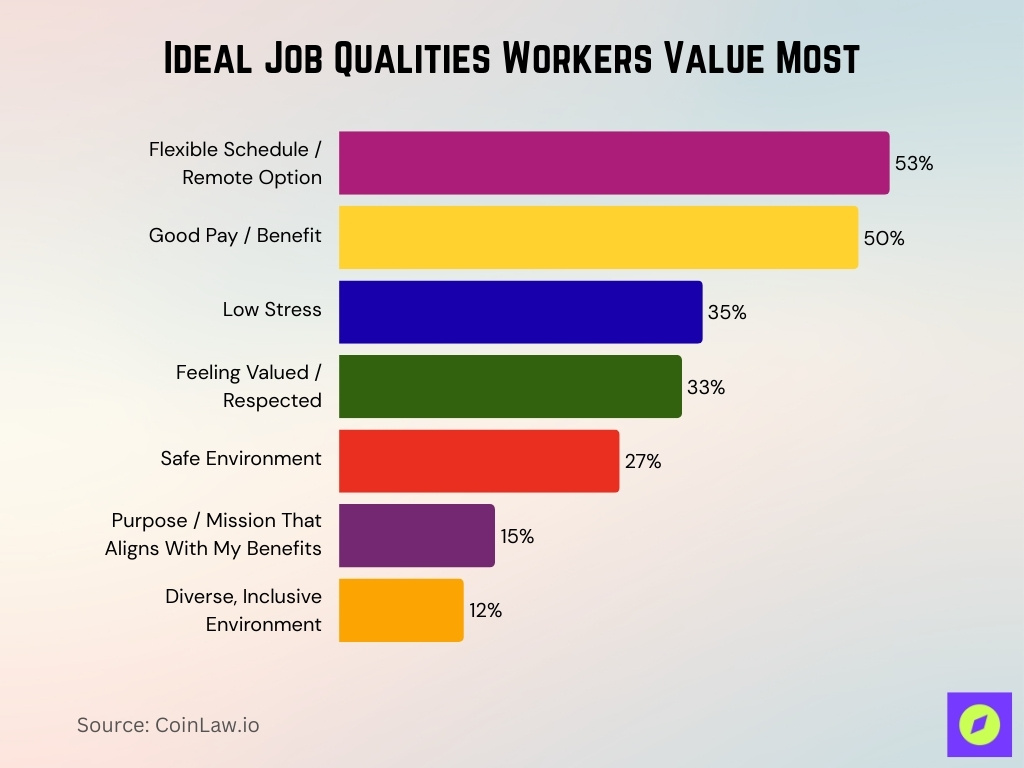
- A flexible schedule or remote work option is the top priority, chosen by 53% of workers, highlighting the continued demand for work-life balance.
- Good pay and benefits rank a close second, valued by 50% of employees, underscoring the importance of financial security.
- About 35% of workers prioritize a low-stress job, reflecting growing concerns about burnout and mental health.
- Feeling valued and respected at work matters to 33% of respondents, emphasizing the role of workplace culture.
- A safe working environment is important for 27% of employees, particularly in physically demanding or high-risk roles.
- Only 15% of workers consider a job’s purpose or mission alignment a top factor, suggesting practical needs outweigh ideological ones for many.
- A diverse and inclusive workplace is prioritized by 12% of respondents, indicating it is valued but less decisive than compensation or flexibility.
 (Reference: doit.software)
Racial and Ethnic Diversity Trends in Financial Services
- Black professionals represent 8% of the US financial services workforce.
- Latinx employees comprise ~10% of US finance entry-level roles.
- Asian professionals hold 6.5% of UK financial services senior leadership.
- People of color hold 15% of investment services sector boards.
- Ethnic minority employees are 11.2% of the FCDO Services workforce Q3.
- 20% of Ethnic Minority-led UK businesses are discouraged from accessing finance.
- Racially diverse teams 35% more likely to financially outperform peers.
Impact of Pronouns on a Resume According to Hiring Managers
- 38% of hiring managers are more likely to interview with she/her pronouns.
- 33% more likely to interview candidates listing they/them pronouns.
- 59% say pronouns on a resume have no impact on hiring decisions.
- 25% more likely to hire candidates listing pronouns.
- 15% less likely to hire candidates with listed pronouns.
- 14% less likely for she/her or he/him pronouns on a resume.
- 16% less likely for they/them pronouns on a resume.
- 66% of hiring managers view pronoun sharing positively at work.
- Resumes with pronouns receive 8% less employer interest.
U.S. Personal Finance: Household Income Distribution Overview
- Median U.S. household income stands at $77,700.
- Households at the 90th percentile earn $251,036.
- Households at the 95th percentile earn $335,575.
- The 50th percentile (median) household earns $77,719.
- Households at the 10th percentile earn around $35,000.
- The 80th percentile household earns $170,800.
- Households at the 99th percentile earn $659,060.
- The top 1% income threshold starts at $659,060.
- Median family household income reaches $96,401.
Benefits of Age Diversity in Asset Management
- 34% of investment management employees are under 35 years old.
- 44% of the asset management workforce are women.
- Gender-diverse investment teams outperform by 45 basis points annually.
- 61% of financial advisors are over 40 years old.
- 38% of advisors set to retire within the decade, managing 42% assets.
- Age-diverse companies outperform by up to 20% in profitability.
- 68% CFP exam takers are under 40, 37% under 30.
- 47% financial services workforce is aged 22-35 years.
- Boards with the greatest age variance yield the strongest stock returns.
Organizations Promoting Diversity in Finance
- 25,000+ members in 100 Women in Finance globally.
- 92,000+ professional and student members in ALPFA.
- 150+ companies support NASP through sponsorship and membership.
- 200+ firms signed the CFA Institute DEI Code.
- 16 initial signatories to the CFA DEI Code managing $4 trillion in assets.
- 160 professional chapters and 45 student chapters in ALPFA.
- 25,000+ women members in 100 Women in Finance.
- NASP NorCal advances diversity for financial services professionals.
- NASP Detroit was established in 1990 for inclusion in securities.
Challenges in Recruiting and Retaining Diverse Talent
- 33% of executives report diverse talent leaving due to a lack of inclusion.
- 85% of financial services companies implement diverse recruitment initiatives.
- 50% of financial institutions struggle to find skilled, diverse candidates.
- 60% of firms see competition as the biggest diverse talent hiring obstacle.
- 40% of CEOs expect harder recruiting for talented, diverse people ahead.
- 65% of executives have programs to recruit diverse employees.
The Benefits of Diversity to Business
- Diverse companies 70% more likely to capture new markets.
- Top quartile ethnic diversity firms 39% more profitable.
- Top quartile gender diversity firms 27% more likely to outperform.
- 10% ethnic diversity raises EBIT 0.8%.
- Gender-diverse boards yield 2-5% higher annual returns.
- Diverse executive teams 9% more likely to outperform peers.
- Diverse firms 35% more likely to financially outperform.
- Top diversity quartile firms 36% more likely to outperform in profitability.
Diversity and Financial Performance
- Top quartile ethnic diversity firms 27% more likely to outperform financially.
- Top quartile gender diversity firms 39% increased likelihood of outperformance.
- Top quartile ethnic diversity 39% more likely to outperform peers.
- Top quartile gender diversity executive teams 21% more likely to have above-average profitability.
- Ethnic diversity in the top quartile 33% likelihood of outperformance on EBIT margin.
- The top quartile board-gender diversity 27% more likely to outperform.
- The top quartile of ethnic diversity 36% more profitable.
- Diverse executive teams 9% more likely to outperform peers.
- Bottom quartile, both genders/ethnic 66% less likely to outperform.
Investor and Government Actions
- 33.70% average female representation on the US 30% Club member boards.
- 24.7% female directors on S&P 100 boards.
- 100% of S&P 100 boards have at least one female director.
- BlackRock removes 30% diversity aspiration from voting guidelines.
- State Street shifts from specific board diversity targets.
- 68% ESG investors plan to vote against non-diverse boards.
- Vanguard emphasizes cognitive diversity over specific metrics.
- ISS retains minority director expectations for Russell 1000.
- Major investors drop explicit quantitative board diversity thresholds.
Frequently Asked Questions (FAQs)
Women comprise 46% of the global finance workforce.
Companies with high ethnic diversity are 36% more profitable.
60% of financial employees feel their organization progresses on DEI.
Women earn 20% less than men on average in finance.
Conclusion
As the finance industry evolves, diversity and inclusion are no longer optional; they are business imperatives. These statistics show progress, but they also reveal the challenges that remain in creating a truly inclusive environment. Firms that embrace diversity will not only enhance their financial performance but also foster innovation, build stronger teams, and create a more equitable industry for all. The data suggests that while efforts are being made, the journey toward full inclusion in finance is far from over, but the future looks promising.
The post Diversity In The Finance Industry Statistics 2026: Powerful Trends Uncovered appeared first on CoinLaw.
You May Also Like

CME Group to launch options on XRP and SOL futures

United Kingdom PPI Core Output (YoY) n.s.a fell from previous 3.2% to 2.9% in January