

Bio Protocol launches Aubrai, the first-ever decentralized AI agent for longevity science

Bio Protocol has kicked off the Ignition Sale for Aubrai, the world’s first decentralized BioAgent designed to accelerate longevity research.
- Co-developed with VitaDAO and informed by Dr. Aubrey de Grey’s longevity research, Aubrai leverages decentralized mechanisms to overcome traditional funding gaps and accelerate translational science.
- Aubrai can generate and validate research hypotheses, design wet-lab experiments, and securely encrypt data.
- Participants can subscribe to the Ignition Sale for AUBRAI by pledging BioXP and committing BIO tokens. All pledges and commitments must be completed before August 26, 11:00 UTC to qualify.
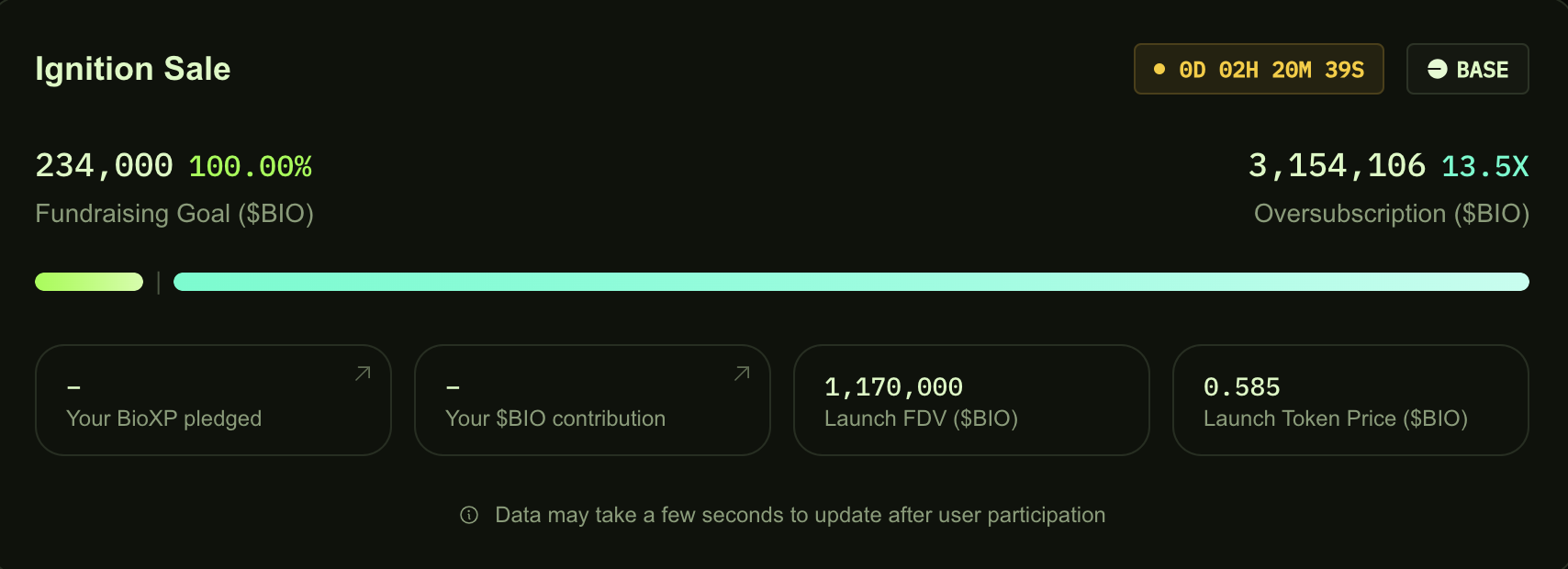
Bio Protocol (BIO) has launched the Ignition Sale for Aubrai, the world’s first decentralized AI agent designed to advance longevity research. Community members can participate by pledging BioXP (community points within the Bio Protocol ecosystem) or committing BIO tokens to the Ignition Sale, with a maximum contribution of 5,850 BIO per participant.
The launch price is set at 0.585 BIO per AUBRAI, and all pledges and commitments must be completed by August 26 11:00 UTC to qualify for an allocation.
The ongoing sale, conducted on the BASE blockchain, set a fundraising target of 234,000 BIO and has already been oversubscribed 13.5x.
About Bioprotocol’s Aubrai
Co-developed by Bio Protocol and VitaDAO, Aubrai is the world’s first decentralized BioAgent, drawing knowledge from thousands of private lab notes, internal chats, and unpublished insights from the lab of Dr. Aubrey de Grey. De Grey is best known for pioneering longevity research through his Strategies for Engineered Negligible Senescence (SENS) framework and advocating the idea that aging is a disease that can be treated.
“The consequences of traditional financing are a chronic funding gap, over-reliance on philanthropy, and a ‘valley of death’ between discovery and the clinic. That’s why we champion alternative mechanisms – DAOs, longevity-focused venture funds, and DeSci platforms – which can tolerate long horizons, align incentives around societal benefit, and crowd-source risk,” de Grey told CoinDesk in an interview.
Aubrai functions as an on-chain AI co-scientist. It can generate and validate hypotheses, design wet-lab experiments, and encrypt data to protect trade secrets while enriching research outputs. At the heart of Aubrai’s mission is the Robust Mouse Rejuvenation (RMR2) project — de Grey’s ambitious study aiming to double the remaining lifespan of middle-aged mice. Aubrai has already demonstrated its capabilities in the RMR2 study, suggesting methodological tweaks and flagging dosing caveats.
AUBRAI token holders gain governance rights over the agent’s research outputs. They also share in potential revenues from discoveries commercialized by the project.
You May Also Like

eBay slashes 800 jobs despite strong revenue and $1.2 billion Depop acquisition

Here’s What XRP Requires to Reach $100, According to a Financial Strategist
