SymTax is a novel AI for citation recommendation. It mimics human behavior by using a "symbiotic" model and hyperbolic geometry to improve accuracy.SymTax is a novel AI for citation recommendation. It mimics human behavior by using a "symbiotic" model and hyperbolic geometry to improve accuracy.

How Symbiotic AI Can Find Your Paper's Next Great Citation

:::info Authors:

(1) Karan Goyal, IIIT Delhi, India ([email protected]);

(2) Mayank Goel, NSUT Delhi, India ([email protected]);

(3) Vikram Goyal, IIIT Delhi, India ([email protected]);

(4) Mukesh Mohania, IIIT Delhi, India ([email protected]).

:::

Abstract and 1. Introduction

  1. Related Work

  2. Proposed Dataset

  3. SymTax Model

    4.1 Prefetcher

    4.2 Enricher

    4.3 Reranker

  4. Experiments and Results

  5. Analysis

    6.1 Ablation Study

    6.2 Quantitative Analysis and 6.3 Qualitative Analysis

  6. Conclusion

  7. Limitations

  8. Ethics Statement and References

Appendix

Abstract

Citing pertinent literature is pivotal to writing and reviewing a scientific document. Existing techniques mainly focus on the local context or the global context for recommending citations but fail to consider the actual human citation behaviour. We propose SymTax[1], a three-stage recommendation architecture that considers both the local and the global context, and additionally the taxonomical representations of query-candidate tuples and the Symbiosis prevailing amongst them. SymTax learns to embed the infused taxonomies in the hyperbolic space and uses hyperbolic separation as a latent feature to compute query-candidate similarity. We build a novel and large dataset ArSyTa, containing 8.27 million citation contexts and describe the creation process in detail. We conduct extensive experiments and ablation studies to demonstrate the effectiveness and design choice of each module in our framework. Also, combinatorial analysis from our experiments shed light on the choice of language models (LMs) and fusion embedding, and the inclusion of section headings as a signal. Our proposed module that captures the symbiotic relationship solely leads to performance gains of 26.66% and 39.25% in Recall@5 w.r.t. SOTA on ACL-200 and RefSeer datasets, respectively. The complete framework yields a gain of 22.56% in Recall@5 wrt SOTA on our proposed dataset. The code and dataset are available at https://github.com/goyalkaraniit/SymTax.

\

1 Introduction

Citing has always been the backbone of scientific research. It enables trust and supports the claims made in the scientific document. The ever-growing increase in the amount of scientific literature makes it imperative to ease out the author’s task of finding a list of suitable papers to follow and cite (Johnson et al., 2018; Bornmann et al., 2021; Nane et al., 2023). Citation recommendation is such a process that helps researchers to be aware of the relevant research in respective domains. There are two different approaches to recommend citations: local (Dai et al., 2019; Ebesu and Fang, 2017; Huang et al., 2012; He et al., 2010), and global (Xie et al., 2021; Ali et al., 2021; Bhagavatula et al., 2018; Guo et al., 2017). Local citation recommendation is the task of finding and recommending the most relevant prior work, mainly corresponding to a specific text passage (also known as citation context), making it context-aware. On the other hand, global citation recommendation recommends a list of suitable prior art for the entire document, mainly given the title and abstract or the whole document. In this paper, we solve the task of local citation recommendation, which is more fine-grained and provides a solution to the actual challenge the author faces.

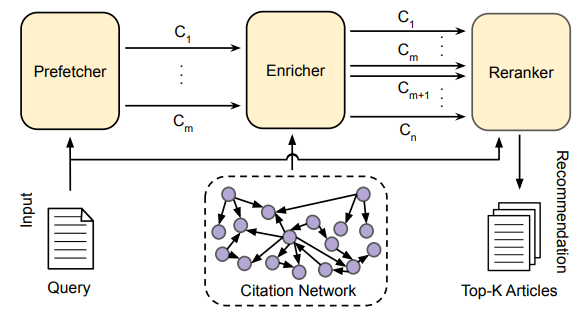
\ Figure 1: Proposed method consists of three essential modules. Prefetcher and Reranker takes query consisting of citation context, title, abstract and taxonomy of the citing paper as input. For each candidate paper (Ci), Enricher uses knowledge from citation network and Reranker generates the final top-K recommendations.
\ For example, consider the below citation excerpt:[2]

\ This can have extreme consequences in real-life scenarios such as autonomous cars CitX.

\ Examining the above context in isolation makes it challenging to predict the specific article cited at CitX. However, leveraging global information such as title, abstract, and taxonomy narrows down the search space while at the same time utilizing symbiotic relationship provides the model with an enriched pool of the most suitable candidates. Unlike ACL-200 and RefSeer datasets with curated contexts of fixed size, we curate richer contexts by incorporating complete information of adjoining sentences with respect to the citation sentence. To summarise, we make the following contributions:

\ • Dataset: We have constructed a dataset ArSyTa comprising 8.27 million comprehensive citation contexts across diverse domains, featuring richer density and relevant features, including taxonomy concepts, to facilitate the task of citation recommendation.

\ • Conceptual: We explore the concept of Symbiosis from Biology and draw its analogy with human citation behaviour in the scientific research ecosystem and select a better pool of candidates.

\ • Methodological: We propose a novel taxonomy fused reranker that subsequently learns projections of fused taxonomies in hyperbolic space and utilises hyperbolic separation as a latent feature.

\ • Empirical: We perform extensive experiments, ablations, and analysis on five datasets and six metrics, demonstrating SymTax consistently outperforms SOTA by huge margins.

\

:::info This paper is available on arxiv under CC by-SA 4.0 Deed (Attribution-Sharealike 4.0 International) license.

:::

[1] Accepted in ACL 2024

\ [2] Excerpt is borrowed from Towards Consistency in Adversarial Classification of (Meunier et al., 2022). The cited article is An analysis of adversarial attacks and defenses on autonomous driving models of (Deng et al., 2020).


Market Opportunity
null Logo
null Price(null)
--
----
USD
null (null) Live Price Chart
Disclaimer: The articles reposted on this site are sourced from public platforms and are provided for informational purposes only. They do not necessarily reflect the views of MEXC. All rights remain with the original authors. If you believe any content infringes on third-party rights, please contact [email protected] for removal. MEXC makes no guarantees regarding the accuracy, completeness, or timeliness of the content and is not responsible for any actions taken based on the information provided. The content does not constitute financial, legal, or other professional advice, nor should it be considered a recommendation or endorsement by MEXC.

You May Also Like

What John Harbaugh And Mike Tomlin’s Departures Mean For NFL Coaching

What John Harbaugh And Mike Tomlin’s Departures Mean For NFL Coaching

The post What John Harbaugh And Mike Tomlin’s Departures Mean For NFL Coaching appeared on BitcoinEthereumNews.com. Baltimore Ravens head coach John Harbaugh (L
Share
BitcoinEthereumNews2026/01/15 10:56
Twitter founder's "weekend experiment": Bitchat encryption software becomes a "communication Noah's Ark"

Twitter founder's "weekend experiment": Bitchat encryption software becomes a "communication Noah's Ark"

Author: Nancy, PANews In the crypto world, both assets and technologies are gradually taking center stage with greater practical significance. In the past few months
Share
PANews2026/01/15 11:00
Urgent: Coinbase CEO Pushes for Crucial Crypto Market Structure Bill

Urgent: Coinbase CEO Pushes for Crucial Crypto Market Structure Bill

BitcoinWorld Urgent: Coinbase CEO Pushes for Crucial Crypto Market Structure Bill The cryptocurrency world is buzzing with significant developments as Coinbase CEO Brian Armstrong recently took to Washington, D.C., advocating passionately for a clearer regulatory path. His mission? To champion the passage of a vital crypto market structure bill, specifically the Digital Asset Market Clarity (CLARITY) Act. This legislative push is not just about policy; it’s about safeguarding investor rights and fostering innovation in the digital asset space. Why a Clear Crypto Market Structure Bill is Essential Brian Armstrong’s visit underscores a growing sentiment within the crypto industry: the urgent need for regulatory clarity. Without clear guidelines, the market operates in a gray area, leaving both innovators and investors vulnerable. The proposed crypto market structure bill aims to bring much-needed definition to this dynamic sector. Armstrong explicitly stated on X that this legislation is crucial to prevent a recurrence of actions that infringe on investor rights, citing past issues with former U.S. Securities and Exchange Commission (SEC) Chair Gary Gensler. This proactive approach seeks to establish a stable and predictable environment for digital assets. Understanding the CLARITY Act: A Blueprint for Digital Assets The Digital Asset Market Clarity (CLARITY) Act is designed to establish a robust regulatory framework for the cryptocurrency industry. It seeks to delineate the responsibilities of key regulatory bodies, primarily the SEC and the Commodity Futures Trading Commission (CFTC). Here are some key provisions: Clear Jurisdiction: The bill aims to specify which digital assets fall under the purview of the SEC as securities and which are considered commodities under the CFTC. Investor Protection: By defining these roles, the act intends to provide clearer rules for market participants, thereby enhancing investor protection. Exemption Conditions: A significant aspect of the bill would exempt certain cryptocurrencies from the stringent registration requirements of the Securities Act of 1933, provided they meet specific criteria. This could reduce regulatory burdens for legitimate projects. This comprehensive approach promises to bring structure to a rapidly evolving market. The Urgency Behind the Crypto Market Structure Bill The call for a dedicated crypto market structure bill is not new, but Armstrong’s direct engagement highlights the increasing pressure for legislative action. The lack of a clear framework has led to regulatory uncertainty, stifling innovation and sometimes leading to enforcement actions that many in the industry view as arbitrary. Passing this legislation would: Foster Innovation: Provide a clear roadmap for developers and entrepreneurs, encouraging new projects and technologies. Boost Investor Confidence: Offer greater certainty and protection for individuals investing in digital assets. Prevent Future Conflicts: Reduce the likelihood of disputes between regulatory bodies and crypto firms, creating a more harmonious ecosystem. The industry believes that a well-defined regulatory landscape is essential for the long-term health and growth of the digital economy. What a Passed Crypto Market Structure Bill Could Mean for You If the CLARITY Act or a similar crypto market structure bill passes, its impact could be profound for everyone involved in the crypto space. For investors, it could mean a more secure and transparent market. For businesses, it offers a predictable environment to build and scale. Conversely, continued regulatory ambiguity could: Stifle Growth: Drive innovation overseas and deter new entrants. Increase Risks: Leave investors exposed to unregulated practices. Create Uncertainty: Lead to ongoing legal battles and market instability. The stakes are incredibly high, making the advocacy efforts of leaders like Brian Armstrong all the more critical. The push for a clear crypto market structure bill is a pivotal moment for the digital asset industry. Coinbase CEO Brian Armstrong’s efforts in Washington, D.C., reflect a widespread desire for regulatory clarity that protects investors, fosters innovation, and ensures the long-term viability of cryptocurrencies. The CLARITY Act offers a potential blueprint for this future, aiming to define jurisdictional boundaries and streamline regulatory requirements. Its passage could unlock significant growth and stability, cementing the U.S. as a leader in the global digital economy. Frequently Asked Questions (FAQs) What is the Digital Asset Market Clarity (CLARITY) Act? The CLARITY Act is a proposed crypto market structure bill aimed at establishing a clear regulatory framework for digital assets in the U.S. It seeks to define the roles of the SEC and CFTC and exempt certain cryptocurrencies from securities registration requirements under specific conditions. Why is Coinbase CEO Brian Armstrong advocating for this bill? Brian Armstrong is advocating for the CLARITY Act to bring regulatory certainty to the crypto industry, protect investor rights from unclear enforcement actions, and foster innovation within the digital asset space. He believes it’s crucial for the industry’s sustainable growth. How would this bill impact crypto investors? For crypto investors, the passage of this crypto market structure bill would mean greater clarity on which assets are regulated by whom, potentially leading to enhanced consumer protections, reduced market uncertainty, and a more stable investment environment. What are the primary roles of the SEC and CFTC concerning this bill? The bill aims to delineate the responsibilities of the SEC (Securities and Exchange Commission) and the CFTC (Commodity Futures Trading Commission) regarding digital assets. It seeks to clarify which assets fall under securities regulation and which are considered commodities, reducing jurisdictional ambiguity. What could happen if a crypto market structure bill like CLARITY Act does not pass? If a clear crypto market structure bill does not pass, the industry may continue to face regulatory uncertainty, potentially leading to stifled innovation, increased legal challenges for crypto companies, and a less secure environment for investors due to inconsistent enforcement and unclear rules. Did you find this article insightful? Share it with your network to help spread awareness about the crucial discussions shaping the future of digital assets! To learn more about the latest crypto market trends, explore our article on key developments shaping crypto regulation and institutional adoption. This post Urgent: Coinbase CEO Pushes for Crucial Crypto Market Structure Bill first appeared on BitcoinWorld.
Share
Coinstats2025/09/18 20:35