This deep-dive analysis proves why SymTax works, showing its 'symbiotic' enricher and taxonomy fusion are essential for its state-of-the-art performance.This deep-dive analysis proves why SymTax works, showing its 'symbiotic' enricher and taxonomy fusion are essential for its state-of-the-art performance.

A Quantitative and Qualitative Analysis of the SymTax Citation Recommendation Model

Abstract and 1. Introduction

  1. Related Work

  2. Proposed Dataset

  3. SymTax Model

    4.1 Prefetcher

    4.2 Enricher

    4.3 Reranker

  4. Experiments and Results

  5. Analysis

    6.1 Ablation Study

    6.2 Quantitative Analysis and 6.3 Qualitative Analysis

  6. Conclusion

  7. Limitations

  8. Ethics Statement and References

Appendix

6 Analysis

We conduct extensive analysis to assess further the modularity of SymTax, the importance of different modules, combinatorial choice of LM and taxonomy fusion, and the usage of hyperbolic space over Euclidean space. Furthermore, we analysed the effect of using section heading as an additional signal (shown in Appendix A).

\

6.1 Ablation Study

We perform an ablation study to highlight the importance of Symbiosis, taxonomy fusion and hyperbolic space. We consider two variants of SymTax, namely SciBERTvector and SPECTERgraph. For each of these two variants, we further conduct three experiments by (i) removing the Enricher module that works on the principle of Symbiosis, (ii) not considering the taxonomy attribute associated with the citation context and (iii) using Euclidean space to calculate the separation score.

\ As evident from Table 3, Symbiosis exclusion results in a drop of 21.40% and 24.45% in Recall@5 and NDCG respectively for SciBERTvector whereas for SPECTERgraph, it leads to a drop of 17.84% and 20.32% in Recall@5 and NDCG respectively. Similarly, taxonomy exclusion results in a drop of 34.94% and 27.88% in Recall@5 and NDCG respectively for SciBERTvector whereas for SPECTERgraph, it leads to a drop of 14.81% and 12.51% in Recall@5 and NDCG respectively. It is clear from Table 3 that the use of Euclidean space instead of hyperbolic space leads to performance drop across all metrics in both variants. Exclusion of Symbiosis impacts higher recall metrics more in comparison to excluding taxonomy fusion and hyperbolic space.

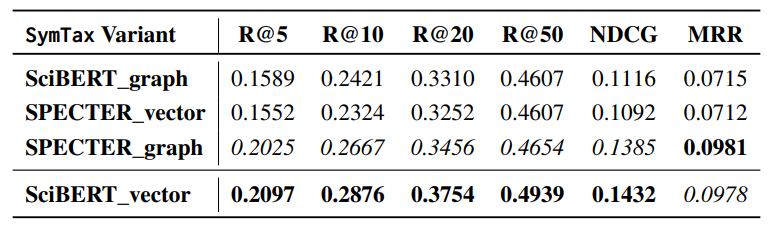
\ Table 4: Analysis on choice of LM and taxonomy fusion on 10k random samples from ArSyTa. Best results are highlighted in bold and second best are italicised.
\

6.2 Quantitative Analysis

We consider two available LMs, i.e. SciBERT and SPECTER, and the two types of taxonomy fusion, i.e. graph-based and vector-based. This results in four variants, as shown in Table 4. As evident from the results, SciBERTvector and SPECTERgraph are the best-performing variants. So, the combinatorial choice of LM and taxonomy fusion plays a vital role in model performance. The above observations can be attributed to SciBERT being a LM trained on plain scientific text. In contrast, SPECTER is a LM trained with Triplet loss using 1-hop neighbours of the positive sample from the citation graph as hard negative samples. So, SPECTER embodies graph information inside itself, whereas SciBERT does not.

\

6.3 Qualitative Analysis

We assess the quality of recommendations given by different algorithms by randomly choosing an example. Though random, we choose the example that has multiple citations in a given context so that we can present the qualitative analysis well by investigating the top-10 ranked predictions. As shown in Table 5, we consider an excerpt from Liu et al. (2020) that contains five citations. As we can see that Symtax correctly recommend three citations in the top-10, whereas HAtten only recommend one citation correctly at rank 1 and BM25 only suggest one correct citation at rank 10. The use of title is crucial to performance, as we can see that many recommendations consist of the words “BERT" and “Pretraining", which are the keywords present in the title. One more observation is that the taxonomy plays a vital role in recommendations. The taxonomy category of the query is ‘Computation and Language‘, and most of the recommended articles are from the same category. SymTax gives only one recommendation (Deep Residual Learning for Image Recognition) from a different category, i.e.“Computer Vision", whereas HAtten recommends three citations from different categories, i.e. (Deep Residual Learning for Image Recognition) from “Computer Vision" and (Batch Normalization, and Adam) from “Machine Learning".
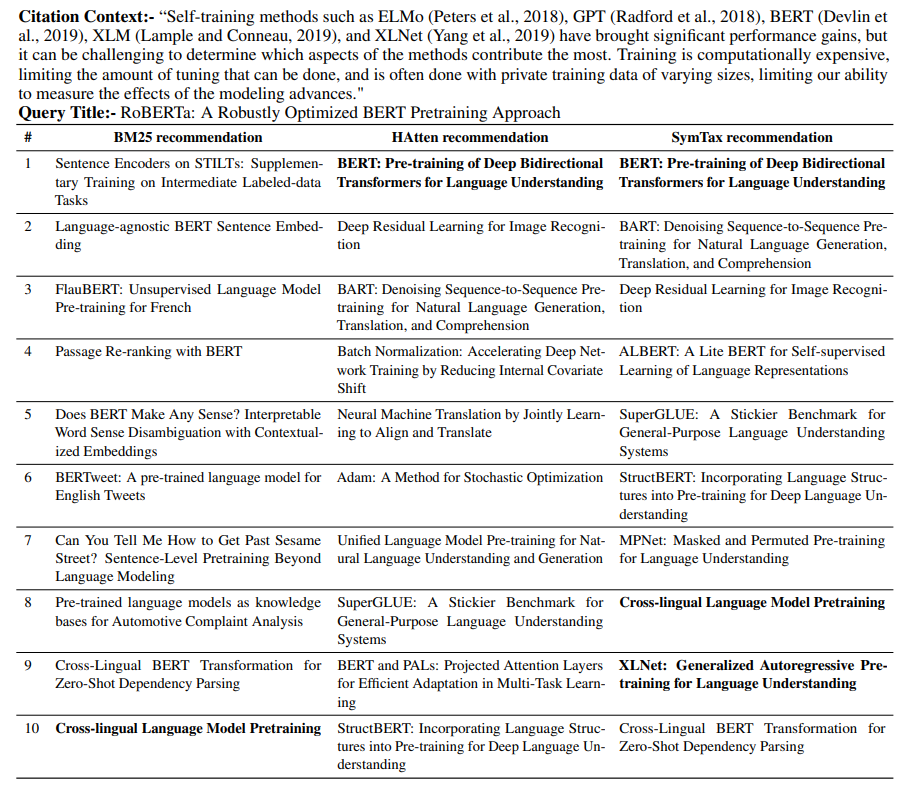
Table 5: The table shows the top-10 citation recommendations given by various algorithms for a randomly chosen example from ArSyTa. Valid predictions are highlighted in bold. It clearly shows that SymTax (SciBERT_vector) is able to recommend three valid articles in the top-10. In contrast, each of the HAtten and BM25 could recommend only one valid article for the given citation context. # denotes the rank of the recommended citations.

\

:::info Authors:

(1) Karan Goyal, IIIT Delhi, India ([email protected]);

(2) Mayank Goel, NSUT Delhi, India ([email protected]);

(3) Vikram Goyal, IIIT Delhi, India ([email protected]);

(4) Mukesh Mohania, IIIT Delhi, India ([email protected]).

:::


:::info This paper is available on arxiv under CC by-SA 4.0 Deed (Attribution-Sharealike 4.0 International) license.

:::

\

Market Opportunity
DeepBook Logo
DeepBook Price(DEEP)
$0.053792
$0.053792$0.053792
-3.30%
USD
DeepBook (DEEP) Live Price Chart
Disclaimer: The articles reposted on this site are sourced from public platforms and are provided for informational purposes only. They do not necessarily reflect the views of MEXC. All rights remain with the original authors. If you believe any content infringes on third-party rights, please contact [email protected] for removal. MEXC makes no guarantees regarding the accuracy, completeness, or timeliness of the content and is not responsible for any actions taken based on the information provided. The content does not constitute financial, legal, or other professional advice, nor should it be considered a recommendation or endorsement by MEXC.

You May Also Like

CME Group to launch options on XRP and SOL futures

CME Group to launch options on XRP and SOL futures

The post CME Group to launch options on XRP and SOL futures appeared on BitcoinEthereumNews.com. CME Group will offer options based on the derivative markets on Solana (SOL) and XRP. The new markets will open on October 13, after regulatory approval.  CME Group will expand its crypto products with options on the futures markets of Solana (SOL) and XRP. The futures market will start on October 13, after regulatory review and approval.  The options will allow the trading of MicroSol, XRP, and MicroXRP futures, with expiry dates available every business day, monthly, and quarterly. The new products will be added to the existing BTC and ETH options markets. ‘The launch of these options contracts builds on the significant growth and increasing liquidity we have seen across our suite of Solana and XRP futures,’ said Giovanni Vicioso, CME Group Global Head of Cryptocurrency Products. The options contracts will have two main sizes, tracking the futures contracts. The new market will be suitable for sophisticated institutional traders, as well as active individual traders. The addition of options markets singles out XRP and SOL as liquid enough to offer the potential to bet on a market direction.  The options on futures arrive a few months after the launch of SOL futures. Both SOL and XRP had peak volumes in August, though XRP activity has slowed down in September. XRP and SOL options to tap both institutions and active traders Crypto options are one of the indicators of market attitudes, with XRP and SOL receiving a new way to gauge sentiment. The contracts will be supported by the Cumberland team.  ‘As one of the biggest liquidity providers in the ecosystem, the Cumberland team is excited to support CME Group’s continued expansion of crypto offerings,’ said Roman Makarov, Head of Cumberland Options Trading at DRW. ‘The launch of options on Solana and XRP futures is the latest example of the…
Share
BitcoinEthereumNews2025/09/18 00:56
XLM Price Prediction: Stellar Targets $0.26-$0.27 Range by February 2026

XLM Price Prediction: Stellar Targets $0.26-$0.27 Range by February 2026

The post XLM Price Prediction: Stellar Targets $0.26-$0.27 Range by February 2026 appeared on BitcoinEthereumNews.com. Zach Anderson Jan 14, 2026 13:31 XLM
Share
BitcoinEthereumNews2026/01/15 10:06
Adoption Leads Traders to Snorter Token

Adoption Leads Traders to Snorter Token

The post Adoption Leads Traders to Snorter Token appeared on BitcoinEthereumNews.com. Largest Bank in Spain Launches Crypto Service: Adoption Leads Traders to Snorter Token Sign Up for Our Newsletter! For updates and exclusive offers enter your email. Leah is a British journalist with a BA in Journalism, Media, and Communications and nearly a decade of content writing experience. Over the last four years, her focus has primarily been on Web3 technologies, driven by her genuine enthusiasm for decentralization and the latest technological advancements. She has contributed to leading crypto and NFT publications – Cointelegraph, Coinbound, Crypto News, NFT Plazas, Bitcolumnist, Techreport, and NFT Lately – which has elevated her to a senior role in crypto journalism. Whether crafting breaking news or in-depth reviews, she strives to engage her readers with the latest insights and information. Her articles often span the hottest cryptos, exchanges, and evolving regulations. As part of her ploy to attract crypto newbies into Web3, she explains even the most complex topics in an easily understandable and engaging way. Further underscoring her dynamic journalism background, she has written for various sectors, including software testing (TEST Magazine), travel (Travel Off Path), and music (Mixmag). When she’s not deep into a crypto rabbit hole, she’s probably island-hopping (with the Galapagos and Hainan being her go-to’s). Or perhaps sketching chalk pencil drawings while listening to the Pixies, her all-time favorite band. This website uses cookies. By continuing to use this website you are giving consent to cookies being used. Visit our Privacy Center or Cookie Policy. I Agree Source: https://bitcoinist.com/banco-santander-and-snorter-token-crypto-services/
Share
BitcoinEthereumNews2025/09/17 23:45