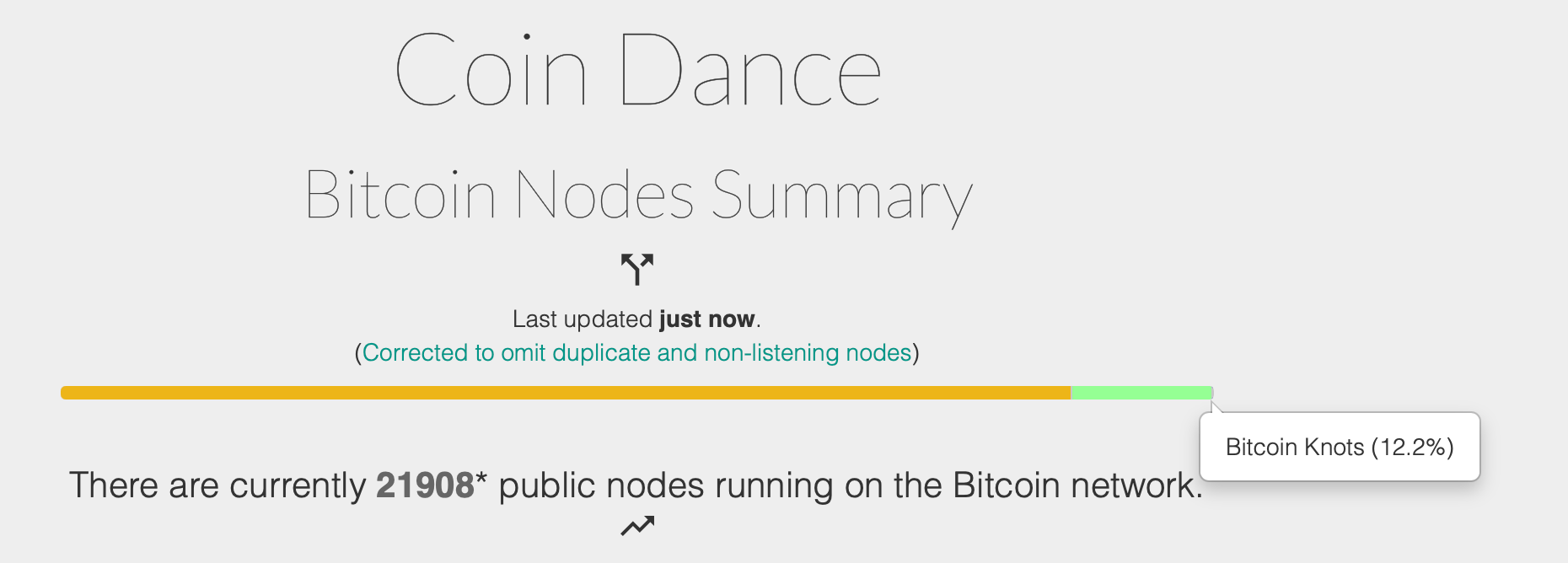
Recent data shows that Bitcoin Knots now powers more than 12% of the 21,908 public Bitcoin nodes. The growing preference for Knots stems largely from debates surrounding Bitcoin Core’s development, particularly proposed adjustments to the OP_RETURN function and its data capacity. 12% and Climbing Data from Coin Dance shows a steady rise in Bitcoin Knots […]Recent data shows that Bitcoin Knots now powers more than 12% of the 21,908 public Bitcoin nodes. The growing preference for Knots stems largely from debates surrounding Bitcoin Core’s development, particularly proposed adjustments to the OP_RETURN function and its data capacity. 12% and Climbing Data from Coin Dance shows a steady rise in Bitcoin Knots […]

Bitcoin Knots Now Powers 12% of the Network in Defiant Push Against Core

2025/06/17 06:05

Recent data shows that Bitcoin Knots now powers more than 12% of the 21,908 public Bitcoin nodes. The growing preference for Knots stems largely from debates surrounding Bitcoin Core’s development, particularly proposed adjustments to the OP_RETURN function and its data capacity.

12% and Climbing

Data from Coin Dance shows a steady rise in Bitcoin Knots adoption, with 2,673 public nodes now running the software. The shift follows Bitcoin Core’s decision to eliminate the 80-byte limit on OP_RETURN transactions. The 80-byte limit refers to the maximum amount of non-payment data—like messages or metadata—that could be included in an OP_RETURN transaction output.
Bitcoin Knots Now Powers 12% of the Network in Defiant Push Against Core

Bitcoin Knots takes a more cautious approach, keeping OP_RETURN transactions limited to 42 bytes while giving users tools to block spam or low-value transactions. Its growing adoption pointedly reflects disagreement with Bitcoin Core’s move to eliminate the 80-byte limit—a controversial change now merged in Core’s code repository on Github and expected in its October 2025 release.

By the end of 2024, approximately 410 Bitcoin Knots nodes were operational, translating to roughly 12.5 new nodes coming online each day over 181 days. With Bitcoin Core currently maintaining 19,186 nodes, Knots would need 554 days at its current growth rate to reach half that figure – far exceeding the 107 days remaining until October 2025.

While 12% may sound significant, even if Bitcoin Knots climbs to 50% node adoption, larger OP_RETURN transactions can still be relayed and confirmed—as long as enough Bitcoin Core nodes transmit them and miners include them in blocks. Relay policies vary by implementation, but consensus rules permit these transactions to be mined and deemed valid across the network.

Right now plenty see the uptick as more than technical—to node runners it’s a symbolic protest in code, a signal of pushback against Bitcoin Core’s policy shifts. Node variety doubles as a quiet form of decentralized defiance. Knots nodes can’t stop transactions from getting mined, but they can clog the propagation lanes for heavier data within their own relay circles—especially if their numbers keep climbing.


Disclaimer: The articles reposted on this site are sourced from public platforms and are provided for informational purposes only. They do not necessarily reflect the views of MEXC. All rights remain with the original authors. If you believe any content infringes on third-party rights, please contact [email protected] for removal. MEXC makes no guarantees regarding the accuracy, completeness, or timeliness of the content and is not responsible for any actions taken based on the information provided. The content does not constitute financial, legal, or other professional advice, nor should it be considered a recommendation or endorsement by MEXC.

You May Also Like

UK Looks to US to Adopt More Crypto-Friendly Approach

UK Looks to US to Adopt More Crypto-Friendly Approach

The post UK Looks to US to Adopt More Crypto-Friendly Approach appeared on BitcoinEthereumNews.com. The UK and US are reportedly preparing to deepen cooperation on digital assets, with Britain looking to copy the Trump administration’s crypto-friendly stance in a bid to boost innovation.  UK Chancellor Rachel Reeves and US Treasury Secretary Scott Bessent discussed on Tuesday how the two nations could strengthen their coordination on crypto, the Financial Times reported on Tuesday, citing people familiar with the matter.  The discussions also involved representatives from crypto companies, including Coinbase, Circle Internet Group and Ripple, with executives from the Bank of America, Barclays and Citi also attending, according to the report. The agreement was made “last-minute” after crypto advocacy groups urged the UK government on Thursday to adopt a more open stance toward the industry, claiming its cautious approach to the sector has left the country lagging in innovation and policy.  Source: Rachel Reeves Deal to include stablecoins, look to unlock adoption Any deal between the countries is likely to include stablecoins, the Financial Times reported, an area of crypto that US President Donald Trump made a policy priority and in which his family has significant business interests. The Financial Times reported on Monday that UK crypto advocacy groups also slammed the Bank of England’s proposal to limit individual stablecoin holdings to between 10,000 British pounds ($13,650) and 20,000 pounds ($27,300), claiming it would be difficult and expensive to implement. UK banks appear to have slowed adoption too, with around 40% of 2,000 recently surveyed crypto investors saying that their banks had either blocked or delayed a payment to a crypto provider.  Many of these actions have been linked to concerns over volatility, fraud and scams. The UK has made some progress on crypto regulation recently, proposing a framework in May that would see crypto exchanges, dealers, and agents treated similarly to traditional finance firms, with…
Share
BitcoinEthereumNews2025/09/18 02:21