Through the lenses of economics, monetary history, and quantitative finance, this paper analyzes Bitcoin. Bitcoin isn't a real currency, safe haven, inflation hedge, or store of wealth, despite its hype. As an alternative, it continues to be a brittle speculative asset with high energy expenses and systemic dangers. Although blockchain technology exhibits mathematical elegance, Bitcoin's use of it exposes inefficiencies, mistrust, and unsustainable mining economics. Ultimately, when examined from an economic perspective, Bitcoin's claims of financial security, freedom from governmental interference, and long-term value fall apart.Through the lenses of economics, monetary history, and quantitative finance, this paper analyzes Bitcoin. Bitcoin isn't a real currency, safe haven, inflation hedge, or store of wealth, despite its hype. As an alternative, it continues to be a brittle speculative asset with high energy expenses and systemic dangers. Although blockchain technology exhibits mathematical elegance, Bitcoin's use of it exposes inefficiencies, mistrust, and unsustainable mining economics. Ultimately, when examined from an economic perspective, Bitcoin's claims of financial security, freedom from governmental interference, and long-term value fall apart.

Why Blockchain’s Math Doesn’t Translate Into Financial Stability

2025/08/27 05:01

:::info Author:

(1) Nassim Nicholas Taleb, Universa Investments, Tandon School of Engineering, New York University Forthcoming, Quantitative Finance.

:::

  1. Introduction/Abstract
  2. The Blockchain
  3. Vulnerability of Revenue-Free Bubbles
  4. Success in Wrong Places
  5. Principles for a Currency
  6. The Difficult with Inflation Hedges
  7. Some Additional Fallacies
  8. Conclusion and References

INTRODUCTION/ABSTRACT

This discussion applies quantitative finance methods and economic arguments to cryptocurrencies in general and bitcoin in particular —as there are about 10, 000 cryptocurrencies, we focus (unless otherwise specified) on the most discussed crypto of those that claim to hew to the original protocol [1] and the one with, by far, the largest market capitalization.

\ In its current version, in spite of the hype, bitcoin failed to satisfy the notion of "currency without government" (it proved to not even be a currency at all), can be neither a short nor long term store of value (its expected value is no higher than 0), cannot operate as a reliable inflation hedge, and, worst of all, does not constitute, not even remotely, a safe haven for one’s investments, a shield against government tyranny, or a tail protection vehicle for catastrophic episodes.

\ Furthermore, bitcoin promoters appear to conflate the success of a payment mechanism (as a decentralized mode of exchange), which so far has failed, with the speculative variations in the price of a zero-sum maximally fragile asset with massive negative externalities.

\ Going through monetary history, we show how a true numeraire must be one of minimum variance with respect to an arbitrary basket of goods and services, how gold and silver lost their inflation hedge status during the Hunt brothers squeeze in the late 1970s and what would be required from a true inflation hedged store of value.

\

THE BLOCKCHAIN

First, let us consider what cryptocurrencies do by examining the notion of blockchain and its intellectual and mathematical appeal.
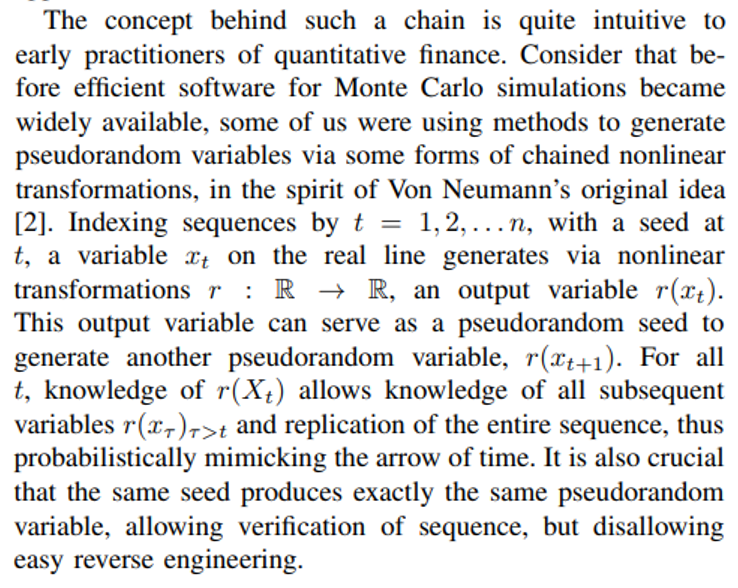
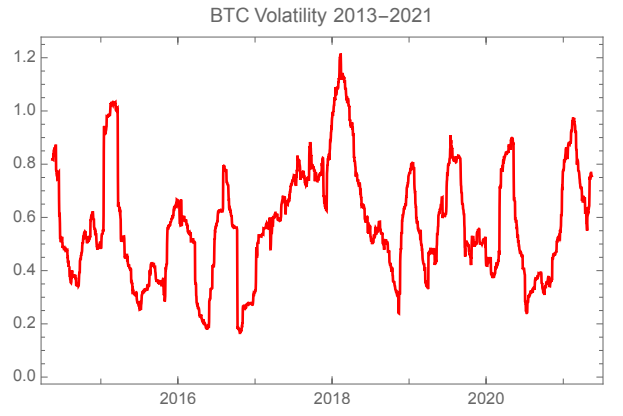
Fig. 1. BTC return, 3 months annualized volatility. It does not seem to drop over time.

\ What the blockchain added, thanks to the hash function, is the condition that r(.) must be functionally and probabilistically bijective: no two seeds should produce the same output (or should produce a vanishingly low probability of that happening), what, in computer science terminology, is called collision.

\ This hard-wired attribute and absence of supervision of the blockchain allow the storage of activities on a public ledger to facilitate peer-to-peer commerce, transactions, and settlements. The blockchain concept also allows for serial record keeping. This is supposed to help create what the original white paper [1] described as:

\ A purely peer-to-peer version of electronic cash would allow online payments to be sent directly from one party to another without going through a financial institution.

\ From that paper, bitcoin makes use of three existing technologies: 1) the hash function, 2) the Merkle tree (to chain blocks of transactions tagged by the hash function), and 3) the concept of proof of work (used to deter spam by forcing agents to use computer time in order to qualify for a transaction) — technologies that, ironically, all came out of the academic literature[3]1 . The idea provides a game theoretic approach to mitigate the effects of the absence of custodian and lack of trust between participants in the maintenance of a permanent shared public ledger — attenuating or circumventing the coordination quandary known as the "Byzantine general problem".

\ The bitcoin transactional currency (BTC) system establishes an adversarial collaboration between the so-called "miners" who validate transactions by getting them on a public ledger; as a reward they get coins plus a fee from the underlying transactions, transfers of coins between parties. The proof of work method has an adjustable degree of difficulty based on the speed of blocks, which aims, in theory, to keep the incentive sufficiently high for miners to keep operating the system. Such adjustments lead to an exponential increase in computer power requirements, making at the time of writing onerous energy demands on the system — energy that could find alternatives in other computational and scientific uses.

\ Miners derive their compensation from both seignorage (the market value of a bitcoin minus its mining costs) and transaction fees upon validation — with the plan to switch to transaction fees as the sole revenues upon the eventual depletion of the coins, which are limited to a fixed number.

\ A central attribute is that bitcoin depends on the existence of such miners for perpetuity.

\ Note that the entire ideological basis behind bitcoin is complete distrust of other operators — there are no partial custodians; the system is fully distributed, though prone to concentration[2]. Furthermore, by the very nature of the blockchain, transactions are irreversible, no matter the reason.

\ Finally, note that bitcoins are zero-sum by virtue of the numerus clausus.

\ As we will see, mathematical and combinatorial qualities do not necessarily translate into financial benefits at either individual or systemic levels.

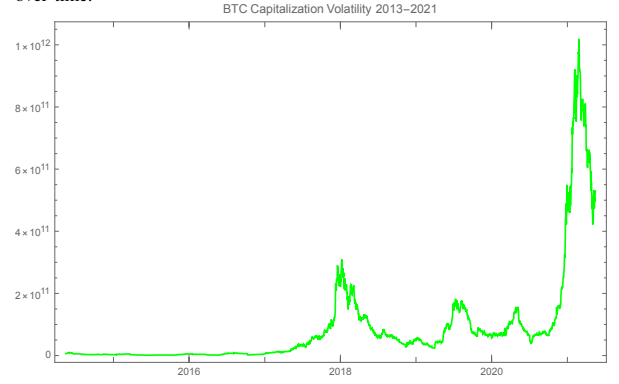
\ \ Fig. 2. Too volatile to fail? We show the volatility of the capitalization of BTC. At higher levels of capitalization, return volatility compounds. In 2021 a swing of half a trillion dollars in the capitalization of bitcoin took place.
\

:::info This paper is available on arxiv under CC BY 4.0 DEED license.

:::

[1] As this discussion is focused on proof of work, we exclude from it Ethereum and other cryptocurrencies.


Disclaimer: The articles reposted on this site are sourced from public platforms and are provided for informational purposes only. They do not necessarily reflect the views of MEXC. All rights remain with the original authors. If you believe any content infringes on third-party rights, please contact [email protected] for removal. MEXC makes no guarantees regarding the accuracy, completeness, or timeliness of the content and is not responsible for any actions taken based on the information provided. The content does not constitute financial, legal, or other professional advice, nor should it be considered a recommendation or endorsement by MEXC.

You May Also Like

Akash Network’s Strategic Move: A Crucial Burn for AKT’s Future

Akash Network’s Strategic Move: A Crucial Burn for AKT’s Future

BitcoinWorld Akash Network’s Strategic Move: A Crucial Burn for AKT’s Future In the dynamic world of decentralized computing, exciting developments are constantly shaping the future. Today, all eyes are on Akash Network, the innovative supercloud project, as it proposes a significant change to its tokenomics. This move aims to strengthen the value of its native token, AKT, and further solidify its position in the competitive blockchain space. The community is buzzing about a newly submitted governance proposal that could introduce a game-changing Burn Mint Equilibrium (BME) model. What is the Burn Mint Equilibrium (BME) for Akash Network? The core of this proposal revolves around a concept called Burn Mint Equilibrium, or BME. Essentially, this model is designed to create a balance in the token’s circulating supply by systematically removing a portion of tokens from existence. For Akash Network, this means burning an amount of AKT that is equivalent to the U.S. dollar value of fees paid by network users. Fee Conversion: When users pay for cloud services on the Akash Network, these fees are typically collected in various cryptocurrencies or stablecoins. AKT Equivalence: The proposal suggests converting the U.S. dollar value of these collected fees into an equivalent amount of AKT. Token Burn: This calculated amount of AKT would then be permanently removed from circulation, or ‘burned’. This mechanism creates a direct link between network utility and token supply reduction. As more users utilize the decentralized supercloud, more AKT will be burned, potentially impacting the token’s scarcity and value. Why is This Proposal Crucial for AKT Holders? For anyone holding AKT, or considering investing in the Akash Network ecosystem, this proposal carries significant weight. Token burning mechanisms are often viewed as a positive development because they can lead to increased scarcity. When supply decreases while demand remains constant or grows, the price per unit tends to increase. Here are some key benefits: Increased Scarcity: Burning tokens reduces the total circulating supply of AKT. This makes each remaining token potentially more valuable over time. Demand-Supply Dynamics: The BME model directly ties the burning of AKT to network usage. Higher adoption of the Akash Network supercloud translates into more fees, and thus more AKT burned. Long-Term Value Proposition: By creating a deflationary pressure, the proposal aims to enhance AKT’s long-term value, making it a more attractive asset for investors and long-term holders. This strategic move demonstrates a commitment from the Akash Network community to optimize its tokenomics for sustainable growth and value appreciation. How Does BME Impact the Decentralized Supercloud Mission? Beyond token value, the BME proposal aligns perfectly with the broader mission of the Akash Network. As a decentralized supercloud, Akash provides a marketplace for cloud computing resources, allowing users to deploy applications faster, more efficiently, and at a lower cost than traditional providers. The BME model reinforces this utility. Consider these impacts: Network Health: A stronger AKT token can incentivize more validators and providers to secure and contribute resources to the network, improving its overall health and resilience. Ecosystem Growth: Enhanced token value can attract more developers and projects to build on the Akash Network, fostering a vibrant and diverse ecosystem. User Incentive: While users pay fees, the potential appreciation of AKT could indirectly benefit those who hold the token, creating a circular economy within the supercloud. This proposal is not just about burning tokens; it’s about building a more robust, self-sustaining, and economically sound decentralized cloud infrastructure for the future. What Are the Next Steps for the Akash Network Community? As a governance proposal, the BME model will now undergo a period of community discussion and voting. This is a crucial phase where AKT holders and network participants can voice their opinions, debate the merits, and ultimately decide on the future direction of the project. Transparency and community engagement are hallmarks of decentralized projects like Akash Network. Challenges and Considerations: Implementation Complexity: Ensuring the burning mechanism is technically sound and transparent will be vital. Community Consensus: Achieving broad agreement within the diverse Akash Network community is key for successful adoption. The outcome of this vote will significantly shape the tokenomics and economic model of the Akash Network, influencing its trajectory in the rapidly evolving decentralized cloud landscape. The proposal to introduce a Burn Mint Equilibrium model represents a bold and strategic step for Akash Network. By directly linking network usage to token scarcity, the project aims to create a more resilient and valuable AKT token, ultimately strengthening its position as a leading decentralized supercloud provider. This move underscores the project’s commitment to innovative tokenomics and sustainable growth, promising an exciting future for both users and investors in the Akash Network ecosystem. It’s a clear signal that Akash is actively working to enhance its value proposition and maintain its competitive edge in the decentralized future. Frequently Asked Questions (FAQs) 1. What is the main goal of the Burn Mint Equilibrium (BME) proposal for Akash Network? The primary goal is to adjust the circulating supply of AKT tokens by burning a portion of network fees, thereby creating deflationary pressure and potentially enhancing the token’s long-term value and scarcity. 2. How will the amount of AKT to be burned be determined? The proposal suggests burning an amount of AKT equivalent to the U.S. dollar value of fees paid by users on the Akash Network for cloud services. 3. What are the potential benefits for AKT token holders? Token holders could benefit from increased scarcity of AKT, which may lead to higher demand and appreciation in value over time, especially as network usage grows. 4. How does this proposal relate to the overall mission of Akash Network? The BME model reinforces the Akash Network‘s mission by creating a stronger, more economically robust ecosystem. A healthier token incentivizes network participants, fostering growth and stability for the decentralized supercloud. 5. What is the next step for this governance proposal? The proposal will undergo a period of community discussion and voting by AKT token holders. The community’s decision will determine if the BME model is implemented on the Akash Network. If you found this article insightful, consider sharing it with your network! Your support helps us bring more valuable insights into the world of decentralized technology. Stay informed and help spread the word about the exciting developments happening within Akash Network. To learn more about the latest crypto market trends, explore our article on key developments shaping decentralized cloud solutions price action. This post Akash Network’s Strategic Move: A Crucial Burn for AKT’s Future first appeared on BitcoinWorld.
Share
Coinstats2025/09/22 21:35