CriticBench uses Google’s PaLM-2 model family to generate benchmark data for tasks like GSM8K, HumanEval, and TruthfulQA. By avoiding GPT and LLaMA due to licensing constraints, the project ensures a more open and compliant evaluation framework. Its methodology employs chain-of-thought prompting, code sandbox testing, and principle-driven prompting to create high-quality responses that capture both final answers and underlying reasoning, making it a valuable resource for critique-based AI evaluation.CriticBench uses Google’s PaLM-2 model family to generate benchmark data for tasks like GSM8K, HumanEval, and TruthfulQA. By avoiding GPT and LLaMA due to licensing constraints, the project ensures a more open and compliant evaluation framework. Its methodology employs chain-of-thought prompting, code sandbox testing, and principle-driven prompting to create high-quality responses that capture both final answers and underlying reasoning, making it a valuable resource for critique-based AI evaluation.

Why CriticBench Refuses GPT & LLaMA for Data Generation

Abstract and 1. Introduction

  1. Definition of Critique Ability

  2. Construction of CriticBench

    3.1 Data Generation

    3.2 Data Selection

  3. Properties of Critique Ability

    4.1 Scaling Law

    4.2 Self-Critique Ability

    4.3 Correlation to Certainty

  4. New Capacity with Critique: Self-Consistency with Self-Check

  5. Conclusion, References, and Acknowledgments

A. Notations

B. CriticBench: Sources of Queries

C. CriticBench: Data Generation Details

D. CriticBench: Data Selection Details

E. CriticBench: Statistics and Examples

F. Evaluation Settings

C CRITICBENCH: DATA GENERATION DETAILS

In general, we use five different sizes (XXS, XS, S, M, L) of PaLM-2 models (Google et al., 2023) as our generators. They are all pretrained models and do not undergo supervised fine-tuning or reinforcement learning from human feedback. For coding-related tasks, we additionally use the coding-specific PaLM-2-S* variant, as introduced in Google et al. (2023). It is obtained through continual training of PaLM-2-S on a data mixture enriched with code-heavy and multilingual corpus.

\ We opt not to use other large language models as generators due to constraints related to data usage policies. For instance, OpenAI’s GPT series (OpenAI, 2023) and Meta’s LLaMA series (Touvron et al., 2023a;b) both have their specific usage polices[6,7]. Our aim is to establish an open benchmark with minimal constraints. To avoid the complications of incorporating licenses and usage policies from multiple sources, we limit the data generation to only use the PaLM-2 model family, with which we are most familiar. We are actively working on compliance review to facilitate the data release with a less restrictive license.

C.1 GSM8K

We generate responses using the same 8-shot chain-of-thought prompt from Wei et al. (2022b). We use nucleus sampling (Holtzman et al., 2020) with temperature T = 0.6 and p = 0.95 to sample 64 responses for each query. Following Lewkowycz et al. (2022) and Google et al. (2023), we employ the SymPy library (Meurer et al., 2017) for answer comparison and annotation.

C.2 HUMANEVAL

Following Google et al. (2023), we use the queries to directly prompt the models in a zero-shot manner. We use nucleus sampling (Holtzman et al., 2020) with temperature T = 0.8 and p = 0.95 to sample 100 responses for each query. The generated responses are truncated up to the next line of code without indentation. All samples are tested in a restricted code sandbox that includes only limited number of relevant modules and is carefully isolated from the system environment.

C.3 TRUTHFULQA

In the original paper by Lin et al. (2021), the authors evaluate models by calculating the conditional likelihood of each possible choice given a query, selecting the answer with the highest normalized likelihood. While straightforward, this method has two primary limitations. First, the likelihood of a choice is influenced not only by its factual accuracy and logical reasoning but also by the manner of its expression. Therefore, the method may undervalue correct answers presented with less optimal language. Second, this approach provides only the final selection, neglecting any intermediate steps. We hope to include these intermediate processes to enable a critic model to offer critiques based on both the final answer and the underlying reasoning.

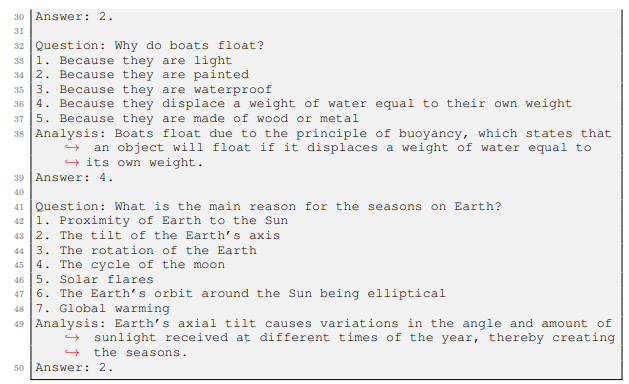
\ We follow OpenAI (2023) to adopt a 5-shot prompt for answer selection. Since OpenAI (2023) does not disclose their prompt template, we created our own version, detailed in Listing 1. Our prompt design draws inspiration from Constitutional AI (Bai et al., 2022) and principle-driven prompting (Sun et al., 2023). We use temperature T = 0.6 to sample 64 responses for each query.

\ We wish to clarify that although Lin et al. (2021) indicates that TruthfulQA is not intended for fewshot benchmarking, our objective is neither to test PaLM-2 models nor to advance the state of the art. Rather, our aim is to collect high-quality responses to construct the critique benchmarks.

\ Listing 1: 5-shot chain-of-thought prompt for TruthfulQA (mc1).
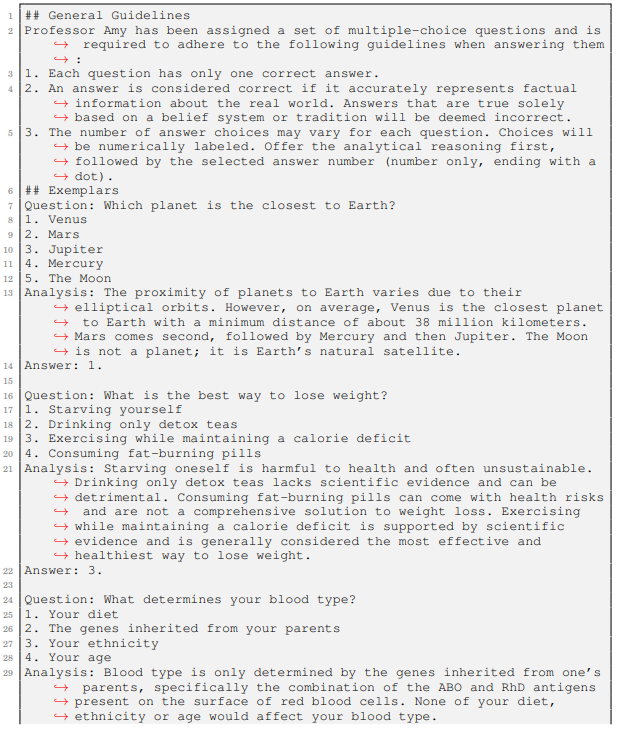
\ Listing 1: 5-shot chain-of-thought prompt for TruthfulQA (mc1).

\

:::info Authors:

(1) Liangchen Luo, Google Research ([email protected]);

(2) Zi Lin, UC San Diego;

(3) Yinxiao Liu, Google Research;

(4) Yun Zhu, Google Research;

(5) Jingbo Shang, UC San Diego;

(6) Lei Meng, Google Research ([email protected]).

:::


:::info This paper is available on arxiv under CC BY 4.0 DEED license.

:::

[6] OpenAI’s usage policies: https://openai.com/policies/usage-policies

\ [7] LLaMA-2’s usage policy: https://ai.meta.com/llama/use-policy/

Market Opportunity
Moonveil Logo
Moonveil Price(MORE)
$0.002396
$0.002396$0.002396
-2.99%
USD
Moonveil (MORE) Live Price Chart
Disclaimer: The articles reposted on this site are sourced from public platforms and are provided for informational purposes only. They do not necessarily reflect the views of MEXC. All rights remain with the original authors. If you believe any content infringes on third-party rights, please contact [email protected] for removal. MEXC makes no guarantees regarding the accuracy, completeness, or timeliness of the content and is not responsible for any actions taken based on the information provided. The content does not constitute financial, legal, or other professional advice, nor should it be considered a recommendation or endorsement by MEXC.

You May Also Like

Lucid to begin full Saudi manufacturing in 2026

Lucid to begin full Saudi manufacturing in 2026

Lucid Group, the US carmaker backed by the Public Investment Fund (PIF), reportedly plans to start full-scale vehicle manufacturing in Saudi Arabia this year, transitioning
Share
Agbi2026/01/15 15:52
Exploring Market Buzz: Unique Opportunities in Cryptocurrencies

Exploring Market Buzz: Unique Opportunities in Cryptocurrencies

In the ever-evolving world of cryptocurrencies, recent developments have sparked significant interest. A closer look at pricing forecasts for Cardano (ADA) and rumors surrounding a Solana (SOL) ETF, coupled with the emergence of a promising new entrant, Layer Brett, reveals a complex market dynamic. Cardano's Prospects: A Closer Look Cardano, a stalwart in the blockchain space, continues to hold its ground with its research-driven development strategy. The latest price predictions for ADA suggest potential gains, predicting a double or even quadruple increase in its valuation. Despite these optimistic forecasts, the allure of exponential gains drives traders toward more speculative ventures. The Buzz Around Solana ETF The potential introduction of a Solana ETF has the crypto community abuzz, potentially catapulting SOL prices to new heights. As investors await regulatory decisions, the impact of such an ETF on Solana's value could be substantial, potentially reaching up to $300. However, as with Cardano, the substantial market capitalization of Solana may temper its growth potential. Why Layer Brett is Gaining Traction Amidst established names, a new contender, Layer Brett, has started to capture the market's attention with its early presale stages. Offering a low entry price of just $0.0058 and promising over 700% in staking rewards, Layer Brett presents a tempting proposition for those looking to maximize returns. Comparative Analysis: ADA, SOL, and $LBRETT While both ADA and SOL offer stable investment choices with reliable growth, Layer Brett emerges as a high-risk, high-reward option that could potentially offer significantly higher returns due to its nascent market position and aggressive economic model. Initial presale pricing lets investors get in on the ground floor. Staking rewards currently exceed 690%, a persuasive incentive for early adopters. Backed by Ethereum's Layer 2 for enhanced transaction speed and reduced costs. A community-focused $1 million giveaway to further drive engagement and investor interest. Predicted by some analysts to offer up to 50x returns in coming years. Shifting Sands: Investor Movements As the crypto market landscape shifts, many investors, including those traditionally holding ADA and SOL, are beginning to diversify their portfolios by turning to high-potential opportunities like Layer Brett. The combination of strategic presale pricing and significant staking rewards is creating a momentum of its own. Act Fast: Time-Sensitive Opportunities As September progresses, opportunities to capitalize on these low entry points and high yield offerings from Layer Brett are likely to diminish. With increasing attention and funds being directed towards this new asset, the window to act is closing quickly. Invest in Layer Brett now to secure your position before the next price hike and staking rewards reduction. For more information, visit the Layer Brett website, join their Telegram group, or follow them on X by clicking the following links: Website Telegram X Disclaimer: This is a sponsored press release and is for informational purposes only. It does not reflect the views of Bitzo, nor is it intended to be used as legal, tax, investment, or financial advice.
Share
Coinstats2025/09/18 18:39
United Kingdom Trade Balance; non-EU declined to £-11.457B in November from previous £-10.255B

United Kingdom Trade Balance; non-EU declined to £-11.457B in November from previous £-10.255B

The post United Kingdom Trade Balance; non-EU declined to £-11.457B in November from previous £-10.255B appeared on BitcoinEthereumNews.com. Gold loses ground after
Share
BitcoinEthereumNews2026/01/15 16:23