

Bitcoin Price Trapped in $65K–$71K Zone After 30% Crash: Breakout Soon?
Key Insights:
- Bitcoin price confirmed the bearish flag and reached the $59.8K target.
- A move above $80K may encounter resistance; $60K is key support.
- Hawkish Fed tone and UAE BTC mining influence market sentiment.
Bitcoin price is showing stabilization after a sharp selloff, confirming a bearish continuation pattern. Analysts said the $88K-$90K breakdown already delivered the 30% drop as projected to $59,800.
The market consolidates in a tight range. Macro headlines and institutional accumulation drive the next move.
Bitcoin Price Confirms Bearish Flag
Bitcoin price formed a bearish flag breakdown from the $88,000 to $90,000 area. That’s Crypto Patel’s roadmap. The chart has a nice flag structure, followed by a continuation drop that touched the $59,800 target.
With that measured move met, Patel frames the current phase as post-breakdown consolidation rather than trend reversal. Bitcoin price formed a bearish flag breakdown from the $88,000 to $90,000 area, which aligns with
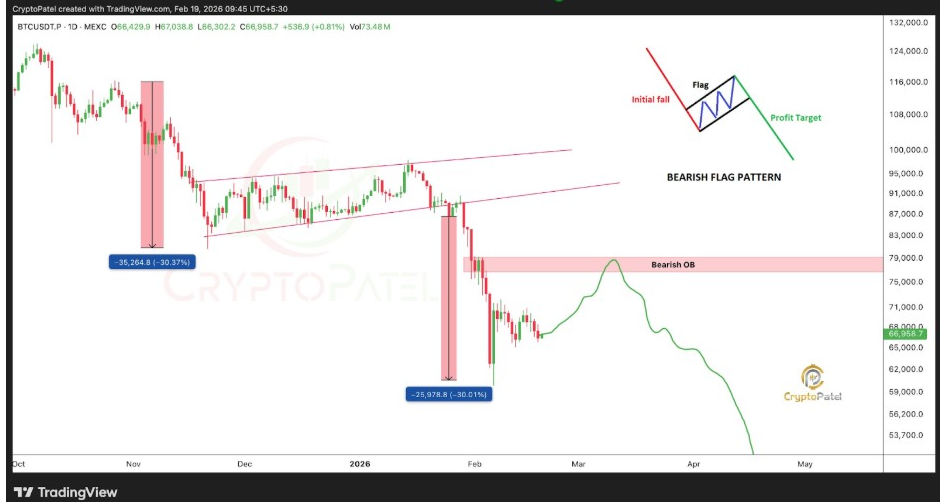 BTUSDT Daily Chart | Source: Crypto Patel, X
The market is between $65,000 and $71,000, a “no trade zone” due to mixed signals. Price action in this band has been volatile with little follow-through in any direction. In practical terms, that range serves as an impulse leg lower.
Even so, Patel stressed that the larger structure is fragile until Bitcoin crypto recovers to higher resistance. Without a clean break above the upper boundary of the range, downside risk remains on the table.
Therefore, near-term focuses tend to move away from confirmation of patterns and onto subsequent levels of decisions.
Bitcoin Price Prediction: $80K Bearish OB and $60K Support
Crypto Patel cited $80,000 as the primary upside checkpoint. He sees a possible relief bounce towards that area but calls this a bearish order block.
In his view, the probability of rejection there is high, not least if the bounce is being driven by short covering rather than fresh demand.
If Bitcoin price rallies into $78,000 – $80,000 and stalls, that could set up another lower high. This will continue the bearish bias and increase the risk of a second leg down. For that reason, Patel considers $80,000 a test zone, not a confirmation zone.
On the downside, Patel reported $60,000 as a strong support and key invalidation level for the bounce thesis.
If Bitcoin breaks below $60,000 with conviction, the next pathway opens toward $50,000 and potentially $40,000. This scenario highlights how critical support levels can trigger sharp downside moves in crypto markets.
That scenario would change sentiment from consolidation to continuation, with volatility likely to quickly rise below the prior low.
Hawkish Fed Minutes Add Pressure
Macro conditions pressure Bitcoin’s price after the Federal Reserve’s January meeting minutes. The unexpectedly hawkish stance intensifies selling as investors reassess risk.
Several officials discussed the prospect of rate hikes. Some pushed for language that would mention possible “upward adjustments” to the policy rate. That pitch prompted markets to re-evaluate expectations for near-term easing.
The FOMC voted 10-2 to hold the rate at 3.5%-3.75%. Governors Christopher Waller and Stephen Miran favored a quarter-point reduction based on labor risks. However, the wider committee was in favor of holding steady, saying inflation progress must be clearer before cuts.
This comes as leadership is set to change. Jerome Powell’s term expires in May, and Kevin Warsh is expected to succeed him in June.
Warsh has praised lower rates, in line with political pressure for cheap borrowing. Analysts warn that a hawkish committee could limit his ability to pivot quickly. They add that inflation picking up again through the PCE index would intensify that challenge.
UAE Royal Group Mines 6,782 BTC
While there is still high macro risk, on-chain accumulation is a contrasting indicator. UAE’s Royal Group, through its mining arm Citadel Mining, has mined 6,782 BTC.
That’s worth around $454 million USD. Arkham Intelligence spotted the cluster of wallets, which had steady inflows with a connection to Foundry Digital mining pools primarily.
 UAE Royal Group | Source: Arkham Intelligence
The wallet history dates back to March 2022. Also, trackers do not show any signs of sales since operations picked up in late 2025.
Entities with large energy resources increasingly pursue direct Bitcoin exposure through mining rather than exchanges. This approach reflects a broader trend of leveraging energy assets to secure long-term participation in the crypto economy.
Royal Group’s strategy also takes advantage of the low-cost energy profile in the UAE in order to increase capacity.
Sheikh Tahnoon bin Zayed Al Nahyan chairs the entity. It operates privately and remains independent of UAE sovereign wealth funds like ADIA or ADQ. Even so, its size and consistency contribute to the tale of institutional grade accumulation amid weakness.
The post Bitcoin Price Trapped in $65K–$71K Zone After 30% Crash: Breakout Soon? appeared first on The Market Periodical.


You May Also Like

Securitize Moves To TRON As Tokenized Real-World Assets Enter New Stage Of Global Adoption

Xanadu Quantum Technologies Shares Surge Over 20% Amid Strong Trading Activity




