

Tokenization, Transparency, And Institutional Demand Dominate Discussion At HSC’s ‘Capital Is Selective Again’ Panel
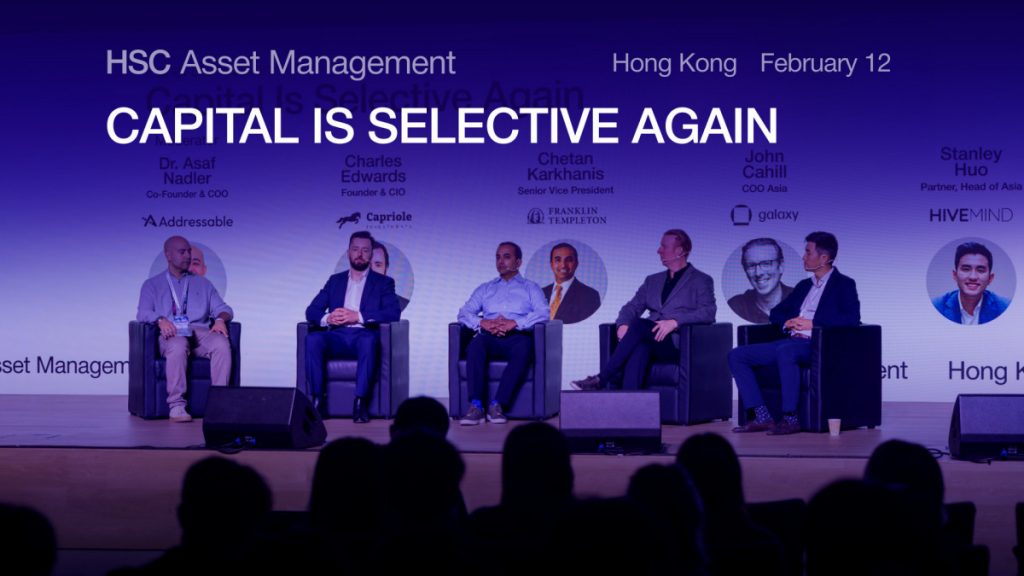
In the middle of February, HSC Asset Management held its event in Hong Kong, bringing together institutional investors, hedge funds, Web2 and crypto‑focused asset managers, and family offices to examine the latest trends shaping the institutional digital‑asset landscape.
One of the central sessions was the “Capital Is Selective Again” panel, which opened the conference and featured Dr. Asaf Nadler of Addressable, Charles Edwards of Capriole Investments, Chetan Karkhanis of Franklin Templeton, John Cahill of Galaxy Digital, and Stanley Huo of Hivemind Capital. The discussion focused on how capital deployment has become significantly more selective in the current cycle, with speakers emphasizing rigorous due diligence, sustainable revenue models, and the reality that only fundamentally strong projects are now securing institutional backing.
Speakers began by noting that the crypto market has moved through several cycles—from the ICO boom to DeFi summer to the collapse of major platforms—which collectively eroded trust and pushed investors toward more disciplined evaluation. Earlier phases were driven by hype, retail speculation, and untested ideas, but the current environment demands revenue, product‑market fit, and sustainable token economics. Only a small fraction of tokens meet these standards, and the era of raising capital on vision alone has ended. The shift from a “tell me” to a “show me” market now requires real business models, identifiable customers, and measurable traction.
Institutionalization And The Rise Of Tokenized Assets
The conversation then turned to institutionalization and real‑world asset tokenization. Institutional participation has grown steadily, particularly in stablecoins, money‑market funds, and tokenized real‑world assets. Speakers highlighted that institutional use cases such as collateral management, treasury operations, and intraday liquidity are advancing faster than retail adoption. Tokenization continues to expand across chains, supported by rising stablecoin issuance and RWA growth, while regulatory clarity remains essential as global institutions operate within jurisdiction‑specific frameworks. The panel noted that tokenization is progressing from simple instruments toward more complex assets such as private credit and private company shares, with compliance and risk management at the core.
How Investors Evaluate Projects Today
When evaluating projects, speakers stressed that transparency does not guarantee accuracy, as on‑chain data can be distorted by artificial activity or inflated metrics. To assess real traction, investors rely on verified customer usage, partner validation, sustainable incentive structures, token‑supply dynamics, revenue trends, and team credibility. Some participants added that macroeconomic conditions, sentiment, and technical indicators also influence decision‑making, especially for liquid token strategies.
Convergence Of Traditional Finance And Web3
The discussion also underscored the growing convergence between traditional finance and Web3. Unified digital wallets offering a holistic view of assets and liabilities, rising interest from banks and asset managers in on‑chain products, and the expectation that automated agents will eventually handle portfolio construction all point to a long‑term structural shift. This transition requires compliant, cross‑border infrastructure capable of supporting tokenized assets at scale, with early progress already visible across Asia, Europe, and the United States.
Finally, the panel examined Asia’s role in the evolving landscape. While global fundamentals are similar, Asia stands out for its large consumer base, rapid adoption of new technologies, and strong engineering talent. High demand for cross‑border payments, growing use of stablecoins for trade and remittances, interest in tokenizing private assets and cultural products, and a strong appetite for consumer‑facing applications all position the region as a fertile ground for Web3 innovation.
The post Tokenization, Transparency, And Institutional Demand Dominate Discussion At HSC’s ‘Capital Is Selective Again’ Panel appeared first on Metaverse Post.


You May Also Like

Bitcoin Depot Reports $3.7M Loss after Breach of Corporate Wallets

Morgan Stanley Low-Fee Bitcoin ETF Sparks Fee War Across Issuers, Analyst Says – Featured Bitcoin News




