Re-ranking in information retrieval improves search accuracy by reordering initial results using methods like relevance feedback, learning-to-rank models, and contextual embeddings. This article explores ColBERT’s contextualized late interaction framework and extends it into a two-stage re-ranking method for image retrieval. By combining filtering, similarity scoring, and localization, the approach enhances not only the precision of retrieved results but also the ability to identify anatomical regions of interest in complex datasets.Re-ranking in information retrieval improves search accuracy by reordering initial results using methods like relevance feedback, learning-to-rank models, and contextual embeddings. This article explores ColBERT’s contextualized late interaction framework and extends it into a two-stage re-ranking method for image retrieval. By combining filtering, similarity scoring, and localization, the approach enhances not only the precision of retrieved results but also the ability to identify anatomical regions of interest in complex datasets.

Embedding Similarity Scoring for Smarter Image Retrieval Systems

Abstract and 1. Introduction

  1. Materials and Methods

    2.1 Vector Database and Indexing

    2.2 Feature Extractors

    2.3 Dataset and Pre-processing

    2.4 Search and Retrieval

    2.5 Re-ranking retrieval and evaluation

  2. Evaluation and 3.1 Search and Retrieval

    3.2 Re-ranking

  3. Discussion

    4.1 Dataset and 4.2 Re-ranking

    4.3 Embeddings

    4.4 Volume-based, Region-based and Localized Retrieval and 4.5 Localization-ratio

  4. Conclusion, Acknowledgement, and References

2.5 Re-ranking retrieval and evaluation

Re-ranking in information retrieval involves the process of re-ordering the initially retrieved results to better align with the user’s information needs. This can be achieved through different methods such as relevance feedback, learning to rank algorithms, or incorporating contextual information [Ai et al., 2018, Guo et al., 2020, MacAvaney et al., 2019]. Relevance feedback allows users to provide input on the initial results, which is then used to adjust the ranking [Ai et al., 2018]. Learning to rank algorithms utilizes machine learning techniques to re-rank results based on relevant features [Guo et al., 2020]. Additionally, re-ranking methods may also consider contextual information such as user behavior, temporal relevance, or other relevant factors to better reflect the user’s current information needs, ultimately enhancing the overall quality of retrieved results [MacAvaney et al., 2019]. A method based on contextualized information proposed in Khattab and Zaharia [2020] called ColBERT (Contextualized Late Interaction over BERT). ColBERT operates by generating contextualized representations of the query and the documents using BERT [Devlin et al., 2018]. In this method, queries and documents are encoded into more detailed multi-vector representations, and relevance is gauged through comprehensive yet scalable interactions between these sets of vectors. ColBERT creates an embedding

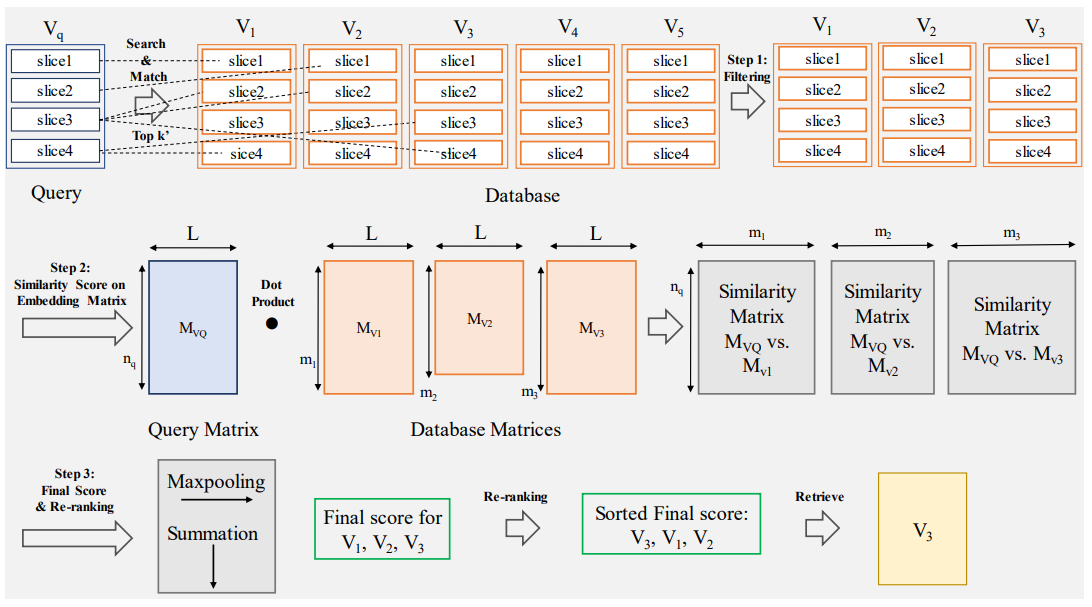
\ Figure 5: Overview of re-ranking. Step 1: Filtering based on at least one similar slice leads to the selection of candidate volumes Step 2: followed by similarity score computation using dot product on the normalized embedding matrices. Step 3: The final step involves max-pooling and summation to determine the top-scoring volumes for retrieval.
\ for each token in the query and document, and it measures relevance as the total of maximum similarities between each query vector and all vectors within the document [Santhanam et al., 2021]. This late interaction approach allows for a more refined and contextually aware retrieval process, thereby enhancing the quality of information retrieval.

\ Inspired by ColBERT we introduce a two-stage method in which filtering of the search space is performed and the total similarity of the entire target volume is considered to re-rank and score the retrieved volumes. To create an analogy to the ColBERT method each word can be considered as one slice and each passage of the database or each question of the query can be considered as one volume. Instead of the BERT encoder for the image retrieval task, the pre-trained vision models can be used to create the embeddings as discussed in Section 2.2.

\ An overview of the proposed method is shown in Figure 5. The method consists of the following steps:

\ 2.5.1 Step 1: Filtering

\

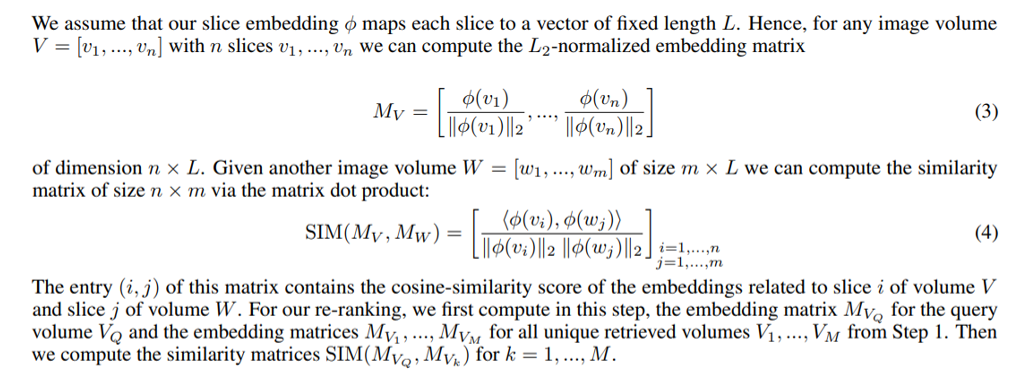
\ 2.5.2 Step 2: Similarity Score on Embedding Matrix

\
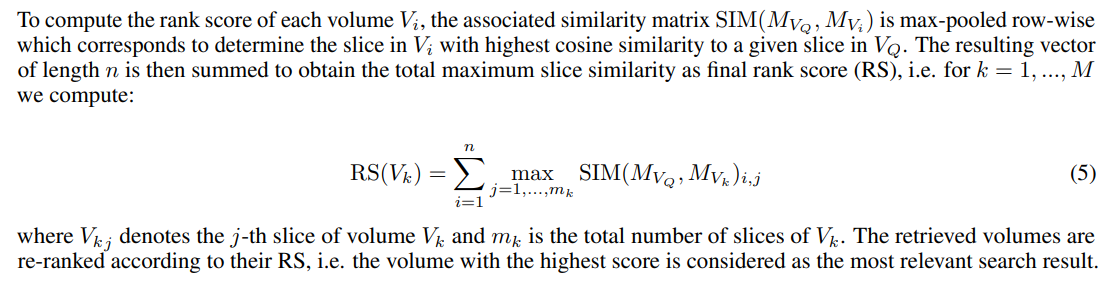
\ 2.5.3 Step 3: Final Score and Re-ranking

\
\ 2.5.4 Localization with Re-ranking

\ In section 2.4.3 we proposed a measure for assessing the capabilities of the search system to localize anatomical regions of interest. This localization measure relied on the hit slices that were finally retrieved by count-based aggregation. As described above, re-ranking may select a volume with a lower total hit count as the final search result based on a more fine-grained similarity measure. We propose to utilize this similarity information to identify slices of maximal similarity with the query data in order to localize the anatomical region of interest.

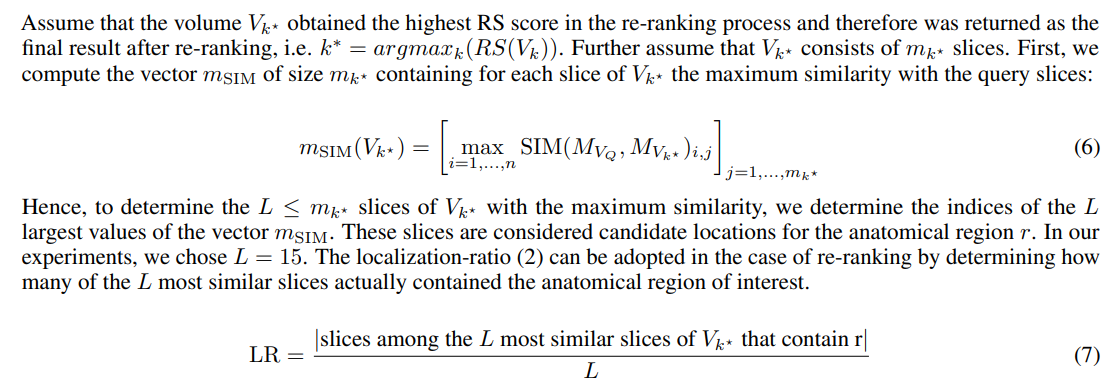
\ In detail, after having obtained the most relevant search result via re-ranking, we need to identify the most relevant slices that could contain the anatomical region of interest r. To this end, we consider the slices that highly contribute to the final RS score (5). Since the full similarity matrices (4) for all candidates from the first search stage are available, we can utilize these to identify the locations of maximum similarity between the query and candidate slices.

\
\

:::info Authors:

(1) Farnaz Khun Jush, Bayer AG, Berlin, Germany ([email protected]);

(2) Steffen Vogler, Bayer AG, Berlin, Germany ([email protected]);

(3) Tuan Truong, Bayer AG, Berlin, Germany ([email protected]);

(4) Matthias Lenga, Bayer AG, Berlin, Germany ([email protected]).

:::


:::info This paper is available on arxiv under CC BY 4.0 DEED license.

:::

\

Market Opportunity
Wink Logo
Wink Price(LIKE)
$0.002697
$0.002697$0.002697
0.00%
USD
Wink (LIKE) Live Price Chart
Disclaimer: The articles reposted on this site are sourced from public platforms and are provided for informational purposes only. They do not necessarily reflect the views of MEXC. All rights remain with the original authors. If you believe any content infringes on third-party rights, please contact [email protected] for removal. MEXC makes no guarantees regarding the accuracy, completeness, or timeliness of the content and is not responsible for any actions taken based on the information provided. The content does not constitute financial, legal, or other professional advice, nor should it be considered a recommendation or endorsement by MEXC.

You May Also Like

Lucid to begin full Saudi manufacturing in 2026

Lucid to begin full Saudi manufacturing in 2026

Lucid Group, the US carmaker backed by the Public Investment Fund (PIF), reportedly plans to start full-scale vehicle manufacturing in Saudi Arabia this year, transitioning
Share
Agbi2026/01/15 15:52
Exploring Market Buzz: Unique Opportunities in Cryptocurrencies

Exploring Market Buzz: Unique Opportunities in Cryptocurrencies

In the ever-evolving world of cryptocurrencies, recent developments have sparked significant interest. A closer look at pricing forecasts for Cardano (ADA) and rumors surrounding a Solana (SOL) ETF, coupled with the emergence of a promising new entrant, Layer Brett, reveals a complex market dynamic. Cardano's Prospects: A Closer Look Cardano, a stalwart in the blockchain space, continues to hold its ground with its research-driven development strategy. The latest price predictions for ADA suggest potential gains, predicting a double or even quadruple increase in its valuation. Despite these optimistic forecasts, the allure of exponential gains drives traders toward more speculative ventures. The Buzz Around Solana ETF The potential introduction of a Solana ETF has the crypto community abuzz, potentially catapulting SOL prices to new heights. As investors await regulatory decisions, the impact of such an ETF on Solana's value could be substantial, potentially reaching up to $300. However, as with Cardano, the substantial market capitalization of Solana may temper its growth potential. Why Layer Brett is Gaining Traction Amidst established names, a new contender, Layer Brett, has started to capture the market's attention with its early presale stages. Offering a low entry price of just $0.0058 and promising over 700% in staking rewards, Layer Brett presents a tempting proposition for those looking to maximize returns. Comparative Analysis: ADA, SOL, and $LBRETT While both ADA and SOL offer stable investment choices with reliable growth, Layer Brett emerges as a high-risk, high-reward option that could potentially offer significantly higher returns due to its nascent market position and aggressive economic model. Initial presale pricing lets investors get in on the ground floor. Staking rewards currently exceed 690%, a persuasive incentive for early adopters. Backed by Ethereum's Layer 2 for enhanced transaction speed and reduced costs. A community-focused $1 million giveaway to further drive engagement and investor interest. Predicted by some analysts to offer up to 50x returns in coming years. Shifting Sands: Investor Movements As the crypto market landscape shifts, many investors, including those traditionally holding ADA and SOL, are beginning to diversify their portfolios by turning to high-potential opportunities like Layer Brett. The combination of strategic presale pricing and significant staking rewards is creating a momentum of its own. Act Fast: Time-Sensitive Opportunities As September progresses, opportunities to capitalize on these low entry points and high yield offerings from Layer Brett are likely to diminish. With increasing attention and funds being directed towards this new asset, the window to act is closing quickly. Invest in Layer Brett now to secure your position before the next price hike and staking rewards reduction. For more information, visit the Layer Brett website, join their Telegram group, or follow them on X by clicking the following links: Website Telegram X Disclaimer: This is a sponsored press release and is for informational purposes only. It does not reflect the views of Bitzo, nor is it intended to be used as legal, tax, investment, or financial advice.
Share
Coinstats2025/09/18 18:39
United Kingdom Trade Balance; non-EU declined to £-11.457B in November from previous £-10.255B

United Kingdom Trade Balance; non-EU declined to £-11.457B in November from previous £-10.255B

The post United Kingdom Trade Balance; non-EU declined to £-11.457B in November from previous £-10.255B appeared on BitcoinEthereumNews.com. Gold loses ground after
Share
BitcoinEthereumNews2026/01/15 16:23