Learn how a Bayesian Network model predicts defective story points in Extreme Programming.Learn how a Bayesian Network model predicts defective story points in Extreme Programming.

The Defected Story Points Model in Extreme Programming

2025/08/27 23:00
2 min read

Abstract and 1. Introduction

  1. Background and 2.1. Related Work

    2.2. The Impact of XP Practices on Software Productivity and Quality

    2.3. Bayesian Network Modelling

  2. Model Design

    3.1. Model Overview

    3.2. Team Velocity Model

    3.3. Defected Story Points Model

  3. Model Validation

    4.1. Experiments Setup

    4.2. Results and Discussion

  4. Conclusions and References

3.3. Defected Story Points Model

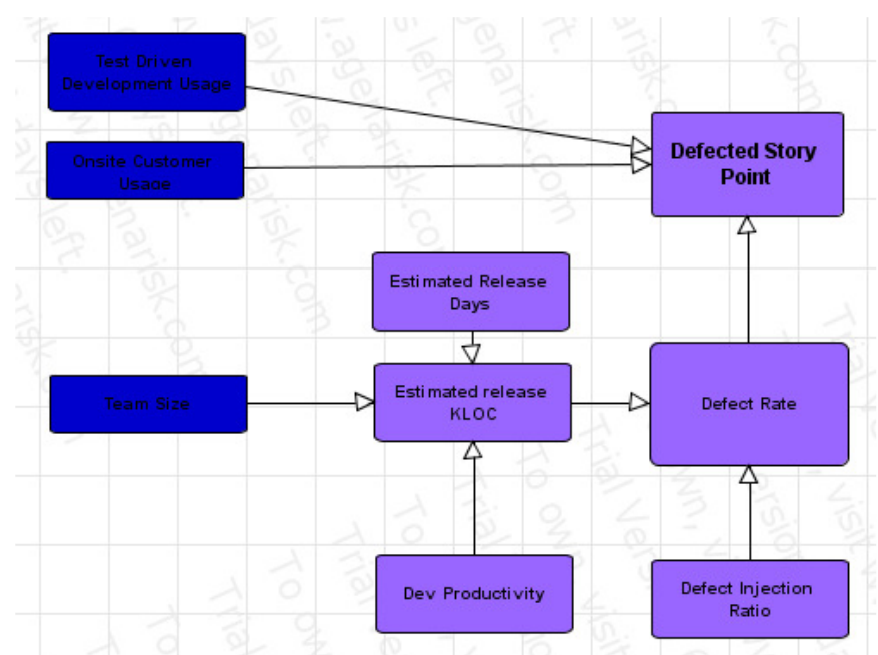
This model calculates an estimate number for the defected story points to be redeveloped in the next release. This number is affected by two XP practices: Test Driven development and Onsite Customer practices. Different components of the model are described as follows:

\

  • Dev. Productivity: The developer productivity measured as the number Line Of Code (LOC) per day. According to the literature [4], a normal distribution with mean 40 and Standard Deviation of 20 represents this value.

    \

  • Estimated Release KLOC: represents the number of KLOC produced from this release. This value is calculated as the product of multiplying Dev. Productivity times Team size times Estimated Release Days.

    \

  • Defect Injection Ratio: represents the number of defects per KLOC. This value was set to a normal distribution with mean 20 and standard deviation 5 [4].

    \

  • Defect Rate: represents the number of defects in this release. It is calculated as the multiplication of the Estimated Release KLOC times Defect Injection Ratio.

    \

  • Defected Story Points: This value represents the number of defected story points to be re-developed in the next release taking into account the impact of two XP practices: Test Driven development and Onsite Customer practices (Equation 3). OSCImpactFactor and TDDImpactFactor represent the impact of the Onsite Customer and Test Driven development practices on reducing the defect rate. According to the literature, there values were set to 0.8 and 0.4 respectively [3],[4]. More details regarding the impact of these practices in the defect rate are available in the Background section.

\ DefectedStoryPoints = DefectRate*(1- OSCImpactFactor * onsitecustomerusage )*(1 TDDImpactFactor *tddusage) Equation (3)

\ Figure 5 Defected Story Points Model
\

:::info Authors:

(1) Mohamed Abouelelam, Software System Engineering, University of Regina, Regina, Canada;

(2) Luigi Benedicenti, Software System Engineering, University of Regina, Regina, Canada.

:::


:::info This paper is available on arxiv under CC BY-NC-ND 4.0 DEED license.

:::

\

Market Opportunity
Brainedge Logo
Brainedge Price(LEARN)
$0.007568
$0.007568$0.007568
+0.13%
USD
Brainedge (LEARN) Live Price Chart
Disclaimer: The articles reposted on this site are sourced from public platforms and are provided for informational purposes only. They do not necessarily reflect the views of MEXC. All rights remain with the original authors. If you believe any content infringes on third-party rights, please contact [email protected] for removal. MEXC makes no guarantees regarding the accuracy, completeness, or timeliness of the content and is not responsible for any actions taken based on the information provided. The content does not constitute financial, legal, or other professional advice, nor should it be considered a recommendation or endorsement by MEXC.

You May Also Like

Is Hyperliquid the new frontier for innovation?

Is Hyperliquid the new frontier for innovation?

The post Is Hyperliquid the new frontier for innovation? appeared on BitcoinEthereumNews.com. This is a segment from the 0xResearch newsletter. To read full editions, subscribe. One of the key things I like to track in crypto is a subjective criterion I call “where are new interesting developments and proposals taking place.” There are plenty of dashboards and analytics sites for this, the most popular being the Electric Capital site. The issue is that it still shows Polkadot as having a lot of developers. (At Blockworks we solved the noise problem with active users; maybe we can try the same for active developers.) Because of this noise, I prefer to track two simple observations: What is the velocity of new products launching, and how much mindshare are these products capturing? Are many people getting nerdsniped into discussing the novelties and intricacies of the chain? A related point is the caliber of people being attracted to new ecosystems. For example, over the past few years, Solana (and Ethereum) attracted the majority of talent. Talent generally goes where: It can solve interesting problems or create interesting projects. It can make a lot of money. In a podcast I did with Icebergy about a year ago, we discussed how crypto still wasn’t attracting talent at the levels AI was, despite offering faster exits and more money. AI was (and probably still is) more interesting to most talent and seen as more prestigious. After FTX, crypto lost a lot of credibility and has only recently started recovering as larger institutional players re-entered. Apart from FTX, crypto has also been criticized for being full of low-effort forks and limited utility products. This dynamic isn’t unique to crypto though. Many AI companies are also just building wrappers around GPT, which is as uninteresting as some projects in crypto. Anyway, to the point: Historically, Solana has captured the majority of…
Share
BitcoinEthereumNews2025/09/18 08:13
Vitalik Buterin Maps Quantum Upgrade to Ethereum to Replace Core Cryptography

Vitalik Buterin Maps Quantum Upgrade to Ethereum to Replace Core Cryptography

The post Vitalik Buterin Maps Quantum Upgrade to Ethereum to Replace Core Cryptography appeared on BitcoinEthereumNews.com. In brief Buterin pointed out four Ethereum
Share
BitcoinEthereumNews2026/02/27 07:44
Power Protocol Surges 96%: On-Chain Data Reveals Why POWER Entered Top 115

Power Protocol Surges 96%: On-Chain Data Reveals Why POWER Entered Top 115

Power Protocol's native token has posted a stunning 96% gain in 24 hours, propelling it to rank #115 with a $381.6 million market cap. Our analysis of on-chain
Share
Blockchainmagazine2026/02/27 07:07