

RWA Issuers Focus on Fundraising Over Secondary Market Liquidity
A report released on February 20, 2026, by tokenization platform Brickken shows that issuers of real-world assets (RWAs) are primarily using blockchain technology to improve capital formation, not to create immediate secondary market liquidity.
The findings suggest that tokenization is being treated first as a fundraising infrastructure tool rather than a trading solution.
Capital Formation Is the Main Driver
The survey, conducted in Q4 2025, included issuers from sectors such as technology (31.6%), entertainment (15.8%), and private credit (15.8%).
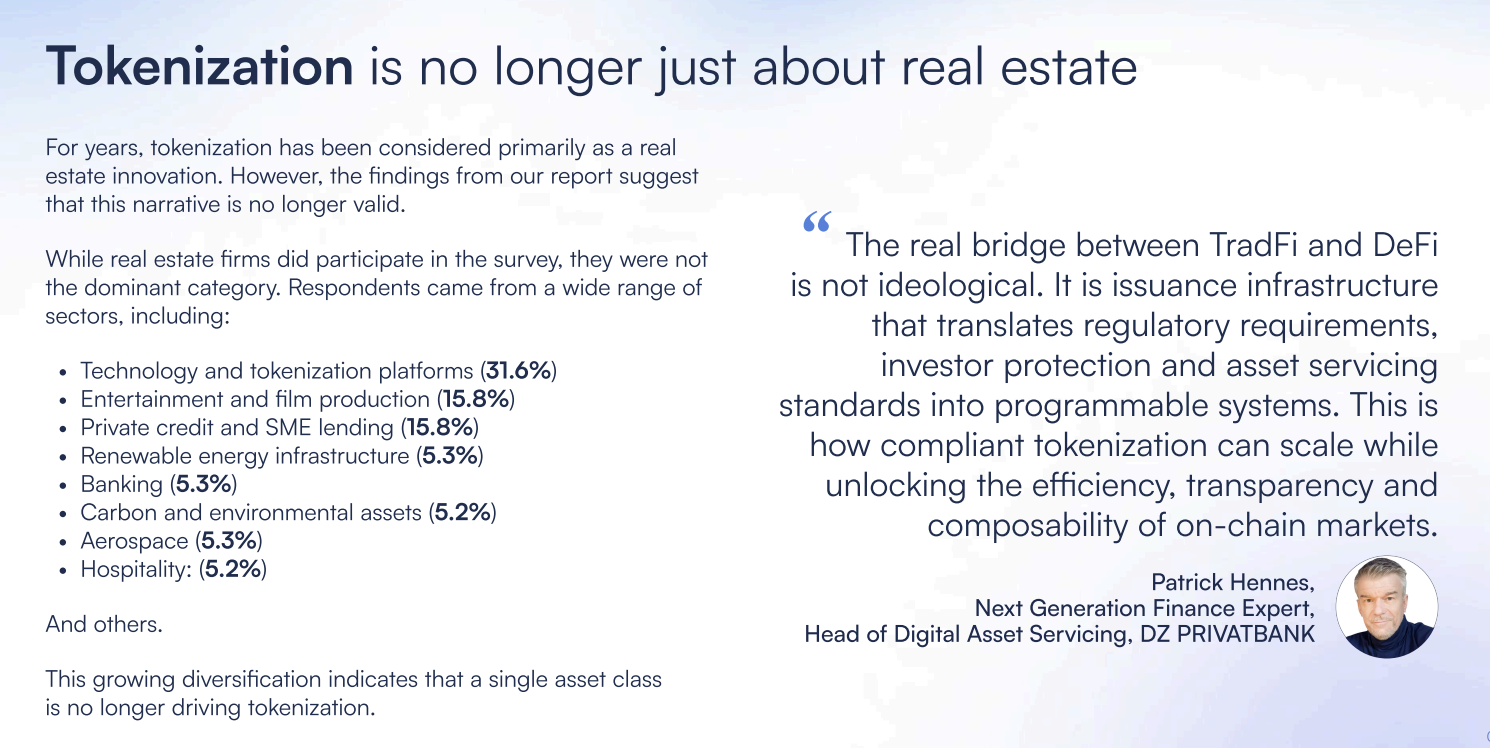 Source: https://drive.google.com/file/d/1FeoES838fzR1J59KsAgCCaZ8JGmFhcWr/view
According to the results, 53.8% of respondents said their primary reason for tokenizing assets was to improve capital formation and fundraising efficiency. In contrast, only 15.4% cited liquidity as their main motivation.
While liquidity is not a current priority for many projects, expectations are shifting. About 38.4% said they do not presently require secondary market access, but 46.2% anticipate needing liquidity within six to twelve months.
Notably, 69.2% of surveyed issuers have already completed the tokenization process and are currently live.
Regulation Remains the Main Barrier
Regulatory friction continues to be the dominant challenge. A substantial 84.6% of respondents reported encountering regulatory hurdles during rollout. By comparison, only 13% identified technology or development issues as their biggest obstacle.
Brickken’s Chief Marketing Officer Jordi Esturi commented that tokenization is moving beyond being a “buzzword” and is increasingly becoming a core financial infrastructure layer for accessing capital.
Asset Types Are Expanding
While early tokenization efforts were heavily concentrated in real estate, the asset mix is broadening. Currently, 28.6% of tokenized or planned assets are equity or shares, followed by intellectual property and entertainment assets at 17.9%.
This diversification indicates that tokenization is spreading beyond property markets into corporate finance and creative industries.
Infrastructure Catching Up
The shift toward issuance infrastructure comes as traditional exchanges such as the NYSE and Nasdaq explore 24/7 trading models for tokenized assets. These developments could eventually connect primary capital formation with more robust secondary market liquidity.
For now, however, the data suggests that most issuers view tokenization as a capital-raising tool first, with liquidity emerging as a later-stage objective rather than an immediate priority.
The post RWA Issuers Focus on Fundraising Over Secondary Market Liquidity appeared first on ETHNews.


You May Also Like
Pepe Coin Price Prediction 2026: Pepeto Presale Gains as EDX Markets Files for National Bank Charter

Bitcoin Depot Reports $3.7M Loss after Breach of Corporate Wallets




