

ETH Restaking Trade Turns Negative as Borrow Costs Overtake Yields
According to a tweet by Sentora, the DeFi leveraged ETH restaking carry trade has officially shifted into negative carry territory.
What was previously a yield-enhancing strategy built on borrowing ETH to capture spreads from liquid staking (LSTs) and liquid restaking tokens (LRTs) is now structurally underwater.
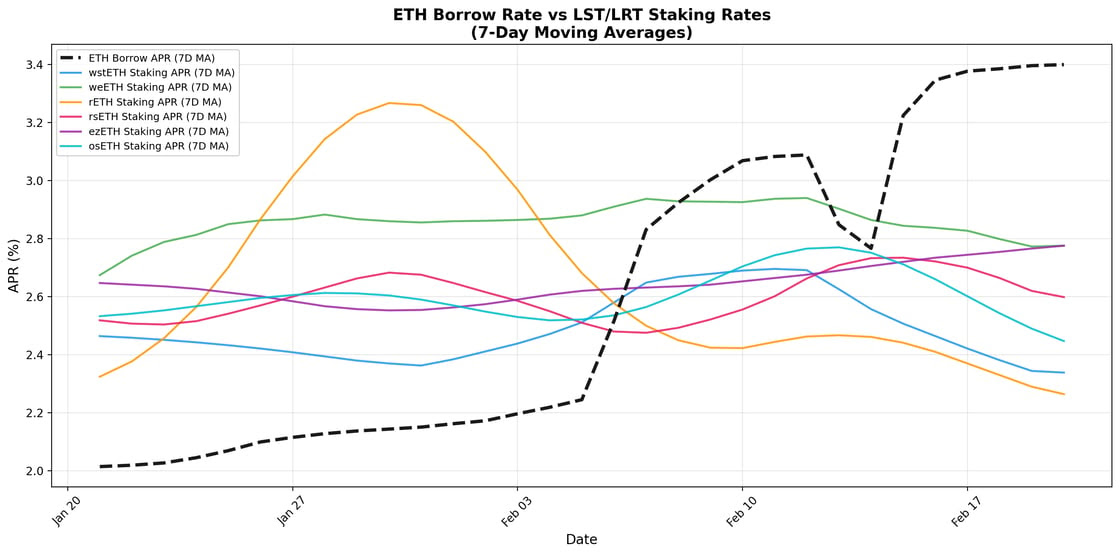
As of February 20, 2026, the debt-weighted average cost of borrowing ETH stands at 3.40%, exceeding the staking yields offered by all major LSTs and LRTs tracked in Sentora’s coverage universe.
The Structural Crossover
After analyzing the provided chart, it is visible that the 7-day moving average of the debt-weighted ETH borrow rate (represented by the black dashed line) has steadily climbed since late January.
 Source: https://x.com/SentoraHQ/status/2024892327462944990
Borrow rates rose from approximately 2.0% to over 3.4% by mid-February. During that same period, staking and restaking yields (represented by colored lines) remained flat or slightly declined.
The chart clearly shows the crossover point, where borrowing costs exceeded protocol yields, creating a persistent negative spread.
This divergence reflects two structural trends:
- Increased validator participation diluting staking yields
- High utilization in lending markets pushing borrowing costs higher
The result is a structurally inverted carry trade.
Impact on Leveraged Positions
For institutions employing recursive leverage strategies, the math has flipped.
A standard 5x leveraged wstETH position now generates an estimated -1.90% annualized return under current spreads. During peak utilization events, when borrow rates spike above 6%, annualized losses can widen dramatically to -15% to -18%.
The asymmetry is key. Staking yields have a natural ceiling, tied to protocol emissions and validator participation. Borrowing costs, however, are theoretically unbounded as lending market utilization approaches 100%.
After analyzing the risk profile, it becomes visible that leveraged restaking is no longer yield-enhancing, it is yield-destructive under current conditions.
Liquidity and Exit Risks
Deleveraging these positions introduces additional complications.
Secondary Market Depth
Liquidity-to-TVL ratios for certain LRTs remain extremely thin. For example, weETH shows a ratio of approximately 0.035%, meaning large exits could trigger severe slippage if done through secondary markets.
Duration Mismatch
Native redemptions are not instantaneous. Beacon chain withdrawals require roughly 9 days, and certain liquid staking protocols may take even longer.
Compounding Borrow Costs
Borrowers remain exposed to fluctuating interest rates throughout the multi-week exit window. If rates spike during this period, losses compound.
Systemic Concentration Risk
A large portion of ETH borrowing appears concentrated in carry trade strategies. If multiple institutions attempt to unwind simultaneously, utilization rates could spike further, pushing borrow costs higher and amplifying volatility across lending markets.
What This Signals
After analyzing Sentora’s data, it is visible that the leveraged ETH restaking carry trade has entered a structurally negative phase.
What was once a relatively stable yield spread has inverted due to ecosystem maturation and elevated lending utilization. The environment now introduces:
- Negative carry
- High exit friction
- Asymmetric risk exposure
The broader implication is not simply lower returns, but increased fragility in a widely adopted institutional strategy. If borrowing costs remain elevated or rise further, synchronized deleveraging could become a meaningful source of volatility in the Ethereum ecosystem.
The post ETH Restaking Trade Turns Negative as Borrow Costs Overtake Yields appeared first on ETHNews.


You May Also Like

Will Iran Really Accept Bitcoin for Passages Through the Strait of Hormuz?

Reiterated XRP Price Prediction: Dom Kwok Calls $1000. Here’s the Timeline




