Global tariff policy dominated the weekend news cycle as the United States further expanded a tariff strategy that has rattled risk assets, including crypto marketsGlobal tariff policy dominated the weekend news cycle as the United States further expanded a tariff strategy that has rattled risk assets, including crypto markets

Trump hikes global tariffs to 15%, crypto markets unfazed
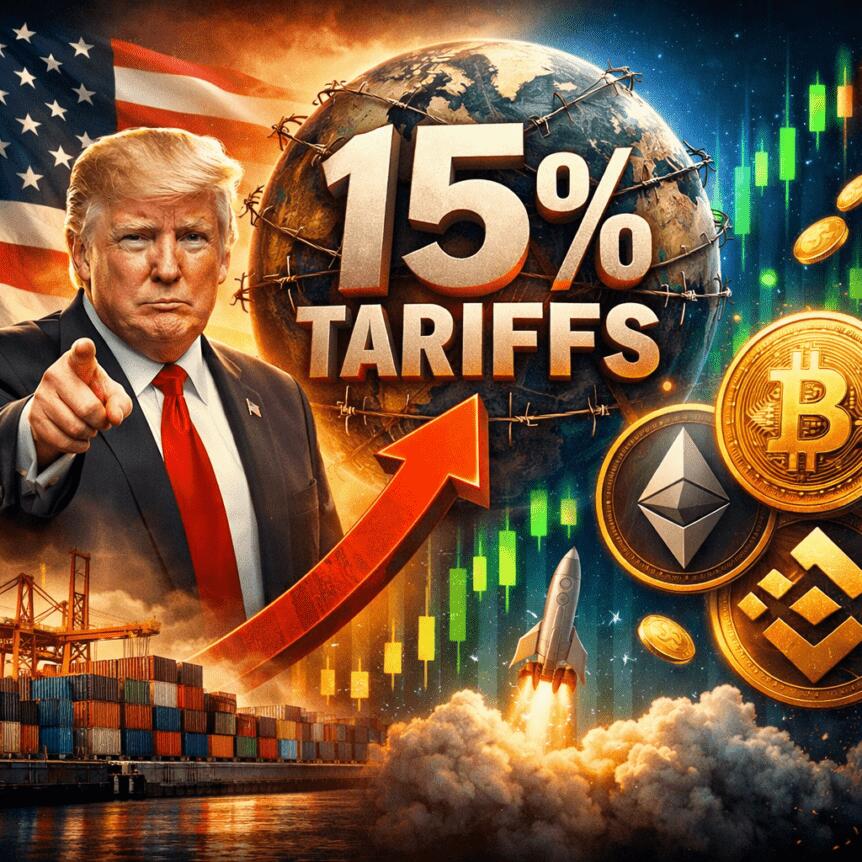
Trump Hikes Global Tariffs To 15%, Crypto Markets Unfazed

Global tariff policy dominated the weekend news cycle as the United States further expanded a tariff strategy that has rattled risk assets, including crypto markets. In a late-Friday move, a 10% global tariff was announced, layered atop existing duties. On Saturday, President Donald Trump signaled an immediate increase to 15% and intensified his critique of the Supreme Court’s ruling that he believed restricted his power under the International Emergency Economic Powers Act (IEEPA). The constitutional and statutory questions remain contested, with critics arguing the scope and duration of such tariffs can be constrained by courts and Congress. Against this backdrop, traders watched how policy risk would filter through liquidity, leverage, and investor sentiment across traditional and digital markets, even as some crypto assets showed notable resilience amid the headlines.

Key takeaways

  • The president raised the global tariff from 10% to 15% with immediate effect, expanding a policy stance that officials described as a corrective measure against perceived imbalances.
  • The legal basis for broad tariffs remains under dispute, with proponents pointing to the Trade Expansion Act of 1962 and the Trade Act of 1974, while critics highlight limits identified by the Supreme Court and calls for congressional oversight.
  • Crypto markets showed relative composure despite the tariff news: Bitcoin traded near $68,000 and Ethereum remained broadly unchanged, even as the broader market indicator Total3 slid less than 1% to around $713 billion.
  • Analysts highlighted that the legal mechanism cited by the administration could constrain the duration and scope of tariffs, particularly for deficits with specific countries, a point underscored by a prominent crypto attorney.
  • Historically, tariff announcements have stirred volatility in crypto and equities, but this episode illustrated a degree of resilience in the sector as policy uncertainty persisted.

Tickers mentioned: $BTC, $ETH

Sentiment: Neutral

Price impact: Neutral. Crypto assets showed limited immediate reaction, with BTC hovering around the prior level and ETH largely stable.

Trading idea (Not Financial Advice): Hold. In the absence of a clear macro-trigger for a sustained move, maintaining existing exposure and watching policy developments is prudent.

Market context: The tariff news appeared to translate into modest shifts within the crypto complex, with BTC and ETH holding their ground while the broader market cap (as measured by TOTAL3) softened only slightly, suggesting a measured risk stance among traders amid regulatory maneuvering.

Why it matters

The episode underscores the sensitivity of crypto assets to macro and regulatory developments, even when specific policy actions are framed as targeted or temporary. While the immediate tariff step and the surrounding legal debates may appear distant from on-chain activity, macro risk sentiment often travels through asset classes in tandem. The resilience observed in major digital assets during the latest headlines points to a broader trend: liquidity and risk appetite in crypto can persist even amid policy shocks, at least in the near term.

From a policy perspective, the episode highlights the complex interplay between executive authority, judicial interpretation, and congressional checks. The administration’s reliance on IEEPA and related statutes has long been a point of contention among legal scholars and market participants alike. Crypto advocates and lawyers have argued that the scope of such powers is inherently limited and time-bound, which can mitigate longer-term distortions in markets. The discussion around duration—cited as potentially 150 days or a finite window—appears to be a critical variable for traders monitoring macro risk in the coming months.

For investors, the news reinforces the importance of differentiating policy risk from sector fundamentals. While tariffs can trigger short-lived liquidity hits, many crypto participants emphasize that network fundamentals, adoption pace, and institutional interest remain drivers of longer-term price trajectories. The incident also brings attention to the role of public commentary and official communications in shaping risk premiums, as market participants parse statements from presidents, lawmakers, and legal commentators for clues about future policy steps.

What to watch next

  • Monitoring any additional tariff announcements or amendments to the policy framework, including statements from the White House and Congress.
  • Watch for updates on the legal interpretation of IEEPA authority and potential judicial checks that could constrain the administration’s tariff powers.
  • Track market liquidity and risk sentiment across crypto and traditional markets as traders digest policy signals and macro data releases.
  • Follow commentary from legal scholars and industry attorneys about the duration and geographic scope of tariffs, and whether carve-outs or exemptions emerge.
  • Observe on-chain indicators and exchange flows that may reveal subtle shifts in demand for flagship assets like Bitcoin and Ether as policy risk evolves.

Sources & verification

  • Official statements and post-announcements from the Trump administration regarding the 15% tariff level and the rationale behind the move.
  • Legal analysis and public commentary on IEEPA authority, including references to the Supreme Court decision that framed the scope of presidential tariff power.
  • Crypto market data and price movements for Bitcoin and Ethereum around the tariff headlines, including price levels cited (BTC near $68,000; ETH broadly unchanged) and the TOTAL3 market-cap indicator around $713 billion.
  • Public remarks from Adam Cochran on the limits of the tariff powers and the 150-day window for any measures under the cited statutes.
  • Trade and market coverage documenting the relationship between tariff announcements and moves in crypto and traditional asset classes.

Tariff escalation tests crypto risk appetite

In a move that intensified an ongoing policy debate, President Donald Trump announced on Saturday that the 10% global tariff would be raised to 15% with immediate effect. The action extended a tariff framework that had already unsettled markets when new levies were proposed and when the courts weighed in on the administration’s authority. The president framed the increase as a legally tested step, asserting that it targets deficits with various countries and would be calibrated within the boundaries of the law. In a Saturday Truth Social post, he declared that he would be “effective immediately, raising the 10% worldwide tariff on countries, many of which have been ‘ripping’ the US off for decades, without retribution, until I came along, to the fully allowed, and legally tested, 15% level.”

Earlier on Friday, the administration had signaled a 10% global tariff as a base level, to be added to pre-existing duties, and had invoked legal measures under the Trade Expansion Act of 1962 and the Trade Act of 1974. The move followed a ruling from the Supreme Court that some argued curtailed presidential authority under IEEPA, complicating the administration’s ability to enact sweeping levies without further legislative action. Crypto enthusiasts and industry observers noted that the legal framing matters because it could limit the duration and reach of the tariffs, particularly for deficits with specific partners. Pro-crypto attorney Adam Cochran highlighted the practical constraints, noting that the law in question applies to a defined set of countries for a finite period and at a capped rate, reducing the likelihood of unfettered, long-term application.

Markets often respond to tariff developments with a tilt toward risk-off behavior, and the immediate reaction can be pronounced in sectors sensitive to global liquidity, leverage, and cross-border trade dynamics. Yet in this cycle, the crypto space demonstrated relative steadiness in the face of the tariff news. Bitcoin (CRYPTO: BTC) price movements remained largely tethered to prior levels, while Ethereum (CRYPTO: ETH) exhibited similar resilience. Data from market trackers showed BTC near the $68,000 mark and ETH holding broadly steady, with the Total3 indicator—representing the combined market capitalization of crypto assets excluding BTC and ETH—falling less than 1% to roughly $713 billion, suggesting that investors differentiated policy risk from fundamental demand for large-cap digital assets.

The narrative around policy power and market impact is ongoing. The tariff announcements have sparked discussions among lawmakers about potential economic consequences, and observers will be watching for signals about the trajectory of regulatory policy, potential exemptions, and the duration of any temporary measures. In the meantime, traders are parsing the implications for risk sentiment, liquidity, and cross-asset correlations as the policy landscape continues to evolve. The interplay between legal interpretation and executive action will likely shape the near-term volatility spectrum for crypto and traditional markets alike.

This article was originally published as Trump hikes global tariffs to 15%, crypto markets unfazed on Crypto Breaking News – your trusted source for crypto news, Bitcoin news, and blockchain updates.


Market Opportunity
OFFICIAL TRUMP Logo
OFFICIAL TRUMP Price(TRUMP)
$3.419
$3.419$3.419
-2.97%
USD
OFFICIAL TRUMP (TRUMP) Live Price Chart
Disclaimer: The articles reposted on this site are sourced from public platforms and are provided for informational purposes only. They do not necessarily reflect the views of MEXC. All rights remain with the original authors. If you believe any content infringes on third-party rights, please contact [email protected] for removal. MEXC makes no guarantees regarding the accuracy, completeness, or timeliness of the content and is not responsible for any actions taken based on the information provided. The content does not constitute financial, legal, or other professional advice, nor should it be considered a recommendation or endorsement by MEXC.

You May Also Like

CryptoQuant: The exchange's whale ratio has risen to 0.64, with large investors dominating selling activity.

CryptoQuant: The exchange's whale ratio has risen to 0.64, with large investors dominating selling activity.

PANews reported on February 22nd that, according to a report by on-chain analytics firm CryptoQuant, the Bitcoin market is currently in the middle of a bear market
Share
PANews2026/02/22 08:42
Unprecedented Surge: Gold Price Hits Astounding New Record High

Unprecedented Surge: Gold Price Hits Astounding New Record High

BitcoinWorld Unprecedented Surge: Gold Price Hits Astounding New Record High While the world often buzzes with the latest movements in Bitcoin and altcoins, a traditional asset has quietly but powerfully commanded attention: gold. This week, the gold price has once again made headlines, touching an astounding new record high of $3,704 per ounce. This significant milestone reminds investors, both traditional and those deep in the crypto space, of gold’s enduring appeal as a store of value and a hedge against uncertainty. What’s Driving the Record Gold Price Surge? The recent ascent of the gold price to unprecedented levels is not a random event. Several powerful macroeconomic forces are converging, creating a perfect storm for the precious metal. Geopolitical Tensions: Escalating conflicts and global instability often drive investors towards safe-haven assets. Gold, with its long history of retaining value during crises, becomes a preferred choice. Inflation Concerns: Persistent inflation in major economies erodes the purchasing power of fiat currencies. Consequently, investors seek assets like gold that historically maintain their value against rising prices. Central Bank Policies: Many central banks globally are accumulating gold at a significant pace. This institutional demand provides a strong underlying support for the gold price. Furthermore, expectations around interest rate cuts in the future also make non-yielding assets like gold more attractive. These factors collectively paint a picture of a cautious market, where investors are looking for stability amidst a turbulent economic landscape. Understanding Gold’s Appeal in Today’s Market For centuries, gold has held a unique position in the financial world. Its latest record-breaking performance reinforces its status as a critical component of a diversified portfolio. Gold offers a tangible asset that is not subject to the same digital vulnerabilities or regulatory shifts that can impact cryptocurrencies. While digital assets offer exciting growth potential, gold provides a foundational stability that appeals to a broad spectrum of investors. Moreover, the finite supply of gold, much like Bitcoin’s capped supply, contributes to its perceived value. The current market environment, characterized by economic uncertainty and fluctuating currency values, only amplifies gold’s intrinsic benefits. It serves as a reliable hedge when other asset classes, including stocks and sometimes even crypto, face downward pressure. How Does This Record Gold Price Impact Investors? A soaring gold price naturally raises questions for investors. For those who already hold gold, this represents a significant validation of their investment strategy. For others, it might spark renewed interest in this ancient asset. Benefits for Investors: Portfolio Diversification: Gold often moves independently of other asset classes, offering crucial diversification benefits. Wealth Preservation: It acts as a robust store of value, protecting wealth against inflation and economic downturns. Liquidity: Gold markets are highly liquid, allowing for relatively easy buying and selling. Challenges and Considerations: Opportunity Cost: Investing in gold means capital is not allocated to potentially higher-growth assets like equities or certain cryptocurrencies. Volatility: While often seen as stable, gold prices can still experience significant fluctuations, as evidenced by its rapid ascent. Considering the current financial climate, understanding gold’s role can help refine your overall investment approach. Looking Ahead: The Future of the Gold Price What does the future hold for the gold price? While no one can predict market movements with absolute certainty, current trends and expert analyses offer some insights. Continued geopolitical instability and persistent inflationary pressures could sustain demand for gold. Furthermore, if global central banks continue their gold acquisition spree, this could provide a floor for prices. However, a significant easing of inflation or a de-escalation of global conflicts might reduce some of the immediate upward pressure. Investors should remain vigilant, observing global economic indicators and geopolitical developments closely. The ongoing dialogue between traditional finance and the emerging digital asset space also plays a role. As more investors become comfortable with both gold and cryptocurrencies, a nuanced understanding of how these assets complement each other will be crucial for navigating future market cycles. The recent surge in the gold price to a new record high of $3,704 per ounce underscores its enduring significance in the global financial landscape. It serves as a powerful reminder of gold’s role as a safe haven asset, a hedge against inflation, and a vital component for portfolio diversification. While digital assets continue to innovate and capture headlines, gold’s consistent performance during times of uncertainty highlights its timeless value. Whether you are a seasoned investor or new to the market, understanding the drivers behind gold’s ascent is crucial for making informed financial decisions in an ever-evolving world. Frequently Asked Questions (FAQs) Q1: What does a record-high gold price signify for the broader economy? A record-high gold price often indicates underlying economic uncertainty, inflation concerns, and geopolitical instability. Investors tend to flock to gold as a safe haven when they lose confidence in traditional currencies or other asset classes. Q2: How does gold compare to cryptocurrencies as a safe-haven asset? Both gold and some cryptocurrencies (like Bitcoin) are often considered safe havens. Gold has a centuries-long history of retaining value during crises, offering tangibility. Cryptocurrencies, while newer, offer decentralization and can be less susceptible to traditional financial system failures, but they also carry higher volatility and regulatory risks. Q3: Should I invest in gold now that its price is at a record high? Investing at a record high requires careful consideration. While the price might continue to climb due to ongoing market conditions, there’s also a risk of a correction. It’s crucial to assess your personal financial goals, risk tolerance, and consider diversifying your portfolio rather than putting all your capital into a single asset. Q4: What are the main factors that influence the gold price? The gold price is primarily influenced by global economic uncertainty, inflation rates, interest rate policies by central banks, the strength of the U.S. dollar, and geopolitical tensions. Demand from jewelers and industrial uses also play a role, but investment and central bank demand are often the biggest drivers. Q5: Is gold still a good hedge against inflation? Historically, gold has proven to be an effective hedge against inflation. When the purchasing power of fiat currencies declines, gold tends to hold its value or even increase, making it an attractive asset for preserving wealth during inflationary periods. To learn more about the latest crypto market trends, explore our article on key developments shaping Bitcoin’s price action. This post Unprecedented Surge: Gold Price Hits Astounding New Record High first appeared on BitcoinWorld.
Share
Coinstats2025/09/18 02:30
Taiko Makes Chainlink Data Streams Its Official Oracle

Taiko Makes Chainlink Data Streams Its Official Oracle

The post Taiko Makes Chainlink Data Streams Its Official Oracle appeared on BitcoinEthereumNews.com. Key Notes Taiko has officially integrated Chainlink Data Streams for its Layer 2 network. The integration provides developers with high-speed market data to build advanced DeFi applications. The move aims to improve security and attract institutional adoption by using Chainlink’s established infrastructure. Taiko, an Ethereum-based ETH $4 514 24h volatility: 0.4% Market cap: $545.57 B Vol. 24h: $28.23 B Layer 2 rollup, has announced the integration of Chainlink LINK $23.26 24h volatility: 1.7% Market cap: $15.75 B Vol. 24h: $787.15 M Data Streams. The development comes as the underlying Ethereum network continues to see significant on-chain activity, including large sales from ETH whales. The partnership establishes Chainlink as the official oracle infrastructure for the network. It is designed to provide developers on the Taiko platform with reliable and high-speed market data, essential for building a wide range of decentralized finance (DeFi) applications, from complex derivatives platforms to more niche projects involving unique token governance models. According to the project’s official announcement on Sept. 17, the integration enables the creation of more advanced on-chain products that require high-quality, tamper-proof data to function securely. Taiko operates as a “based rollup,” which means it leverages Ethereum validators for transaction sequencing for strong decentralization. Boosting DeFi and Institutional Interest Oracles are fundamental services in the blockchain industry. They act as secure bridges that feed external, off-chain information to on-chain smart contracts. DeFi protocols, in particular, rely on oracles for accurate, real-time price feeds. Taiko leadership stated that using Chainlink’s infrastructure aligns with its goals. The team hopes the partnership will help attract institutional crypto investment and support the development of real-world applications, a goal that aligns with Chainlink’s broader mission to bring global data on-chain. Integrating real-world economic information is part of a broader industry trend. Just last week, Chainlink partnered with the Sei…
Share
BitcoinEthereumNews2025/09/18 03:34