This article explores how re-ranking methods enhance retrieval recall across anatomical structures in AI models. By applying re-ranking, all evaluated models—DreamSim, DINOv1, and SwinTransformer—show improved performance. While DreamSim consistently achieves the best results in region-based and localized retrieval, DINOv1 and SwinTransformer also excel in specific conditions. The findings highlight how re-ranking not only raises recall rates but also strengthens localization, proving its critical role in medical imaging and anatomical AI systems.This article explores how re-ranking methods enhance retrieval recall across anatomical structures in AI models. By applying re-ranking, all evaluated models—DreamSim, DINOv1, and SwinTransformer—show improved performance. While DreamSim consistently achieves the best results in region-based and localized retrieval, DINOv1 and SwinTransformer also excel in specific conditions. The findings highlight how re-ranking not only raises recall rates but also strengthens localization, proving its critical role in medical imaging and anatomical AI systems.

Boosting Anatomical Retrieval Accuracy with Re-Ranking Methods

Abstract and 1. Introduction

  1. Materials and Methods

    2.1 Vector Database and Indexing

    2.2 Feature Extractors

    2.3 Dataset and Pre-processing

    2.4 Search and Retrieval

    2.5 Re-ranking retrieval and evaluation

  2. Evaluation and 3.1 Search and Retrieval

    3.2 Re-ranking

  3. Discussion

    4.1 Dataset and 4.2 Re-ranking

    4.3 Embeddings

    4.4 Volume-based, Region-based and Localized Retrieval and 4.5 Localization-ratio

  4. Conclusion, Acknowledgement, and References

3.2 Re-ranking

This section presents the retrieval recalls after applying the re-ranking method of Section 2.5.

\ 3.2.1 Volume-based

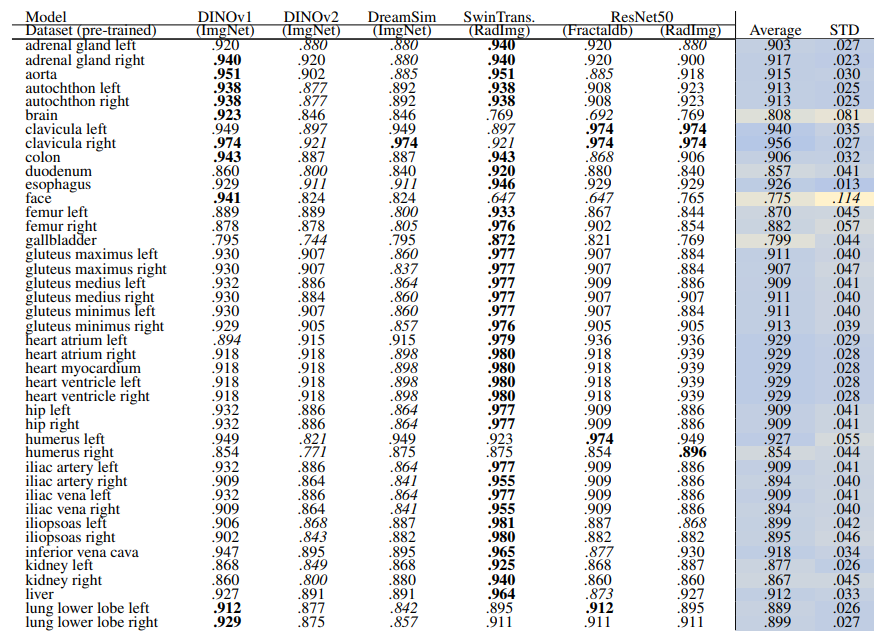
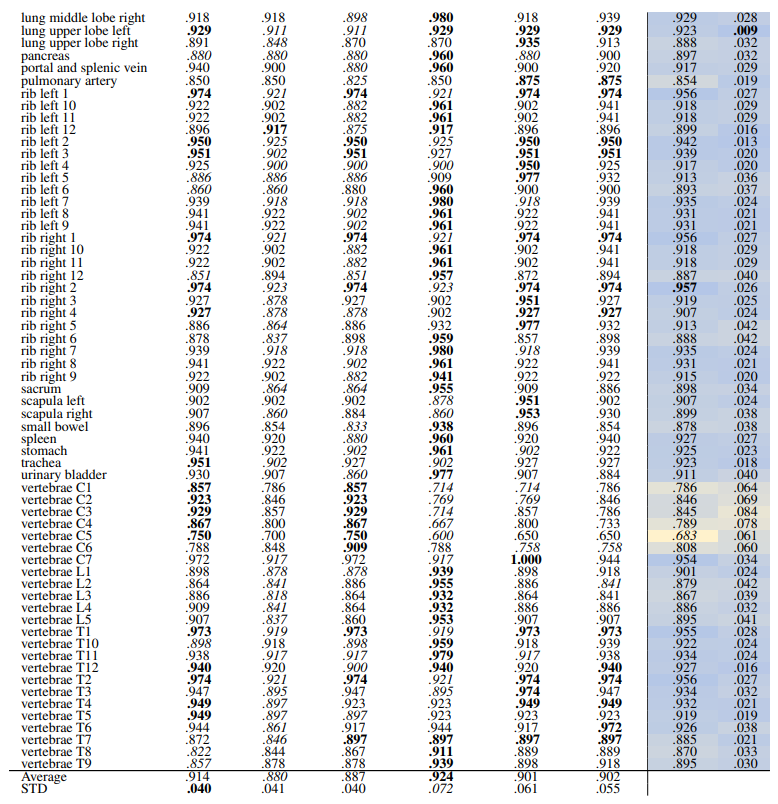
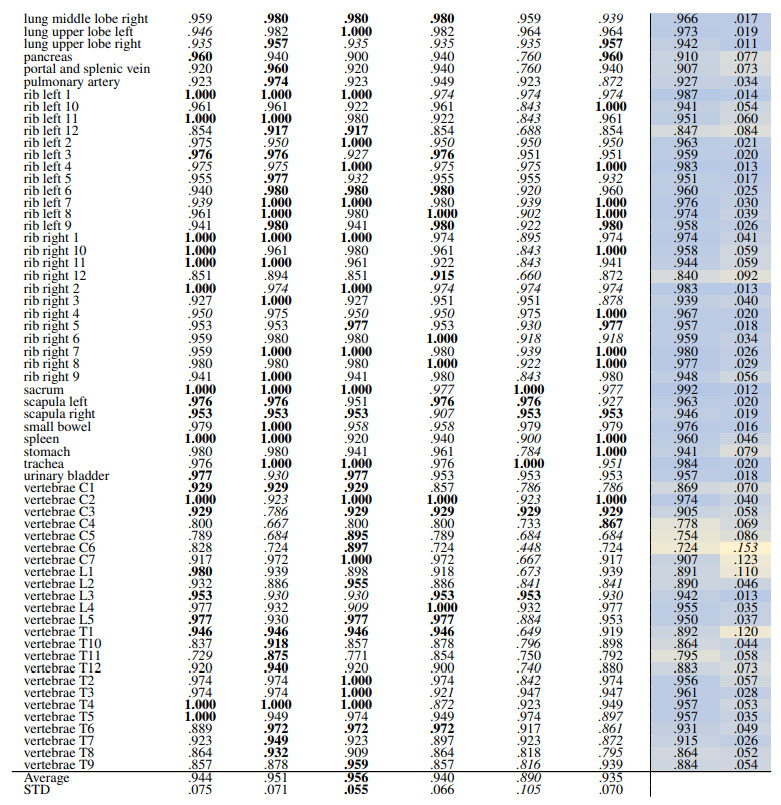
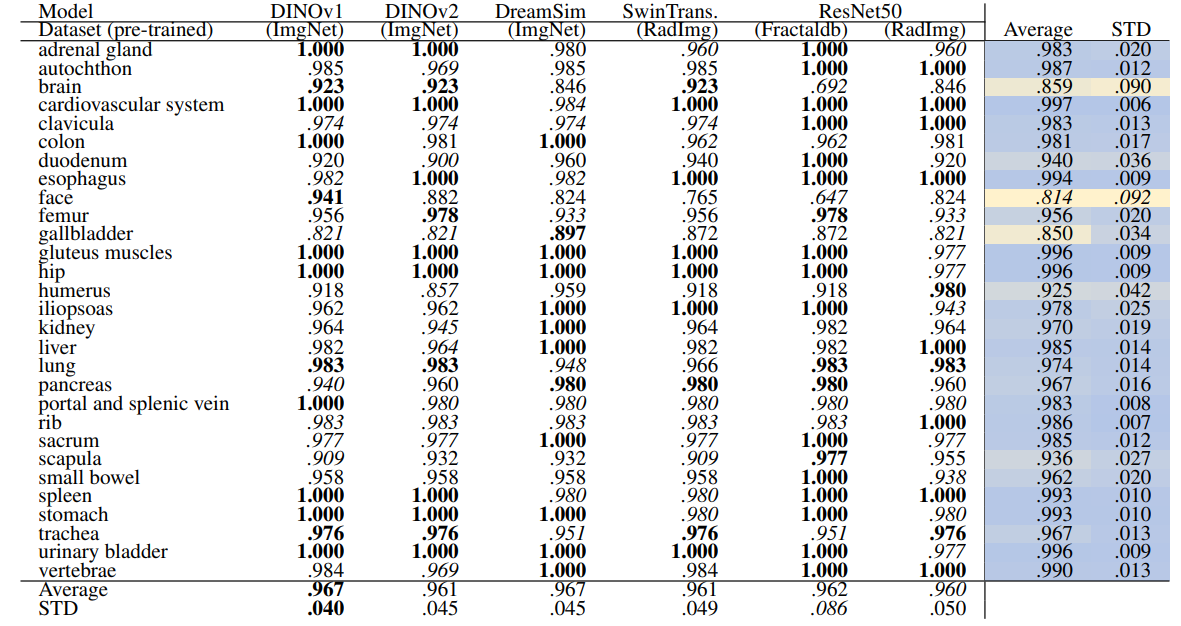
\ Table 12 and Table 13 show the retrieval recalls for 29 coarse anatomical structures and 104 original TS anatomical structures using the proposed re-ranking method. All the recalls are improved using re-ranking. The performance of the models for 29 classes is close with only slight differences. DINOv1 and DreamSim have a slightly better recall in comparison, with an average recall of .967 but the standard deviation of DINOv1 is slightly lower (.040 vs. .045). In 104 anatomical regions, SwinTransformer performs better than the other models with an average recall of .924 but its standard deviation (.072) is the lowest.

\ Table 12: Volume-based retrieval recall of coarse anatomical regions (29 classes) using HNSW Indexing and re-ranking. In each row, bold numbers represent the best-performing values, while italicized numbers indicate the worst-performing. The separate average and standard deviation (STD) columns are color-coded, with blue indicating the best-performing values and yellow indicating the worst-performing values across different models. Additionally, bold numbers in colored columns represent the best classes in terms of average and standard deviation, while italicized values represent the worst-performing class across the models.
\ Continue with the next figure

\ Table 13: Volume-based retrieval recall of all TS anatomical regions (104 classes) using HNSW Indexing and re-ranking. In each row, bold numbers represent the best-performing values, while italicized numbers indicate the worst-performing. The separate average and standard deviation (STD) columns are color-coded, with blue indicating the best-performing values and yellow indicating the worst-performing values across different models. Additionally, bold numbers in colored columns represent the best classes in terms of average and standard deviation, while italicized values represent the worst-performing class across the models.

\ 3.2.2 Region-based

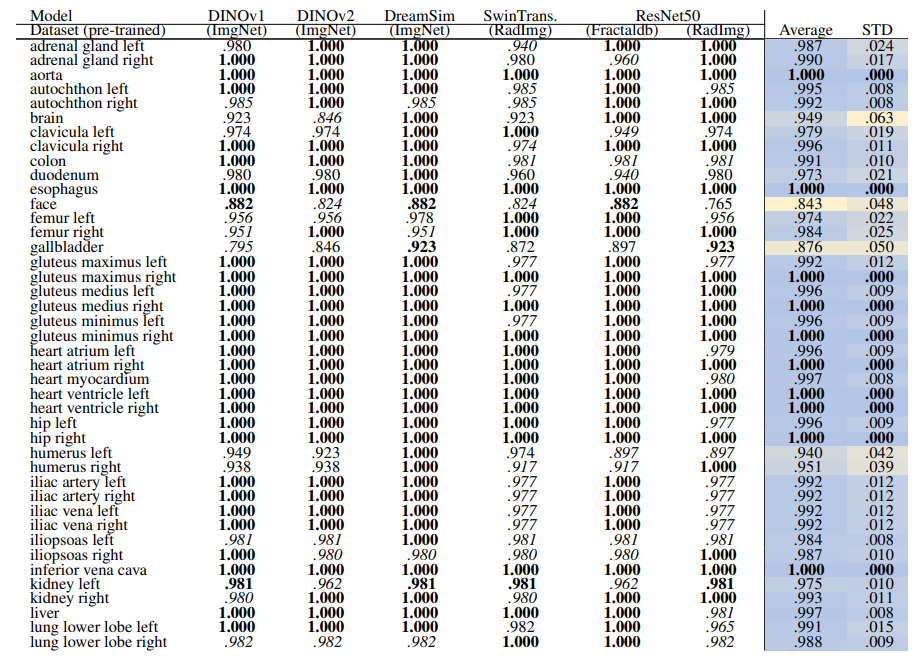
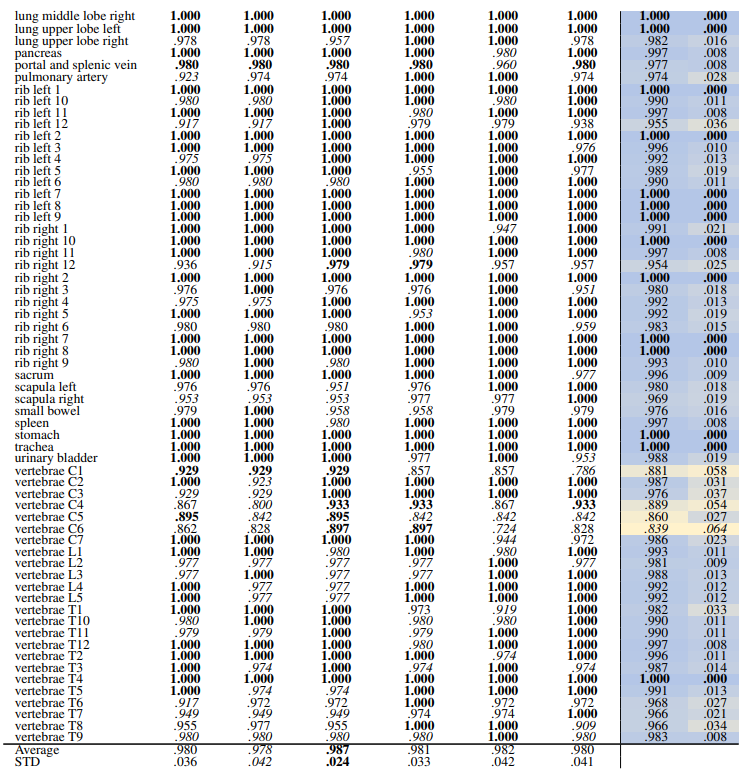
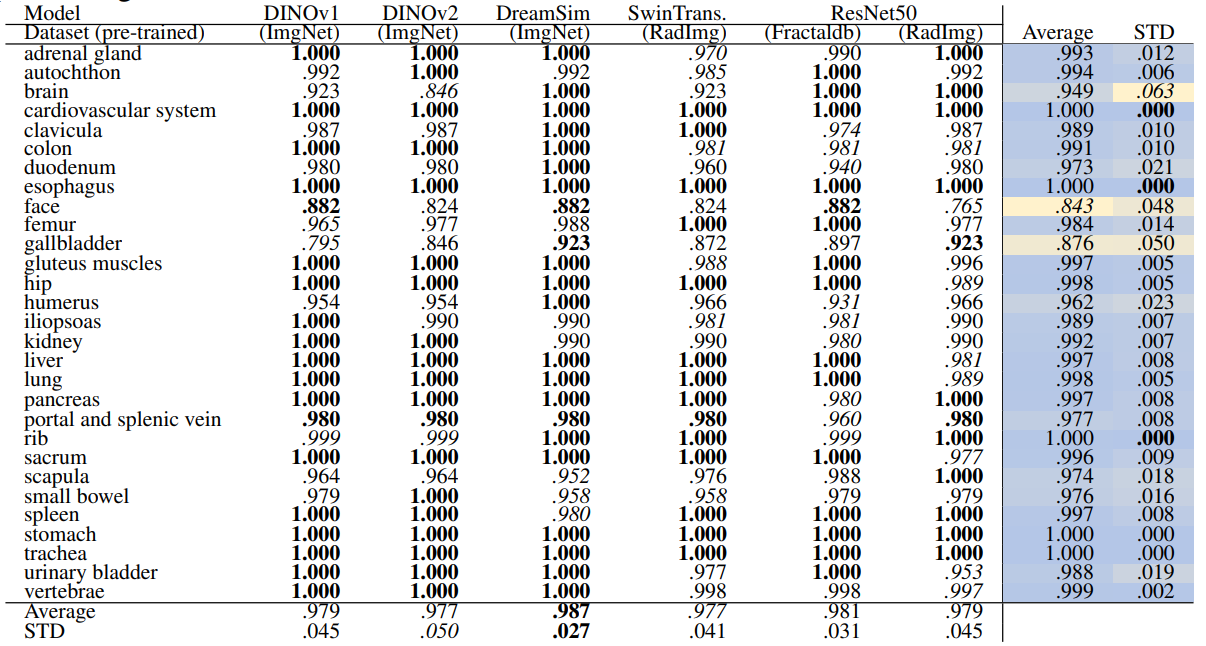
\ Table 14 and Table 15 show the retrieval recall for 29 coarse anatomical structures and 104 original TS anatomical structures employing the proposed re-ranking method. Using the re-ranking, the overall performance of all the models has improved. DreamSim performs the best with the average retrieval recall of .987 ± .027 and .987 ± .024 for 29 and 104 classes, respectively. There are only slight variations between the performance on coarse and all the original TS classes. Similar to the count-based method in the anatomical region retrieval many classes are perfectly retrieved (recall of 1.0). There is a low variation among models and between classes where the highest standard deviation is .064 and .042.

\ Table 14: Region-based retrieval recall of coarse anatomical regions (29 classes) using HNSW Indexing and re-ranking. In each row, bold numbers represent the best-performing values, while italicized numbers indicate the worst-performing. The separate average and standard deviation (STD) columns are color-coded, with blue indicating the best performing values and yellow indicating the worst-performing values across different models. Additionally, bold numbers in colored columns represent the best classes in terms of average and standard deviation, while italicized values represent the worst-performing class across the models.
\ Continue with the next figure

\ Table 15: Region-based retrieval recall of all TS anatomical regions (104 classes) using HNSW Indexing and re-ranking. In each row, bold numbers represent the best-performing values, while italicized numbers indicate the worst-performing. The separate average and standard deviation (STD) columns are color-coded, with blue indicating the best-performing values and yellow indicating the worst-performing values across different models. Additionally, bold numbers in colored columns represent the best classes in terms of average and standard deviation, while italicized values represent the worst-performing class across the models.

\ 3.2.3 Localized

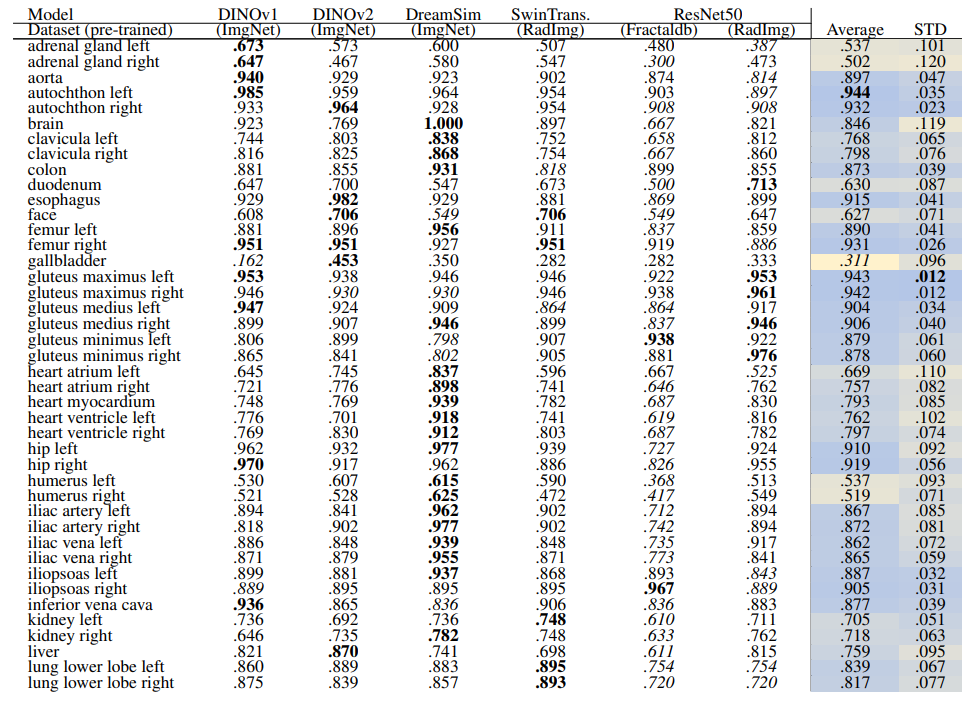
\ Localized Retrieval Recall Table 16 and Table 17 show the retrieval recall for 29 coarse anatomical structures and 104 original TS anatomical structures after re-ranking for L = 15. Re-ranking improved the localization for all the models. DreamsSim is the best-performing model with an average recall of .955 ± .062 for coarse anatomical structures and .956 ± .055 for original TS classes. Although the retrieval is lower compared to region-based or volume-based evaluation, it is still high which shows that the pretrained vision embeddings not only can retrieve similar cases but also can localize the corresponding region of interest.

\ Continue with the next figure
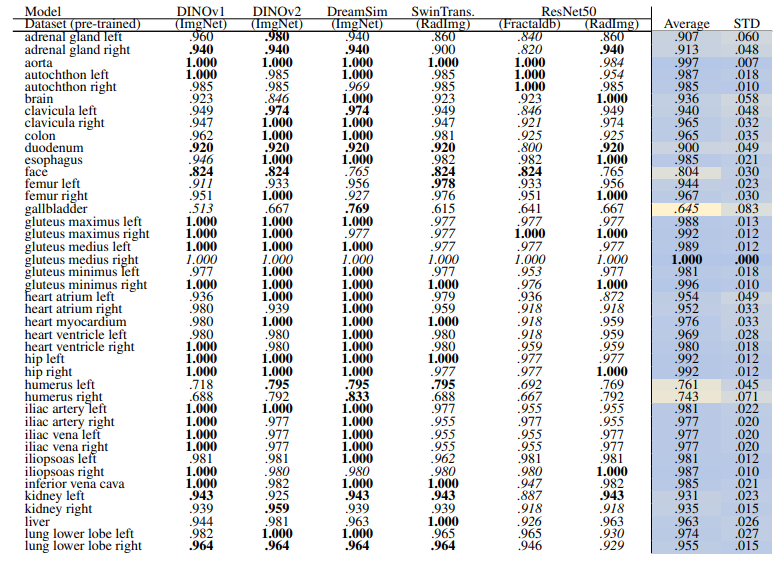
\ Table 17: Localized retrieval recall of all TS anatomical regions (104 classes) using HNSW Indexing and re-ranking, L = 15. In each row, bold numbers represent the best-performing values, while italicized numbers indicate the worst-performing. The separate average and standard deviation (STD) columns are color-coded, with blue indicating the best-performing values and yellow indicating the worst-performing values across different models. Additionally, bold numbers in colored columns represent the best classes in terms of average and standard deviation, while italicized values represent the worst-performing class across the models.

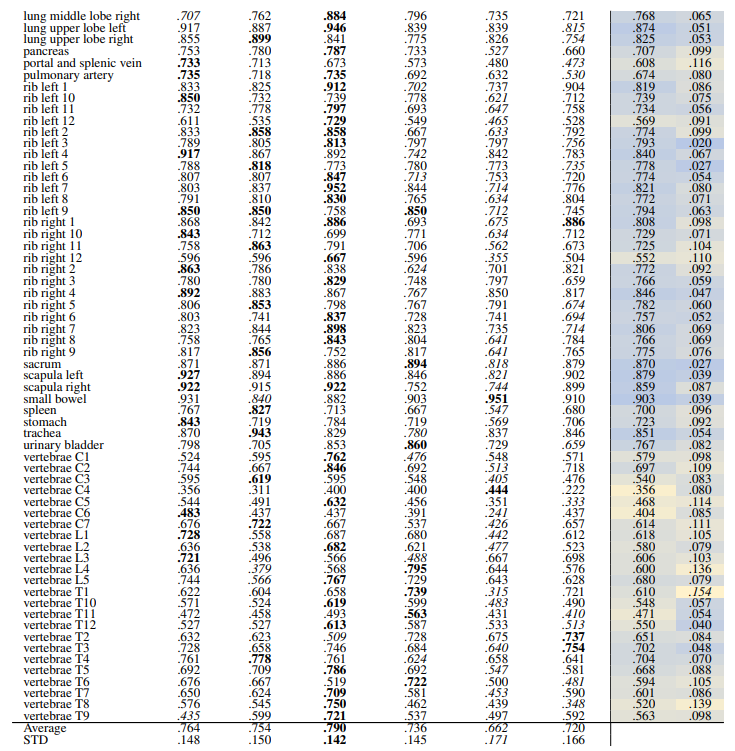
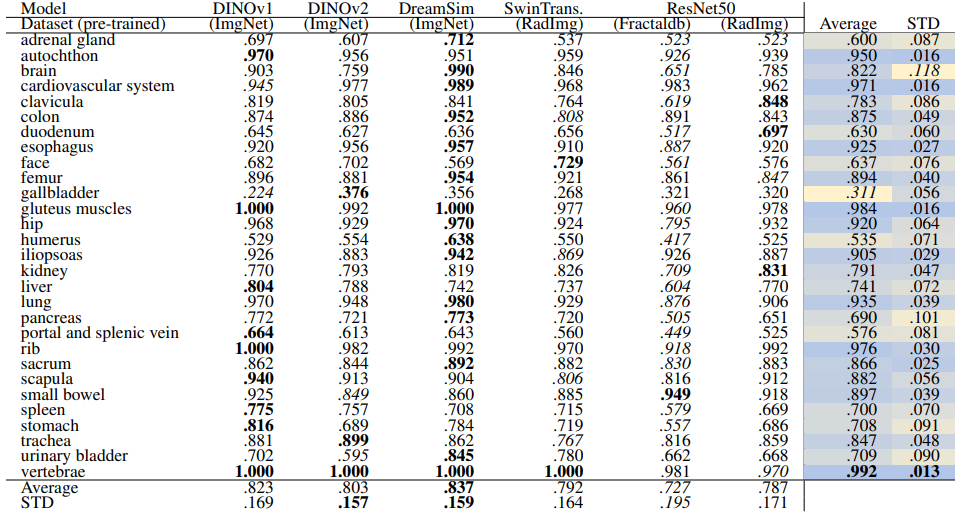
\ Localization-ratio The localization-ratio is calculated based on (7). Table 18 and Table 19 demonstrate the localization-ratio for 29 coarse and 104 original TS anatomical regions after re-ranking for L = 15. The bestperforming embedding is still DreamSim with a localization-ratio of .837 ± .159 and .790 ± .142 for 29 coarse and 104 original TS classes. After re-ranking the overall localization-ratio is reduced (previously, .864 ± .0145 and .803 ± .130, respectively).

\ Table 18: Localization-ratio of coarse anatomical regions (29 classes) using HNSW Indexing and re-ranking, L = 15. In each row, bold numbers represent the best-performing values, while italicized numbers indicate the worst-performing. The separate average and standard deviation (STD) columns are color-coded, with blue indicating the best-performing values and yellow indicating the worst-performing values across different models. Additionally, bold numbers in colored columns represent the best classes in terms of average and standard deviation, while italicized values represent the worst-performing class across the models.
\ Continue with the next figure

\ Table 19: Localization-ratio of all TS anatomical regions (104 classes) using HNSW Indexing and re-ranking, L = 15. In each row, bold numbers represent the best-performing values, while italicized numbers indicate the worst-performing. The separate average and standard deviation (STD) columns are color-coded, with blue indicating the best-performing values and yellow indicating the worst-performing values across different models. Additionally, bold numbers in colored columns represent the best classes in terms of average and standard deviation, while italicized values represent the worst-performing class across the models.

\

:::info Authors:

(1) Farnaz Khun Jush, Bayer AG, Berlin, Germany ([email protected]);

(2) Steffen Vogler, Bayer AG, Berlin, Germany ([email protected]);

(3) Tuan Truong, Bayer AG, Berlin, Germany ([email protected]);

(4) Matthias Lenga, Bayer AG, Berlin, Germany ([email protected]).

:::


:::info This paper is available on arxiv under CC BY 4.0 DEED license.

:::

\

Market Opportunity
null Logo
null Price(null)
--
----
USD
null (null) Live Price Chart
Disclaimer: The articles reposted on this site are sourced from public platforms and are provided for informational purposes only. They do not necessarily reflect the views of MEXC. All rights remain with the original authors. If you believe any content infringes on third-party rights, please contact [email protected] for removal. MEXC makes no guarantees regarding the accuracy, completeness, or timeliness of the content and is not responsible for any actions taken based on the information provided. The content does not constitute financial, legal, or other professional advice, nor should it be considered a recommendation or endorsement by MEXC.

You May Also Like

Over $145M Evaporates In Brutal Long Squeeze

Over $145M Evaporates In Brutal Long Squeeze

The post Over $145M Evaporates In Brutal Long Squeeze appeared on BitcoinEthereumNews.com. Crypto Futures Liquidations: Over $145M Evaporates In Brutal Long Squeeze
Share
BitcoinEthereumNews2026/01/16 11:35
Vitalik Buterin Reveals Ethereum’s Bold Plan to Stay Quantum-Secure and Simple!

Vitalik Buterin Reveals Ethereum’s Bold Plan to Stay Quantum-Secure and Simple!

Buterin unveils Ethereum’s strategy to tackle quantum security challenges ahead. Ethereum focuses on simplifying architecture while boosting security for users. Ethereum’s market stability grows as Buterin’s roadmap gains investor confidence. Ethereum founder Vitalik Buterin has unveiled his long-term vision for the blockchain, focusing on making Ethereum quantum-secure while maintaining its simplicity for users. Buterin presented his roadmap at the Japanese Developer Conference, and splits the future of Ethereum into three phases: short-term, mid-term, and long-term. Buterin’s most ambitious goal for Ethereum is to safeguard the blockchain against the threats posed by quantum computing.  The danger of such future developments is that the future may call into question the cryptographic security of most blockchain systems, and Ethereum will be able to remain ahead thanks to more sophisticated mathematical techniques to ensure the safety and integrity of its protocols. Buterin is committed to ensuring that Ethereum evolves in a way that not only meets today’s security challenges but also prepares for the unknowns of tomorrow. Also Read: Ethereum Giant The Ether Machine Takes Major Step Toward Going Public! However, in spite of such high ambitions, Buterin insisted that Ethereum also needed to simplify its architecture. An important aspect of this vision is to remove unnecessary complexity and make Ethereum more accessible and maintainable without losing its strong security capabilities. Security and simplicity form the core of Buterin’s strategy, as they guarantee that the users of Ethereum experience both security and smooth processes. Focus on Speed and Efficiency in the Short-Term In the short term, Buterin aims to enhance Ethereum’s transaction efficiency, a crucial step toward improving scalability and reducing transaction costs. These advantages are attributed to the fact that, within the mid-term, Ethereum is planning to enhance the speed of transactions in layer-2 networks. According to Butterin, this is part of Ethereum’s expansion, particularly because there is still more need to use blockchain technology to date. The other important aspect of Ethereum’s development is the layer-2 solutions. Buterin supports an approach in which the layer-2 networks are dependent on layer-1 to perform some essential tasks like data security, proof, and censorship resistance. This will enable the layer-2 systems of Ethereum to be concerned with verifying and sequencing transactions, which will improve the overall speed and efficiency of the network. Ethereum’s Market Stability Reflects Confidence in Long-Term Strategy Ethereum’s market performance has remained solid, with the cryptocurrency holding steady above $4,000. Currently priced at $4,492.15, Ethereum has experienced a slight 0.93% increase over the last 24 hours, while its trading volume surged by 8.72%, reaching $34.14 billion. These figures point to growing investor confidence in Ethereum’s long-term vision. The crypto community remains optimistic about Ethereum’s future, with many predicting the price could rise to $5,500 by mid-October. Buterin’s clear, forward-thinking strategy continues to build trust in Ethereum as one of the most secure and scalable blockchain platforms in the market. Also Read: Whales Dump 200 Million XRP in Just 2 Weeks – Is XRP’s Price on the Verge of Collapse? The post Vitalik Buterin Reveals Ethereum’s Bold Plan to Stay Quantum-Secure and Simple! appeared first on 36Crypto.
Share
Coinstats2025/09/18 01:22
Non-Opioid Painkillers Have Struggled–Cannabis Drugs Might Be The Solution

Non-Opioid Painkillers Have Struggled–Cannabis Drugs Might Be The Solution

The post Non-Opioid Painkillers Have Struggled–Cannabis Drugs Might Be The Solution appeared on BitcoinEthereumNews.com. In this week’s edition of InnovationRx, we look at possible pain treatments from cannabis, risks of new vaccine restrictions, virtual clinical trials at the Mayo Clinic, GSK’s $30 billion U.S. manufacturing commitment, and more. To get it in your inbox, subscribe here. Despite their addictive nature, opioids continue to be a major treatment for pain due to a lack of effective alternatives. In an effort to boost new drugs, the FDA released new guidelines for non-opioid painkillers last week. But making these drugs hasn’t been easy. Vertex Pharmaceuticals received FDA approval for its non-opioid Journavx in January, then abandoned a next generation drug after a failed clinical trial earlier this summer. Acadia similarly abandoned a promising candidate after a failed trial in 2022. One possible basis for non-opioids might be cannabis. Earlier this year, researchers at Washington University at St. Louis and Stanford published a study showing that a cannabis-derived compound successfully eased pain in mice with minimal side effects. Munich-based pharmaceutical company Vertanical is perhaps the furthest along in this quest. It is developing a cannabinoid-based extract to treat chronic pain it hopes will soon become an approved medicine, first in the European Union and eventually in the United States. The drug, currently called Ver-01, packs enough low levels of cannabinoids (including THC) to relieve pain, but not so much that patients get high. Founder Clemens Fischer, a 50-year-old medical doctor and serial pharmaceutical and supplement entrepreneur, hopes it will become the first cannabis-based painkiller prescribed by physicians and covered by insurance. Fischer founded Vertanical, with his business partner Madlena Hohlefelder, in 2017, and has invested more than $250 million of his own money in it. With a cannabis cultivation site and drug manufacturing plant in Denmark, Vertanical has successfully passed phase III clinical trials in Germany and expects…
Share
BitcoinEthereumNews2025/09/18 05:26