Polymarket Federal Lawsuit Could Define Regulatory Authority Over US Prediction Markets
Polymarket federal lawsuit against Massachusetts is becoming a key case that could decide how U.S. prediction markets are regulated. The legal action challenges whether state governments can control event contracts or if the Commodity Futures Trading Commission (CFTC) has exclusive authority.
The outcome could determine if prediction markets operate under a single federal system. It may also decide whether platforms have to follow different rules in each state.
What does the Polymarket federal lawsuit entail?
In February 2026, Polymarket filed a federal court case in Massachusetts to challenge the state’s gambling rules on its platform. The company claims that “event contracts,” which are the main products in prediction markets, are regulated solely by the CFTC.
 Polymarket Federal Lawsuit Could Define Regulatory Authority Over US Prediction Markets 4
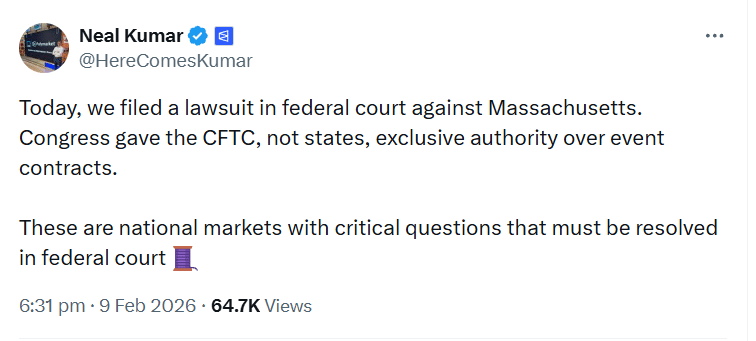
Neal Kumar, the company’s chief legal officer, posted on X saying that Congress gave the CFTC, not the states, exclusive authority over event contracts and that these national markets involve important questions that must be decided in federal court. The lawsuit aims to prevent states from enforcing their own rules separately and to ensure consistent oversight for prediction markets across the country.
 Polymarket Federal Lawsuit Could Define Regulatory Authority Over US Prediction Markets 5
How did state actions trigger the lawsuit?
The lawsuit comes after Massachusetts courts acted against Kalshi, another prediction market platform. A judge ordered Kalshi to stop Massachusetts residents from accessing sports-related contracts, classifying them as unlicensed wagers under state gambling rules.
At the same time, Nevada regulators temporarily restricted Polymarket’s sports-related offerings, saying they conflicted with state sports betting regulations. These actions by the states created uncertainty, which led Polymarket to file its federal lawsuit to clarify jurisdiction in the industry, now known as the Polymarket federal lawsuit.
Why is federal versus state authority significant?
The core of the Polymarket federal lawsuit is about who has the authority to regulate prediction markets. Polymarket argues that its event contracts, covering elections, economic trends, and sports, are financial derivatives under the Commodity Exchange Act and should be overseen by federal law.
This would stop individual states from applying their own rules, licensing, or restrictions. On the other hand, Massachusetts and some other states say that when prediction markets look like gambling, they must follow state rules to protect consumers and enforce local regulations. The court’s decision will decide whether federal law takes priority or if states can continue to regulate these platforms on their own.
What is at stake for the prediction market industry?
Prediction markets are growing fast. Dune reports $3.7 billion in trading volume in just one week in January 2026. Platforms like Polymarket and Kalshi are getting mainstream attention. States try to add protections like those in traditional gambling laws.
A good ruling for the Polymarket could mean uniform federal oversight. This would make compliance easier and help markets grow. If states keep control, platforms face different rules in each place. That makes operations harder and limits user access.
How could the Polymarket federal lawsuit reshape regulatory control?
The Polymarket federal lawsuit is part of a larger national discussion about the balance between state and federal authority over event contracts. Courts in Massachusetts and Nevada are reviewing the powers of individual states, while federal agencies and lawmakers are considering nationwide guidelines.
 Polymarket Federal Lawsuit Could Define Regulatory Authority Over US Prediction Markets 6
The outcome of this lawsuit will affect how companies organize prediction markets and how regulators monitor them. It will also shape the balance between innovation and consumer protection across the United States.
Conclusion
The Polymarket federal lawsuit is a big moment for prediction markets in the United States. It challenges state power. The case could set if these platforms use one federal framework or deal with different rules per state.
Its result will affect market access, regulatory clarity, and the future development of event-based trading platforms across the country. Neal Kumar’s X post highlights the importance of the case, stating that these national markets involve critical questions that must be resolved in federal court, and the ruling is likely to set a lasting precedent for the industry.
Glossary
Polymarket: US platform for trading contracts on future events.
Massachusetts: State where the federal lawsuit was filed.
CFTC: Federal agency regulating derivatives and event contracts.
State Gambling Laws: Rules states use to control betting.
Federal Authority: Power of federal government to oversee markets.
Frequently Asked Questions About Polymarket Federal Lawsuit
Who filed the lawsuit?
Polymarket filed the lawsuit in federal court in Massachusetts.
Why did Polymarket file the lawsuit?
Polymarket filed lawsuit to stop Massachusetts and other states from enforcing their own gambling rules on its platform.
What are event contracts?
Event contracts are prediction market products where people trade based on outcome of events.
Why is federal versus state authority important?
The case will decide if prediction markets follow one federal set of rules or separate rules in each state.
How could lawsuit affect prediction market industry?
A federal ruling could create consistent national rules. Making it easier for platforms to operate and support market growth.
Sources
Cointelegraph
X
Binance
Read More: Polymarket Federal Lawsuit Could Define Regulatory Authority Over US Prediction Markets">Polymarket Federal Lawsuit Could Define Regulatory Authority Over US Prediction Markets


You May Also Like

The Chemistry of UV Resistance: How Titanium Dioxide Protects Against the California Sun

Top Line plans Cebu energy complex to boost storage capacity