Some have labeled it pseudoscience, but for decades, this simple little trick has accurately predicted the onset of various global conflicts. The Unlikely War Oracle: How Pizza Orders Predict Global Conflicts “As of 6:59pm ET nearly all pizza establishments nearby the Pentagon have experienced a HUGE surge in activity,” wrote the Pentagon Pizza Report X […]Some have labeled it pseudoscience, but for decades, this simple little trick has accurately predicted the onset of various global conflicts. The Unlikely War Oracle: How Pizza Orders Predict Global Conflicts “As of 6:59pm ET nearly all pizza establishments nearby the Pentagon have experienced a HUGE surge in activity,” wrote the Pentagon Pizza Report X […]

The Curious Case of the Pentagon Pizza Index: It Accurately Predicts Wars

2 min read

Some have labeled it pseudoscience, but for decades, this simple little trick has accurately predicted the onset of various global conflicts.

The Unlikely War Oracle: How Pizza Orders Predict Global Conflicts

“As of 6:59pm ET nearly all pizza establishments nearby the Pentagon have experienced a HUGE surge in activity,” wrote the Pentagon Pizza Report X account on Thursday, June 12. An hour later, explosions rocked Tehran, Iran’s capital. Israel had just launched a pre-emptive attack on its archnemesis, alleging Iran was secretly building a nuclear weapon that it planned to use against the Jewish nation.

That prediction has given credence to what many consider to be a 1990s urban legend of how pizza order volume in establishments adjacent to the Pentagon, accurately predicts major geopolitical events.
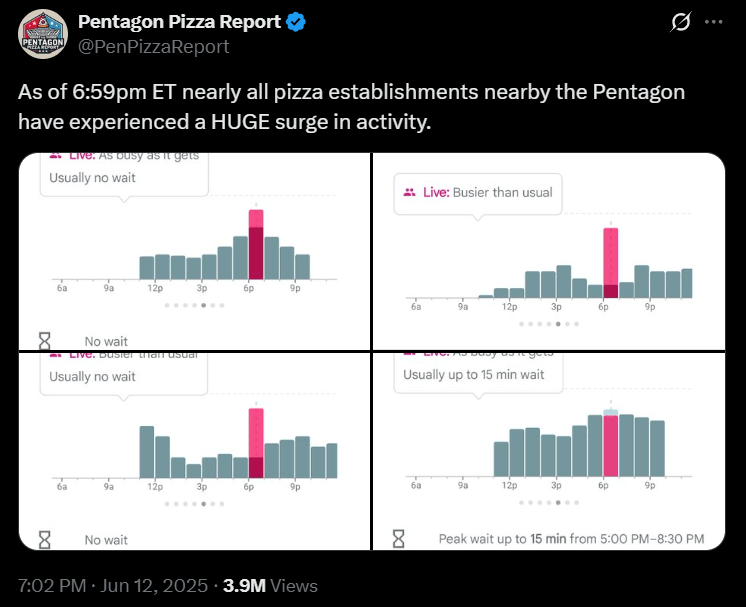
The Curious Case of the Pentagon Pizza Index: It Accurately Predicts Wars(A surge in Pentagon-area pizza orders preceded Israel’s strike on Iran / @PenPizzaReport)

When a critical development pops up, Pentagon officials often work late into the night, and it turns out, pizza is their food of choice. It’s greasy, satiating, delicious, and most of all convenient. Sure, sometimes the index is wrong, pizza orders can spike during a football game for example. But despite experts dismissing this convenient form of so-called open-source intelligence (OSINT), they can’t deny that it has accurately predicted multiple global events.

“Pentagon orders doubled up the night before the Panama attack; same thing happened before the Grenada invasion,” one pizza deliverer explained, according to reporting by Time Magazine in August of 1990. “We got a lot of orders, starting around midnight. We figured something was up.” It turns out Iraq, under Saddam Hussein, had invaded Kuwait on August 2, 1990.

As former CNN Pentagon correspondent Wolf Blitzer, once said according to Slate.com, “Bottom line for journalists: Always monitor the pizzas.”


Market Opportunity
Index Cooperative Logo
Index Cooperative Price(INDEX)
$0.3565
$0.3565$0.3565
-5.08%
USD
Index Cooperative (INDEX) Live Price Chart
Disclaimer: The articles reposted on this site are sourced from public platforms and are provided for informational purposes only. They do not necessarily reflect the views of MEXC. All rights remain with the original authors. If you believe any content infringes on third-party rights, please contact [email protected] for removal. MEXC makes no guarantees regarding the accuracy, completeness, or timeliness of the content and is not responsible for any actions taken based on the information provided. The content does not constitute financial, legal, or other professional advice, nor should it be considered a recommendation or endorsement by MEXC.

You May Also Like

Cashing In On University Patents Means Giving Up On Our Innovation Future

Cashing In On University Patents Means Giving Up On Our Innovation Future

The post Cashing In On University Patents Means Giving Up On Our Innovation Future appeared on BitcoinEthereumNews.com. “It’s a raid on American innovation that would deliver pennies to the Treasury while kneecapping the very engine of our economic and medical progress,” writes Pipes. Getty Images Washington is addicted to taxing success. Now, Commerce Secretary Howard Lutnick is floating a plan to skim half the patent earnings from inventions developed at universities with federal funding. It’s being sold as a way to shore up programs like Social Security. In reality, it’s a raid on American innovation that would deliver pennies to the Treasury while kneecapping the very engine of our economic and medical progress. Yes, taxpayer dollars support early-stage research. But the real payoff comes later—in the jobs created, cures discovered, and industries launched when universities and private industry turn those discoveries into real products. By comparison, the sums at stake in patent licensing are trivial. Universities collectively earn only about $3.6 billion annually in patent income—less than the federal government spends on Social Security in a single day. Even confiscating half would barely register against a $6 trillion federal budget. And yet the damage from such a policy would be anything but trivial. The true return on taxpayer investment isn’t in licensing checks sent to Washington, but in the downstream economic activity that federally supported research unleashes. Thanks to the bipartisan Bayh-Dole Act of 1980, universities and private industry have powerful incentives to translate early-stage discoveries into real-world products. Before Bayh-Dole, the government hoarded patents from federally funded research, and fewer than 5% were ever licensed. Once universities could own and license their own inventions, innovation exploded. The result has been one of the best returns on investment in government history. Since 1996, university research has added nearly $2 trillion to U.S. industrial output, supported 6.5 million jobs, and launched more than 19,000 startups. Those companies pay…
Share
BitcoinEthereumNews2025/09/18 03:26
Trump foe devises plan to starve him of what he 'craves' most

Trump foe devises plan to starve him of what he 'craves' most

A longtime adversary of President Donald Trump has a plan for a key group to take away what Trump craves the most — attention. EX-CNN journalist Jim Acosta, who
Share
Rawstory2026/02/04 01:19
Why Bitcoin Is Struggling: 8 Factors Impacting Crypto Markets

Why Bitcoin Is Struggling: 8 Factors Impacting Crypto Markets

Failed blockchain adoption narratives and weak fee capture have undercut confidence in major crypto projects.
Share
CryptoPotato2026/02/04 01:05