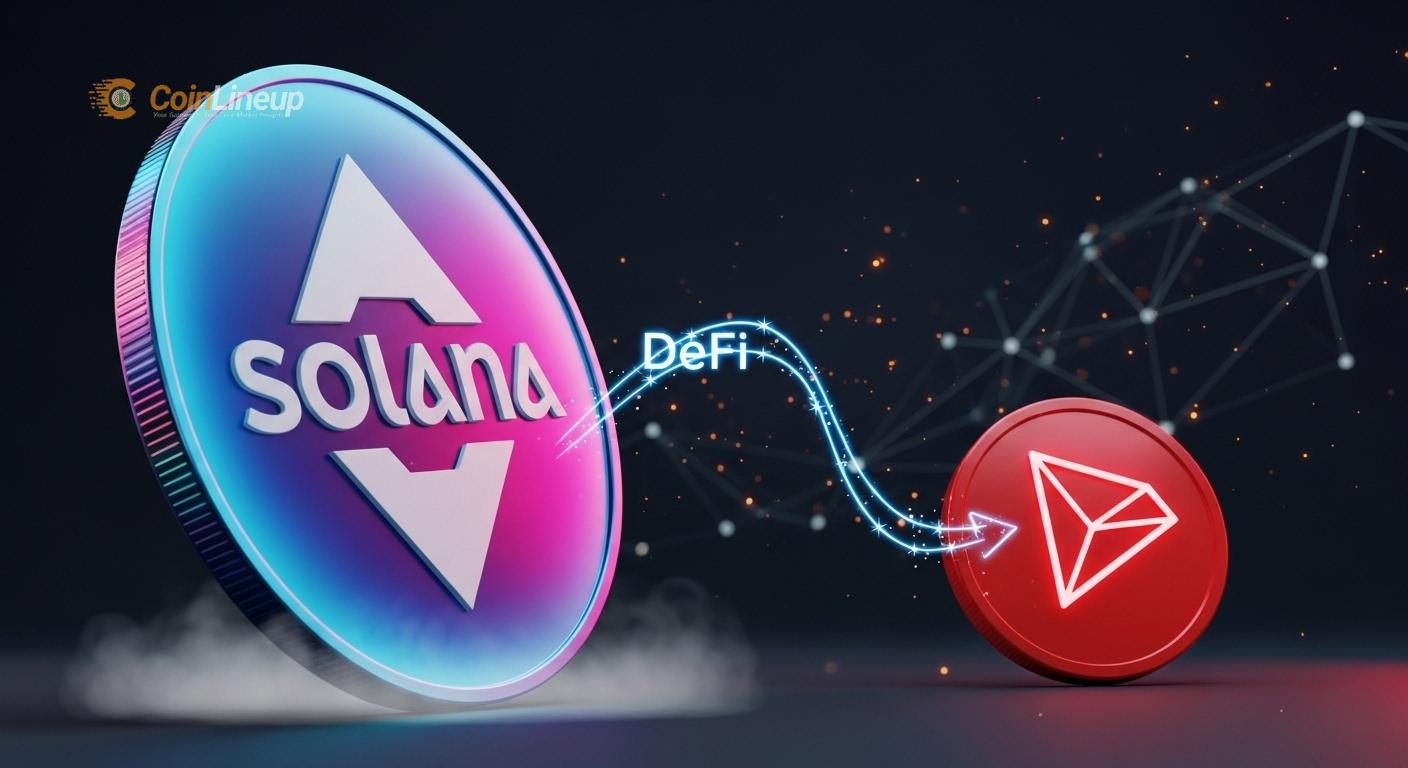
Data shows Solana led 24h fees on DeFi/MEV; TRC-20 USDT drove Tron on 7d/30d per data. Solana vs Tron fees, DeFiLlama fee revenue, USDT stablecoin transfersData shows Solana led 24h fees on DeFi/MEV; TRC-20 USDT drove Tron on 7d/30d per data. Solana vs Tron fees, DeFiLlama fee revenue, USDT stablecoin transfers

Solana edges past Tron in 24h fees on DeFi activity
2026/02/23 03:19
3 min read
Solana edges past Tron in 24h fees on DeFi activity

Key Takeaways:

  • Solana briefly surpassed TRON in 24h network fees, conditionally and timeframe-dependent.
  • Interpret flips by confirming 24h vs 7d windows and Fees versus Revenue.
  • Fee drivers differ: TRON stablecoin transfers; Solana volatile DeFi and trading.

A reported 24-hour flip suggests Solana briefly surpassed TRON in network fees. The signal is timeframe-dependent and hinges on whether a dashboard is set to Fees or Revenue.

Immediate takeaways are methodological. Confirm the exact window (24h vs 7d vs 30d), ensure you are comparing identical metrics, and then assess the quality and durability of the activity producing those fees.

On TRON, fee generation is closely tied to TRC-20 USDT transfers and network design choices; a sector analysis noted that stablecoin transfer fees remained elevated versus Solana even after fee reductions aimed at boosting usage, based on data from PANewsLab. This implies high-frequency payments and remittance-style flows can dominate TRON’s fee profile.

On Solana, fee revenue is more volatile and often associated with DEX trading, liquid staking, and broader DeFi activity, as reported by AltCryptoTalk. This mix can amplify fee swings during bursts of liquidity, bot activity, or memecoin launches.

TRON’s governance has also cut gas costs, with subsequent short-term revenue compression for block producers before volume recovery, according to Cointelegraph. Such policy levers can reshape daily fee tallies without necessarily reflecting organic fee-paying demand.

A separate lens is fee concentration: one analysis attributed 95% of Solana fees to about 1.26% of users, said BTCC.com summarizing research by Michael Nadeau. Concentration can inflate headline fees while masking how broadly the cost burden is distributed across regular users.

Start at the DeFiLlama Fees/Revenue dashboard for chains. This interface is widely used for cross-chain fee comparisons and provides 24h, 7d, and 30d windows.

Set the view explicitly to Fees, not Revenue, and select the 24h filter. Revenue can include protocol-level take rates and may differ from raw fees paid.

Search for and select Solana and TRON to display side-by-side series. Confirm the chains are mapped correctly and that no custom filters are hiding either protocol.

Toggle across 7d and 30d to see whether the daily flip persists. If the lead reverses at longer horizons, the initial 24h observation was likely a transient spike.

This cross-check matters because single-day snapshots can conflict with other windows; as reported by U.Today, “Tron pulled in ~$676,000 in fees over a 24-hour span, beating Solana’s ~$599,197 for the same period.” Interpreting any flip requires anchoring the timeframe and metric.

For neutral market context at the time of this writing, CoinGecko data show roughly $2.08 billion in 24-hour trading activity with a day-over-day decline, while SOL trades in the mid-$80s. Context like this does not validate fees but helps frame overall market conditions.

Disclaimer: CoinLineup.com provides cryptocurrency and financial market information for educational and informational purposes only. The content on this site does not constitute financial, investment, or trading advice. Cryptocurrency and stock markets involve significant risk, and past performance is not indicative of future results. Always conduct your own research and consult a qualified financial advisor before making any investment decisions.


Market Opportunity
DeFi Logo
DeFi Price(DEFI)
$0.000339
$0.000339$0.000339
+6.60%
USD
DeFi (DEFI) Live Price Chart
Disclaimer: The articles reposted on this site are sourced from public platforms and are provided for informational purposes only. They do not necessarily reflect the views of MEXC. All rights remain with the original authors. If you believe any content infringes on third-party rights, please contact [email protected] for removal. MEXC makes no guarantees regarding the accuracy, completeness, or timeliness of the content and is not responsible for any actions taken based on the information provided. The content does not constitute financial, legal, or other professional advice, nor should it be considered a recommendation or endorsement by MEXC.

You May Also Like

If you put $1,000 in Intel at the start of 2025, here’s your return now

If you put $1,000 in Intel at the start of 2025, here’s your return now

The post If you put $1,000 in Intel at the start of 2025, here’s your return now appeared on BitcoinEthereumNews.com. Intel (NASDAQ: INTC) and Nvidia (NASDAQ: NVDA) announced a new partnership on Thursday, September 18, working on several generations of custom data center and computing chips designed to boost performance in hyperscale, enterprise, and consumer applications. As part of the collaboration, Nvidia, the undisputed leader of the semiconductor sector, will also invest $5 billion in Intel by purchasing its common stock at a price of $23.28 per share. Following the news, Intel stock jumped more than 30% in pre-market trading, while Nvidia saw a 3% uptick, a welcome change following weeks of shaky performance and controversies regarding its Chinese sales. Trading at $31.34 at the time of writing, INTC shares are up 54.99% year-to-date (YTD). INTC YTD stock price. Source: Google Accordingly, a $1,000 investment in the tech company at the start of the year would now be worth $1,549.90, giving you a return of $549.90. ‘The next era of computing’ The move follows a wave of fresh backing for the struggling Intel, including a nearly $9 billion U.S. government purchase of a 10% stake just weeks ago and a $2 billion investment from Japan’s SoftBank. As such, the deal has the potential to put Intel back into the game after years of trying to catch up not just with Nvidia but also AMD (NASDAQ: AMD) and Broadcom (NASDAQ: AVGO). “This historic collaboration tightly couples NVIDIA’s AI and accelerated computing stack with Intel’s CPUs and the vast x86 ecosystem — a fusion of two world-class platforms. Together, we will expand our ecosystems and lay the foundation for the next era of computing,” wrote Nvidia founder and chief executive officer (CEO), Jensen Huang.  However, the U.S. government’s direct involvement suggests that more is at stake than simply propping up Intel, as it likely reflects a broader concern about keeping America competitive…
Share
BitcoinEthereumNews2025/09/18 22:47
In an era of agent explosion, how should we cope with AI anxiety?

In an era of agent explosion, how should we cope with AI anxiety?

Author: XinGPT AI is yet another movement for technological equality. A recent article titled "The Internet is Dead, Agents Live On" went viral on social media
Share
PANews2026/02/23 11:33
SEC Approves! Paving the Way for Altcoin ETFs: New Decision Closely Concerns 12 Altcoins Including XRP!

SEC Approves! Paving the Way for Altcoin ETFs: New Decision Closely Concerns 12 Altcoins Including XRP!

The SEC has approved general listing standards for cryptocurrency ETFs, covering 12 altcoins including XRP, Solana (SOL). Continue Reading: SEC Approves! Paving the Way for Altcoin ETFs: New Decision Closely Concerns 12 Altcoins Including XRP!
Share
Coinstats2025/09/18 21:32