

SEC Allows Broker-Dealers a 2% Haircut on Stablecoins
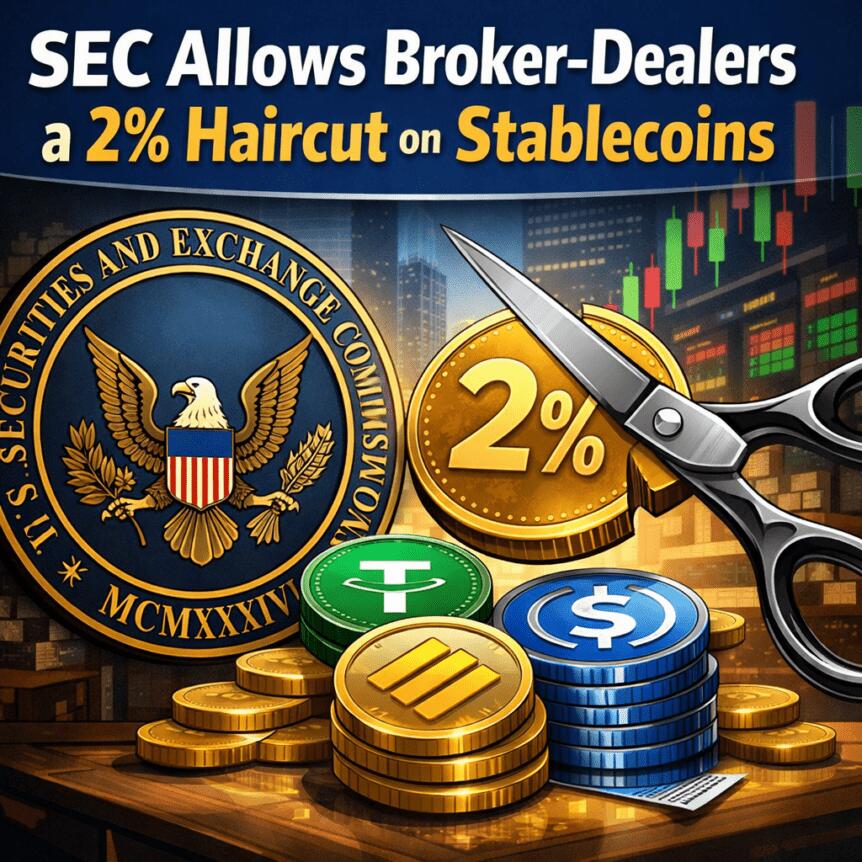
The U.S. Securities and Exchange Commission’s staff provided regulatory clarity last week on how broker-dealers can treat stablecoin holdings for net capital purposes, allowing a 2% haircut rather than applying a full 100% deduction. The guidance appeared as an official posting in the SEC’s “Frequently Asked Questions Relating to Crypto Asset Activities and Distributed Ledger Technology,” a living document used to address practical questions about handling crypto assets within traditional market infrastructure. The change comes after broker-dealers faced ambiguity about whether stablecoins—cryptocurrency tokens pegged to the US dollar—should count toward capital requirements. Commissioner Hester Peirce publicly welcomed the middle-ground approach, arguing a 100% haircut would be unduly punitive given the reserves backing these coins. The policy frames stablecoins more like cash-equivalents in balance sheets, a move that could unlock broader participation in tokenized securities and related crypto activities, without compromising the capital backbone of broker-dealers.
Key takeaways
- The SEC staff’s FAQ clarifies that broker-dealers may apply a 2% haircut to stablecoins when calculating net capital, reducing the capital impact compared with a full haircut.
- The guidance positions stablecoins closer to money-market-like instruments, linking their treatment to the reserves backing the tokens and their role in settlement rails.
- Illustratively, a broker-dealer holding $100 million in stablecoins could count $98 million toward net capital under the new guidance.
- Commissioner Peirce described the stance as measured, noting that a 100% haircut would be punitive relative to the underlying assets backing payment-stable coins.
- The development coincides with growing stablecoin traction in the United States, even as some officials question practical use cases and regulatory implications.
Tickers mentioned:
Sentiment: Neutral
Market context: The move reflects ongoing regulatory adjustments as stablecoins gain ground in US markets, spurred in part by recent legislation and ongoing debates about the role of crypto in mainstream finance.
Why it matters
The haircut clarification matters because it reduces the capital burden on broker-dealers that wish to hold and potentially utilize stablecoins in a broader set of activities, including trading and settlement of tokenized securities. By treating stablecoins more like cash equivalents, broker-dealers can allocate a portion of their stablecoin holdings toward capital requirements with a smaller drag on liquidity. That has implications for how these institutions manage risk, liquidity, and regulatory capital, potentially enabling more cost-effective participation in digital-asset markets.
From a risk-management perspective, the 2% haircut aligns with the notion that stablecoins mirror short-duration, high-quality reserve assets—the same logic used to justify the treatment of money market funds. The guidance thus reduces a prior barrier to using stablecoins for on-chain settlement and liquidity provisioning in tokenized markets. It also dovetails with industry commentary about stablecoins enabling more efficient cross-asset transactions and broader adoption of on-chain finance in mainstream trading desks.
While the SEC clarification is a positive signal for market participants seeking clearer capital rules, it does not replace comprehensive regulatory rulemaking or policy debates. The guidance is a staff-level interpretation, not a formal amendment to net capital rules, meaning future adjustments could still occur as regulators evaluate risks, reserve adequacy, and systemic implications. Nevertheless, the response from industry observers has been to view the move as a meaningful step toward practical use-cases for stablecoins within regulated financial infrastructures.
Beyond the regulatory text, market dynamics around stablecoins have remained a focal point. Data tracked by RWA.XYZ shows a stablecoin market capitalization that has hovered in the high hundreds of billions, with fluctuations tied to sentiment, regulatory developments, and policy signals. The GENIUS stablecoin bill, signed into law in July 2025 by the US President, was widely seen as a landmark in digital-asset policy, spurring a surge in interest and activity around regulated stablecoin frameworks. The market cap climbed after the signing, reaching a reported peak above $300 billion in December 2025 and a current level around $295 billion. This trajectory illustrates how regulatory clarity and legislative actions can influence the adoption and liquidity of digital-asset primitives like stablecoins.
Yet not everyone in the policy community is sold on the immediate practical value of stablecoins. Neel Kashkari, president of the Federal Reserve Bank of Minneapolis, has dismissed broad utility claims for crypto and stablecoins, at least in the sense of everyday financial transactions. In a public remarks sequence, he questioned what advantage stablecoins offer beyond existing payment rails, a stance that underscores the ongoing debate about the real-world use cases for digital assets in the U.S. financial system. The tension between regulation that enables innovation and skepticism about the utility of crypto assets as payment instruments continues to shape the regulatory narrative.
The weekend chatter among industry observers and crypto-analysts highlighted the significance of the SEC’s clarification for market participants seeking to align risk controls with evolving capital requirements. The reaction on social platforms and among executives underscored that the guidance, while incremental, could unlock a more expansive role for stablecoins in large financial operations, particularly as broker-dealers explore new settlement mechanisms, collateral arrangements, and asset tokenization ventures. In a market where headlines can rapidly influence liquidity and pricing, even modest shifts in capital treatment can ripple through trading desks, liquidity pools, and balance sheet strategies across the traditional-crypto interface.
What to watch next
- Whether the SEC issues additional formal guidance or rules clarifying net capital treatment for other crypto assets beyond stablecoins.
- Broker-dealer adoption: how quickly institutions incorporate the 2% haircut guidance into internal risk models and capital planning.
- Regulatory dialogues around stablecoins’ reserve assets and disclosure standards, particularly in relation to the GENIUS framework and related legislation.
- Monitoring shifts in market liquidity and settlement activity as broker-dealers experiment with stablecoins for tokenized-securities trading and other crypto-asset workflows.
- Further public commentary from policymakers, including any updates on the perspectives of central banks regarding crypto-like payments and reserve structures.
Sources & verification
- SEC staff guidance: “Frequently Asked Questions Relating to Crypto Asset Activities and Distributed Ledger Technology.” https://www.sec.gov/rules-regulations/staff-guidance/trading-markets-frequently-asked-questions/frequently-asked-questions-relating-crypto-asset-activities-distributed-ledger-technology
- SEC Commissioner Hester Peirce speech on stablecoins and capital requirements: https://www.sec.gov/newsroom/speeches-statements/peirce-stablecoin-021926-cutting-two-would-do
- SEC staff clarification page referenced in coverage: https://www.sec.gov/rules-regulations/staff-guidance/trading-markets-frequently-asked-questions/frequently-asked-questions-relating-crypto-asset-activities-distributed-ledger-technology
- RWA.XYZ stablecoins data: https://app.rwa.xyz/stablecoins
- Trump signs GENIUS stablecoin bill into law: https://cointelegraph.com/news/donald-trump-stablecoin-law-signed
- Associated Press video of the GENIUS signing: https://www.youtube.com/watch?v=FHD1G9UkCAU
- Marc Baumann LinkedIn post on the SEC guidance impact: https://www.linkedin.com/posts/marcphilippeb_%F0%9D%97%9D%F0%9D%97%A8%F0%9D%97%A6%F0%9D%97%A7-%F0%9D%97%9C%F0%9D%97%A1-the-sec-just-quietly-put-activity-7431070237011165184-oEfq?utm_source=share&utm_medium=member_desktop&rcm=ACoAAACDbMEBdyjl2O5sxzEsy9aglmivyOPP2qs
SEC clarifies 2% haircut rule for broker-dealers’ stablecoins
The publication of the SEC staff’s Frequently Asked Questions on crypto asset activities and distributed ledger technology marks a notable point in the ongoing evolution of regulatory clarity around digital assets used in traditional financial infrastructure. By allowing broker-dealers to apply a modest 2% haircut to their stablecoin holdings when calculating net capital, the staff provides a practical path forward for integrating stablecoins into regulated markets without forcing sharp, punitive reductions in capital buffers. The guidance explicitly references the Reserve- and asset-backed nature of stablecoins and positions these tokens as potential collateral and settlement assets that can support a broader spectrum of financial activities within the broker-dealer ecosystem.
In explaining the rationale, Peirce’s remarks emphasize the importance of avoiding unnecessarily punitive treatment that could hinder innovation. While the agency’s statement stops short of broad policy changes, it offers a concrete interpretive framework that market participants can incorporate into risk management, liquidity planning, and product development. The 2% haircut aligns with the conceptual approach of treating stablecoins similarly to money market instruments, which typically occupy a lower tier of capital risk in traditional finance. This alignment could lower barriers to using stablecoins as a practical tool in rapid settlement and collateralization for tokenized assets, potentially accelerating the adoption of blockchain-enabled workflows in regulated environments.
From a market perspective, the move arrives at a moment when the stablecoin sector has demonstrated resilience and growth, even as public officials debate the broader role of crypto assets in the financial system. The GENIUS law’s passage in mid-2025 and the subsequent market dynamics around stablecoins have illustrated both regulatory appetite for a clear framework and the continuing question of how these instruments will function alongside conventional payment rails. While some policymakers remain skeptical about the immediate utility of crypto-based payment methods—as reflected in cautious remarks by figures like the Federal Reserve’s Kashkari—the sector’s measured regulatory progress signals a potential for more defined, scalable usage in professional finance. As broker-dealers begin to implement and test the new haircut guidance, observers will watch for practical enrollment, risk controls, and any regulatory updates that accompany evolving supervision of digital assets.
This article was originally published as SEC Allows Broker-Dealers a 2% Haircut on Stablecoins on Crypto Breaking News – your trusted source for crypto news, Bitcoin news, and blockchain updates.


You May Also Like
Dems corner GOP on Trump's 'rank corruption' as public sours

Sen. Warren launches a probe into the OCC, accusing the Trump administration of illegally granting “national trust” bank charters




