Standard Chartered Holds to $2T Stablecoin Call, Cuts T-bill Impact
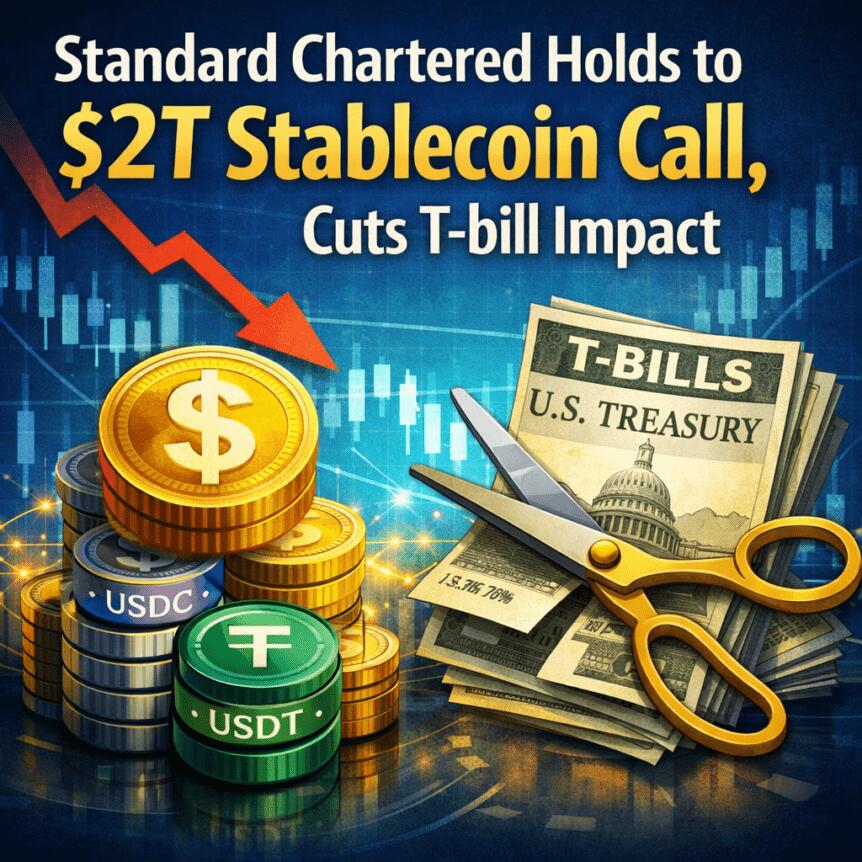
Standard Chartered’s newest briefing sticks to a bullish view on stablecoins, arguing that the sector will swell to about $2 trillion in market capitalization by late 2028, even as near-term demand for U.S. Treasuries eases. The bank’s analysts, Geoffrey Kendrick and John Davies, contend that dollar-backed stablecoins such as Tether’s USDt (USDT)(CRYPTO: USDT) and Circle’s USDC (USDC)(CRYPTO: USDC) will remain the bedrock of a shift in reserve management that could lift Treasury bill demand toward the $2.2 trillion mark by 2028. The note comes despite a cooling in the overall crypto cycle that has kept the dollar-stablecoin market cap hovering near $300 billion in recent months.
In making the case, the analysts point to policy momentum in Washington that they say underpins the thesis. The GENIUS Act, signed into law in 2025, is cited as a potential catalyst for broader acceptance and clarity around stablecoins, which in turn could influence both institutional wallet allocations and sovereign appetite for short-duration Treasuries. The report argues that the structural shift remains intact even if the pace of near-term demand is tempered by market cycles.
“We see these issues as cyclical rather than structural, and we continue to expect stablecoin market cap to reach $2 trillion by end-2028,” the Standard Chartered note states, framing a longer-run reallocation of liquidity toward crypto-enabled reserves as a core driver of T-bill demand.
Stablecoins may drive Treasury to issue more bills despite lowered demand
Standard Chartered’s forecast envisions a substantial uplift in T-bill demand driven by stablecoins acting as reserve assets. The bank now sees stablecoins generating an additional $800 billion to $1 trillion in fresh T-bill demand by late 2028, a sizeable downgrade from the $1.6 trillion projected in April 2025, even after GENIUS Act provisions took effect. The fundamental idea is that as stablecoins grow as credible cash-equivalents, institutions and cash-rich entities will prefer Treasuries as collateral or reserve holdings, prompting a broader issuance program by the Treasury.
The piece underscores that the Treasury may respond to this reserve-driven demand by issuing more T-bills. It cites Treasury Secretary Scott Bessent’s remarks in early February, which framed the GENIUS Act as a potentially important financing tool for the U.S. government, aligning policy with the evolving liquidity landscape created by stablecoins. The quarterly refunding announcement on the same day highlighted “growing demand for Treasury bills from the private sector,” the bank notes, signaling a potential loop where rising demand for crypto-backed reserves could spur additional government debt supply.
Beyond the stablecoin thesis, Standard Chartered has not abandoned itsBitcoin(BTC)(CRYPTO: BTC) outlook. While the bank previously carried a bullish longer-run target, it recently trimmed its price forecast for 2026 from $150,000 to $100,000, acknowledging that BTC could dip toward $50,000 before any meaningful recovery unfolds. The downgrade illustrates the bank’s approach to balancing aggressive longer-term premises with near-term macro uncertainties.
In tandem with these macro considerations, the bank’s researchers maintain that the stablecoin storyline remains a key driver of liquidity and risk sentiment in crypto markets. The broader takeaway is that the relationship between sovereign debt management, central-bank operations, and the crypto ecosystem is evolving in a way that could rewire how liquidity is allocated in the coming years, even as the sector continues to navigate cycles of volatility and regulatory scrutiny.
Source: Standard Chartered
Market context
The forecast arrives as a broader crypto environment continues to digest policy signals and investor appetite for digital assets. The GENIUS Act is a central thread in this narrative, offering a legislative framework that could reduce regulatory friction for stablecoins while clarifying their role in institutional reserve practices. At the same time, the Fed’s reserve management purchases and its ongoing balance-sheet adjustments—alongside a possible reweighting of Treasuries in private-sector liquidity pools—shape the backdrop against which stablecoins could influence T-bill issuance and market depth.
Why it matters
The projection matters because it links stablecoin growth to sovereign debt management and macro liquidity dynamics. If stablecoins become a routine, preferred form of reserve or collateral, banks, institutions, and non-bank financials may channel more liquidity into Treasuries, potentially altering demand curves for T-bills and influencing credit conditions across markets. For crypto users and builders, the interplay between regulatory clarity, stablecoin infrastructure, and central-bank liquidity programs could translate into a more robust on-ramp to digital-asset ecosystems and a longer horizon of institutional participation.
From an investor perspective, the narrative signals that stablecoins are not simply a payments convenience but a bridge between the crypto world and traditional finance. The possibility of more T-bill issuance to accommodate rising secure-lien demand could keep risk-free yields anchored while offering new channels for liquidity and collateral management. Yet the path remains contingent on how regulators implement policy, how successfully stablecoins maintain reserve health, and how swiftly the broader market absorbs shifts in risk sentiment.
What to watch next
- Details on GENIUS Act implementation and regulatory guidance as 2025–2026 unfolds.
- Updates from the Treasury’s refunding calendar and any reported private-sector demand signals.
- Federal Reserve communications about reserve management purchases and any shifts in MBS-to-T-bill reallocation.
- Progress in stablecoin reserve frameworks, including regulatory clarity on collateral and liquidity requirements (SEC developments).
Sources & verification
- Standard Chartered report outlining a $2 trillion stablecoin market by end-2028 and the projected impact on T-bill demand.
- References to the GENIUS Act and its role in shaping stablecoin policy.
- Treasury quarterly refunding announcements and statements on private-sector demand for T-bills.
- Federal Reserve actions related to reserve management purchases (RMPs).
- SEC discussions on stablecoin exemptions or haircuts for broker-dealers.
This article was originally published as Standard Chartered Holds to $2T Stablecoin Call, Cuts T-bill Impact on Crypto Breaking News – your trusted source for crypto news, Bitcoin news, and blockchain updates.


You May Also Like

Tether Files Seven Trademarks in South Korea
Trump's $1B ballroom funding on the verge of being 'ejected' by his own party