

Why Binance Stablecoin Reserves Decline 18.6% Since November Peak
This article was first published on The Bit Journal.
Binance’s stablecoin reserves hit their lowest point since October, underscoring near-constant liquidity pressure in crypto markets. CryptoQuant has had a stark compression since November, suggesting slower capital inflows and cautious investor posture on exchanges.
Stablecoin reserves on Binance, according to the CryptoQuant analyst Darkfost have taken a 18.6% drop since November. Balances fell by about $10 billion, dropping from $50.9 billion to $41.4 billion. The change is indicative of softening exchange-held liquidity at a time when wider markets are slower.
Binance Maintains 64% Share of Exchange Stablecoin Reserves
Despite the drop, about 64% of total Stablecoin reserves across centralized exchanges still held by Binance. Analysts note that shifts on a platform this large have significance. A continued drawdown may reflect structural caution rather than temporary volatility.
Stablecoins reserves are seen as a live metric of liquidity in the crypto market. Increasing balances suggests that investors are raising capital and getting ready to allocate towards digital assets. Declining balances can only indicate withdrawals, less trading, or some conversion back to fiat.
Exchange balances generally readjust according to investor demand, Darkfost notes. He said crypto liquidity dynamics can be proxied by stablecoin flows. He noted current trends reveal low incoming liquidity across the market.
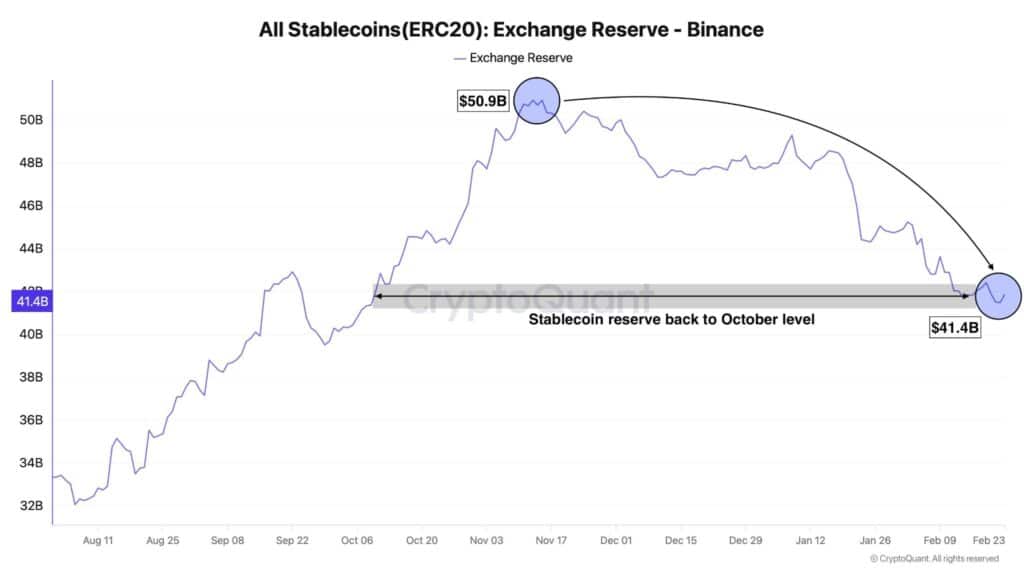 Source: CryptoQuant
Binance’s Market Share in Stablecoin Holdings
Even after the decline, Binance remains the dominant exchange for Stablecoin reserves. Holding nearly two-thirds of exchange balances gives it outsized influence over liquidity conditions. When Binance’s reserves contract, broader market sentiment often follows.
Analysts caution that shifts at this scale should not be ignored. Because Binance processes a large share of global trading activity, its reserve movements can reflect changing institutional and retail behavior.
Liquidity Withdrawal Signals
A contraction in exchange Stablecoin reserves generally indicates that investors are removing liquidity from crypto markets. Instead of keeping stablecoins on exchanges for rapid re-entry, they may be converting assets back to fiat or transferring funds off-platform.
Darkfost identified the lack of incoming liquidity as a major headwind. From a broader cross-market liquidity perspective, he said conditions are unlikely to improve in the near term. Without fresh inflows, buying momentum can remain limited.
Stablecoin Market Capitalization Stalls
Data from DeFiLlama shows that the total stablecoin market capitalization has plateaued at just over $300 billion since October. This pause follows two years of strong expansion, during which circulation grew by approximately 150%.
The last significant contraction in the stablecoin sector occurred in mid-2022. That downturn followed the Terra/Luna collapse and marked the beginning of a prolonged bear cycle. Recovery did not begin until November 2023, roughly 18 months later.
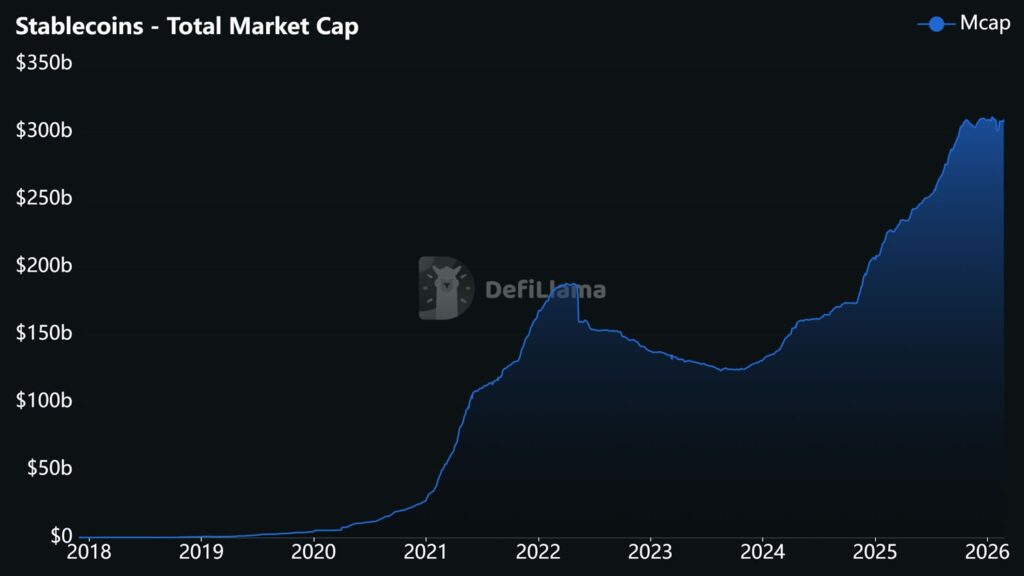 Source: DeFiLlama
Interest Rates Add External Pressure
Reserves and total liquidity will still be driven mainly by macro policy. Higher interest rates typically reduce risk appetite and slow the movement of capital into speculative assets such as cryptocurrencies.
Federal Reserve Governor Christopher Waller said he might keep rates unchanged at the March meeting if February’s labor data suggests economic stabilization. His comments cemented expectations that any caution on policy would come but not with immediate easing.
CME Futures Signal Limited Policy Change
Currently, the CME futures markets assign a 95.5% probability to no change in interest rates this March. A steady monetary policy may keep borrowing costs elevated. That dynamic can stifle liquidity growth in crypto markets.
Analysts said a new wave of stablecoin inflows would be required to put liquidity conditions back on the upswing. Market stabilization may thus be an illusive until reserves begin to increase again.
What Could Reverse the Trend?
A rebound in reserves would suggest fresh capital entering exchanges. That shift could signal renewed confidence and stronger trading activity. It may also indicate improved macro conditions or greater institutional participation.
However, liquidity cycles often move gradually. Market participants are watching for sustained inflows rather than short-term spikes.
Conclusion
The reduction of Binance Stablecoin reserves depicts tighter liquidity and nervous investor sentiment. Binance, which has the largest share of exchange balances, contracted but this is a sign of wider market restraint.
Appendix: Glossary of Key Terms
Liquidity: The availability of capital in a market that enables taking positions, either long or short without affecting the asset price.
Exchange Outflows: The transfer of Stablecoins or Cryptocurrencies to trading platforms, could signal potential investments.
Exchange Flows: Reflect the transfer of digital assets to and from exchanges, offering insights on potential deposit (indicates reduced trading intent) or withdrawal activity (people pulling funds for capital repositioning).
Market Cap: The total market value of a cryptocurrency, which is computed by multiplying the price per coin times the circulating supply.
Interest Rates: The price charged for borrowing money and set by central banks, affecting investment flows and net liquidity in the economy.
Crypto Liquidity Dynamics: The tendency of capital to come and go from digital asset markets, often tracked via stablecoin flows.
Frequently Asked Questions About Stablecoin reserves
1- What are Stablecoin reserves?
Stablecoin reserves represent the total amount of stablecoins held on crypto exchanges. They are commonly used to measure available liquidity and potential buying power.
2- Why are Binance’s reserves closely monitored?
Binance controls about 64% of exchange-held stablecoins. Because of its size, changes in its balances can influence overall market liquidity trends.
3- What does a decline in reserves mean?
A drop usually signals that investors are withdrawing funds or converting stablecoins back into fiat. This reduces immediate capital available for trading.
4- What is the influence of interest rates on crypto liquidity?
A drop typically indicates that investors are taking money out or redeeming stablecoins back to fiat. This limits the capital onboard to execute trades in real time.
References
CoinTelegraph
CryptoQuant
Read More: Why Binance Stablecoin Reserves Decline 18.6% Since November Peak">Why Binance Stablecoin Reserves Decline 18.6% Since November Peak


You May Also Like

The changing face of elder care in Malaysia — Sayed Mohammad Reza Yamani Sayed Umar

Not a loophole: Singapore AI export controls let China tap US AI legally

Exclusive interview with Smokey The Bera, co-founder of Berachain: How the innovative PoL public chain solves the liquidity problem and may be launched in a few months



