Solana’s Rust validator client Agave has matched Firedancer’s lab record, briefly peaking at 1.1 million transactions per second in a synthetic, single-node benchmark. The result was disclosed by Solana core engineer Andrew Fitzgerald, who wrote: “Hit a burst of 1.1m TPS on agave this morning. Single-node synthetic test with simple transfers. On a branch with […]Solana’s Rust validator client Agave has matched Firedancer’s lab record, briefly peaking at 1.1 million transactions per second in a synthetic, single-node benchmark. The result was disclosed by Solana core engineer Andrew Fitzgerald, who wrote: “Hit a burst of 1.1m TPS on agave this morning. Single-node synthetic test with simple transfers. On a branch with […]

Solana Client Agave Smashes 1.1 Million TPS, Matching Firedancer’s Record

Solana’s Rust validator client Agave has matched Firedancer’s lab record, briefly peaking at 1.1 million transactions per second in a synthetic, single-node benchmark. The result was disclosed by Solana core engineer Andrew Fitzgerald, who wrote: “Hit a burst of 1.1m TPS on agave this morning. Single-node synthetic test with simple transfers. On a branch with several changes not yet merged,” before listing PoH recording and status-cache improvements alongside new “scheduler-bindings,” with block/shred limits disabled for the run.

Pressed on caveats, Fitzgerald added a plain-English qualifier: “disabled block/shred limits, and it’s a burst not sustained. have several long-term perf improvements squashed on top of scheduler-bindings to make this happen.” The exchange underscored that this is a laboratory datapoint, not a network-wide throughput number.

Solana’s Core Client Smashes 1.1M TPS

The milestone immediately fed a broader narrative about client-level competition on Solana. Helius co-founder Mert Mumtaz framed it this way: “last year Firedancer hit 1.1M TPS on a synthetic test — now, Agave has done the same. There is an outdated notion that Solana will become faster only if Firedancer. This is from a time when Agave wasn’t as competitive — but it is now. The competition between the two client teams will improve the chain like never before.”

Anatoly Yakovenko, Solana’s co-founder, poked fun at the victory lap, quipping: “Pls no more. Just ship ag and lower the timers to 150ms.” The remark tracks with the network’s ongoing push to reduce consensus latencies. That push is currently crystallized in SIMD-0326 (“Alpenglow”), a consensus overhaul now in community voting that targets ~150 ms block finality by reworking how and where validator votes occur.

Under the hood, the Agave test hints at where performance headroom is being unlocked. “Scheduler-bindings” — a forthcoming extension that lets validators plug in custom block-packing logic without forking core — has been on Anza’s public roadmap since May. Recent Agave 2.3 literature also details a revamped TPU client (“tpu-client-next”), AccountsDB I/O reductions, a greedy scheduler, and snapshot/gossip improvements, all of which cut real-world overhead even if they don’t show up in synthetic peaks one-for-one.

The obvious question is what the 1.1M TPS burst actually means for users. Synthetic single-node tests measure raw execution and scheduling throughput with some guardrails temporarily lifted; they do not translate linearly to mainnet capacity, which is bounded by network propagation, signature verification, scheduler policy, and economic constraints. Still, the number is directionally consistent with the network’s trajectory. Earlier this month, independent experiments observed six-figure TPS bursts on mainnet under heavy program-call load — a separate datapoint that, taken together with Agave’s lab figure, reinforces the pace of optimization across both client and protocol layers.

Two broader takeaways stand out. First, Solana’s client diversity is no longer hypothetical: Agave (Anza) and Firedancer (Jump Crypto) are now trading blows on the same synthetic leaderboard, with different codebases stressing different parts of the system — a healthy sign for resilience and future performance. Second, the product focus has shifted from trophy numbers to latency and predictability: the 150 ms target, if adopted, compresses user-perceived finality in ways that matter for payments, trading, and real-time apps even when headline TPS fluctuates.

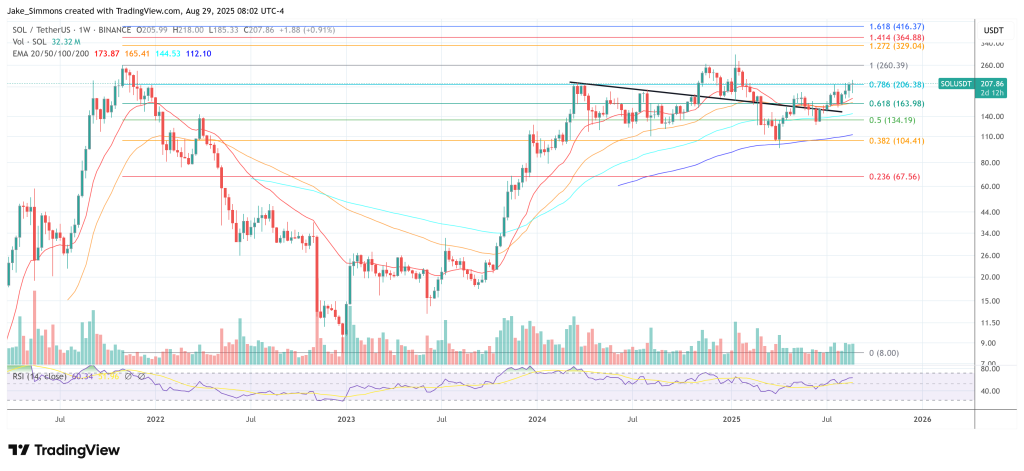
At press time, SOL traded at $207.86.
Solana price
Market Opportunity
NODE Logo
NODE Price(NODE)
$0.01518
$0.01518$0.01518
-0.39%
USD
NODE (NODE) Live Price Chart
Disclaimer: The articles reposted on this site are sourced from public platforms and are provided for informational purposes only. They do not necessarily reflect the views of MEXC. All rights remain with the original authors. If you believe any content infringes on third-party rights, please contact [email protected] for removal. MEXC makes no guarantees regarding the accuracy, completeness, or timeliness of the content and is not responsible for any actions taken based on the information provided. The content does not constitute financial, legal, or other professional advice, nor should it be considered a recommendation or endorsement by MEXC.

You May Also Like

Fed forecasts only one rate cut in 2026, a more conservative outlook than expected

Fed forecasts only one rate cut in 2026, a more conservative outlook than expected

The post Fed forecasts only one rate cut in 2026, a more conservative outlook than expected appeared on BitcoinEthereumNews.com. Federal Reserve Chairman Jerome Powell talks to reporters following the regular Federal Open Market Committee meetings at the Fed on July 30, 2025 in Washington, DC. Chip Somodevilla | Getty Images The Federal Reserve is projecting only one rate cut in 2026, fewer than expected, according to its median projection. The central bank’s so-called dot plot, which shows 19 individual members’ expectations anonymously, indicated a median estimate of 3.4% for the federal funds rate at the end of 2026. That compares to a median estimate of 3.6% for the end of this year following two expected cuts on top of Wednesday’s reduction. A single quarter-point reduction next year is significantly more conservative than current market pricing. Traders are currently pricing in at two to three more rate cuts next year, according to the CME Group’s FedWatch tool, updated shortly after the decision. The gauge uses prices on 30-day fed funds futures contracts to determine market-implied odds for rate moves. Here are the Fed’s latest targets from 19 FOMC members, both voters and nonvoters: Zoom In IconArrows pointing outwards The forecasts, however, showed a large difference of opinion with two voting members seeing as many as four cuts. Three officials penciled in three rate reductions next year. “Next year’s dot plot is a mosaic of different perspectives and is an accurate reflection of a confusing economic outlook, muddied by labor supply shifts, data measurement concerns, and government policy upheaval and uncertainty,” said Seema Shah, chief global strategist at Principal Asset Management. The central bank has two policy meetings left for the year, one in October and one in December. Economic projections from the Fed saw slightly faster economic growth in 2026 than was projected in June, while the outlook for inflation was updated modestly higher for next year. There’s a lot of uncertainty…
Share
BitcoinEthereumNews2025/09/18 02:59
Pump.fun CEO to Call Low-Cap Gem to Test New ‘Callouts’ Feature — Is a 100x Incoming?

Pump.fun CEO to Call Low-Cap Gem to Test New ‘Callouts’ Feature — Is a 100x Incoming?

Pump.fun has rolled out a new social feature that is already stirring debate across Solana’s meme coin scene, after founder Alon Cohen said he would personally
Share
CryptoNews2026/01/16 06:26
Iran’s Crypto Use Reaches $7.8 Billion Amid Protests

Iran’s Crypto Use Reaches $7.8 Billion Amid Protests

Iran's crypto usage hit $7.8 billion in 2025, fueled by protests and economic instability, says Chainalysis.
Share
bitcoininfonews2026/01/16 05:51