By Tiger Research Compiled by AididiaoJP, Foresight News summary While the AI agent market saw a sharp decline in popularity following the token price crash, technological development continues at a steady pace. The DeFAI sector is regaining attention with real product releases and specialized on-chain functionality. Specialized agents optimized for specific functions have replaced the previous general-purpose agents. Projects such as Virtuals are actively building the infrastructure to connect these agents and enable them to collaborate. AI agents will be integrated into crypto projects as core functionality. Infrastructure that enables smooth communication and collaboration between agents will become crucial. The hype ends, the technology continues The cryptocurrency industry has incorporated AI technology in various ways, with AI agents receiving the most attention. The total market capitalization of agent-related tokens reached approximately $16 billion at one point. This demonstrated strong market interest, but the interest was short-lived. Most projects failed to meet development expectations, and token prices plummeted by over 90% from their peak. Falling prices don't necessarily signal technological regression. AI agents remain a crucial area of technology in the crypto space. Discussions about practical use cases are becoming more concrete, and teams continue to test new approaches. This report explores how AI agents are playing a role in crypto and explores potential future developments. Reshaping the AI Agent Ecosystem After the Hype Early AI agent projects gradually faded from the market The AI agent sector in the crypto space began to gain traction in late 2024. ElizaOS by the ai16z team and the GAME development stack by the Virtuals Protocol team significantly lowered the barrier to entry for agent development. Launchpads like DAOS.fun and Virtuals Fun provided platforms for tokenizing developed agents. This streamlined process from development to release fueled a surge in market interest, leading to the rapid emergence of numerous agent projects. Most projects have ambitious roadmaps leveraging AI technology. Investors, anticipating innovative services, have driven up token prices. In reality, these projects are merely wrappers of OpenAI or Anthropic's base models, tweaked or cue-engineered. Most are building advanced chatbots for X or Telegram rather than developing standalone services. While these projects emphasize innovative visions and technological differentiation, their actual operations are virtually indistinguishable from meme coins. Source: aixbt However, some projects are exceptions. Projects like aixbt and Soleng have partially implemented their roadmaps and launched actual services. They use token gating to provide exclusive access to token holders. Aixbt provides project analysis reports, while Soleng analyzes Github repositories to support investor decision-making. Even these relatively successful projects couldn't overcome structural limitations. Unstable revenue structures reliant solely on token price increases hindered progress. Technological competitiveness lagged behind that of Web2 companies. Token prices eventually plummeted, operating funds dried up, and most projects have now suspended operations. The DeFAI project has rekindled hope in the field AI agent technology, once facing over-hyped expectations, is now entering a correction phase. The DeFi (DeFi) sector is regaining attention by proving its real-world value. DeFi agents execute automated investment strategies 24/7. They enable users to easily access complex DeFi services through simple natural language commands. This sector was a core narrative in the early days of the AI agent space. Most projects remained in the roadmap phase, struggling to achieve actual implementation. The sector temporarily lost attention. Recent product launches are rebuilding market expectations. Representative projects include Wayfinder and HeyAnon. Wayfinder uses specialized AI agents called "Shells" to perform on-chain tasks. Shells execute transactions directly on-chain through a built-in dedicated wallet. The system utilizes a specialized multi-agent architecture, encompassing trading agents, perpetual agents, and contract agents. Each agent type specializes in a specific role, enabling automation of various investment strategies. Users can easily execute simple cross-chain trades or advanced strategies such as basis trading and leveraged fixed-investing. From individual agents to agent networks Early AI agent projects promoted "general-purpose agents" that could perform all functions. This approach prioritized funding over technological completeness. Projects proposed excessive roadmaps to capture a broader market, and most exposed limitations during implementation. The current agent ecosystem is moving in a completely different direction. Builders, recognizing the limitations of general-purpose agents, are now developing specialized agents. These agents can collaborate with one another, similar to how skilled craftsmen with diverse expertise—carpenters, electricians, plumbers, and so on—collaborate to build a house. Virtuals Protocol's ACP represents this trend. It provides a standard framework for communication and task allocation between different agents. Theoriq and General Impression are also building infrastructure to enhance interoperability between agents. The market is reshaping itself, shifting towards maximizing the value of the entire agent ecosystem, rather than the value of individual agents. Future scenarios for the AI agent market Even after the early hype cooled, AI agents continued to evolve. While the speculation ended, projects continued to build new features and services using AI agents. Two developments stood out. First, AI agents are becoming essential infrastructure. They are no longer a standalone field, but are being integrated into crypto projects as a fundamental feature. Nansen, a blockchain data platform, has developed research agents to make complex on-chain data easier to explore. DeFi projects are also adding agents to improve user access. AI agents will become the final interface connecting users to the blockchain, not an optional feature. Second, agent commerce will grow. As AI agents become standard, interactions between agents and humans will become more frequent. Secure transaction protocols and trust mechanisms will become increasingly important. Projects like Virtuals Protocol's ACP are laying the foundation for this. These changes will simplify the complexities of the crypto space, improve user experience, and create new economic opportunities.By Tiger Research Compiled by AididiaoJP, Foresight News summary While the AI agent market saw a sharp decline in popularity following the token price crash, technological development continues at a steady pace. The DeFAI sector is regaining attention with real product releases and specialized on-chain functionality. Specialized agents optimized for specific functions have replaced the previous general-purpose agents. Projects such as Virtuals are actively building the infrastructure to connect these agents and enable them to collaborate. AI agents will be integrated into crypto projects as core functionality. Infrastructure that enables smooth communication and collaboration between agents will become crucial. The hype ends, the technology continues The cryptocurrency industry has incorporated AI technology in various ways, with AI agents receiving the most attention. The total market capitalization of agent-related tokens reached approximately $16 billion at one point. This demonstrated strong market interest, but the interest was short-lived. Most projects failed to meet development expectations, and token prices plummeted by over 90% from their peak. Falling prices don't necessarily signal technological regression. AI agents remain a crucial area of technology in the crypto space. Discussions about practical use cases are becoming more concrete, and teams continue to test new approaches. This report explores how AI agents are playing a role in crypto and explores potential future developments. Reshaping the AI Agent Ecosystem After the Hype Early AI agent projects gradually faded from the market The AI agent sector in the crypto space began to gain traction in late 2024. ElizaOS by the ai16z team and the GAME development stack by the Virtuals Protocol team significantly lowered the barrier to entry for agent development. Launchpads like DAOS.fun and Virtuals Fun provided platforms for tokenizing developed agents. This streamlined process from development to release fueled a surge in market interest, leading to the rapid emergence of numerous agent projects. Most projects have ambitious roadmaps leveraging AI technology. Investors, anticipating innovative services, have driven up token prices. In reality, these projects are merely wrappers of OpenAI or Anthropic's base models, tweaked or cue-engineered. Most are building advanced chatbots for X or Telegram rather than developing standalone services. While these projects emphasize innovative visions and technological differentiation, their actual operations are virtually indistinguishable from meme coins. Source: aixbt However, some projects are exceptions. Projects like aixbt and Soleng have partially implemented their roadmaps and launched actual services. They use token gating to provide exclusive access to token holders. Aixbt provides project analysis reports, while Soleng analyzes Github repositories to support investor decision-making. Even these relatively successful projects couldn't overcome structural limitations. Unstable revenue structures reliant solely on token price increases hindered progress. Technological competitiveness lagged behind that of Web2 companies. Token prices eventually plummeted, operating funds dried up, and most projects have now suspended operations. The DeFAI project has rekindled hope in the field AI agent technology, once facing over-hyped expectations, is now entering a correction phase. The DeFi (DeFi) sector is regaining attention by proving its real-world value. DeFi agents execute automated investment strategies 24/7. They enable users to easily access complex DeFi services through simple natural language commands. This sector was a core narrative in the early days of the AI agent space. Most projects remained in the roadmap phase, struggling to achieve actual implementation. The sector temporarily lost attention. Recent product launches are rebuilding market expectations. Representative projects include Wayfinder and HeyAnon. Wayfinder uses specialized AI agents called "Shells" to perform on-chain tasks. Shells execute transactions directly on-chain through a built-in dedicated wallet. The system utilizes a specialized multi-agent architecture, encompassing trading agents, perpetual agents, and contract agents. Each agent type specializes in a specific role, enabling automation of various investment strategies. Users can easily execute simple cross-chain trades or advanced strategies such as basis trading and leveraged fixed-investing. From individual agents to agent networks Early AI agent projects promoted "general-purpose agents" that could perform all functions. This approach prioritized funding over technological completeness. Projects proposed excessive roadmaps to capture a broader market, and most exposed limitations during implementation. The current agent ecosystem is moving in a completely different direction. Builders, recognizing the limitations of general-purpose agents, are now developing specialized agents. These agents can collaborate with one another, similar to how skilled craftsmen with diverse expertise—carpenters, electricians, plumbers, and so on—collaborate to build a house. Virtuals Protocol's ACP represents this trend. It provides a standard framework for communication and task allocation between different agents. Theoriq and General Impression are also building infrastructure to enhance interoperability between agents. The market is reshaping itself, shifting towards maximizing the value of the entire agent ecosystem, rather than the value of individual agents. Future scenarios for the AI agent market Even after the early hype cooled, AI agents continued to evolve. While the speculation ended, projects continued to build new features and services using AI agents. Two developments stood out. First, AI agents are becoming essential infrastructure. They are no longer a standalone field, but are being integrated into crypto projects as a fundamental feature. Nansen, a blockchain data platform, has developed research agents to make complex on-chain data easier to explore. DeFi projects are also adding agents to improve user access. AI agents will become the final interface connecting users to the blockchain, not an optional feature. Second, agent commerce will grow. As AI agents become standard, interactions between agents and humans will become more frequent. Secure transaction protocols and trust mechanisms will become increasingly important. Projects like Virtuals Protocol's ACP are laying the foundation for this. These changes will simplify the complexities of the crypto space, improve user experience, and create new economic opportunities.
AI Agent Market Map: Hype is over, technology continues

2025/08/30 10:29

By Tiger Research

Compiled by AididiaoJP, Foresight News

summary

  • While the AI agent market saw a sharp decline in popularity following the token price crash, technological development continues at a steady pace. The DeFAI sector is regaining attention with real product releases and specialized on-chain functionality.
  • Specialized agents optimized for specific functions have replaced the previous general-purpose agents. Projects such as Virtuals are actively building the infrastructure to connect these agents and enable them to collaborate.
  • AI agents will be integrated into crypto projects as core functionality. Infrastructure that enables smooth communication and collaboration between agents will become crucial.

The hype ends, the technology continues

The cryptocurrency industry has incorporated AI technology in various ways, with AI agents receiving the most attention. The total market capitalization of agent-related tokens reached approximately $16 billion at one point. This demonstrated strong market interest, but the interest was short-lived. Most projects failed to meet development expectations, and token prices plummeted by over 90% from their peak.

Falling prices don't necessarily signal technological regression. AI agents remain a crucial area of technology in the crypto space. Discussions about practical use cases are becoming more concrete, and teams continue to test new approaches. This report explores how AI agents are playing a role in crypto and explores potential future developments.

Reshaping the AI Agent Ecosystem After the Hype

Early AI agent projects gradually faded from the market

The AI agent sector in the crypto space began to gain traction in late 2024. ElizaOS by the ai16z team and the GAME development stack by the Virtuals Protocol team significantly lowered the barrier to entry for agent development. Launchpads like DAOS.fun and Virtuals Fun provided platforms for tokenizing developed agents. This streamlined process from development to release fueled a surge in market interest, leading to the rapid emergence of numerous agent projects.
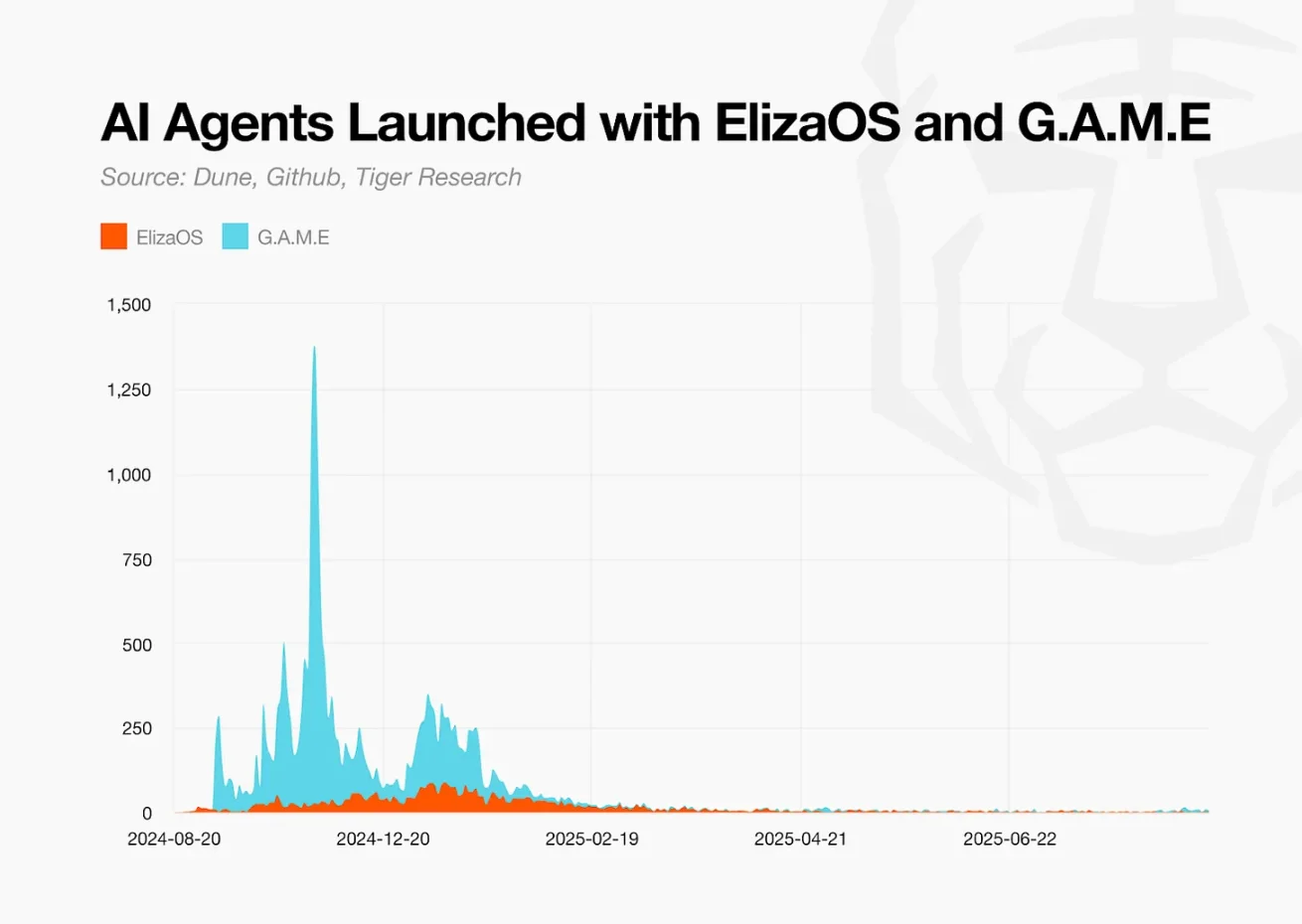
Most projects have ambitious roadmaps leveraging AI technology. Investors, anticipating innovative services, have driven up token prices. In reality, these projects are merely wrappers of OpenAI or Anthropic's base models, tweaked or cue-engineered. Most are building advanced chatbots for X or Telegram rather than developing standalone services. While these projects emphasize innovative visions and technological differentiation, their actual operations are virtually indistinguishable from meme coins.
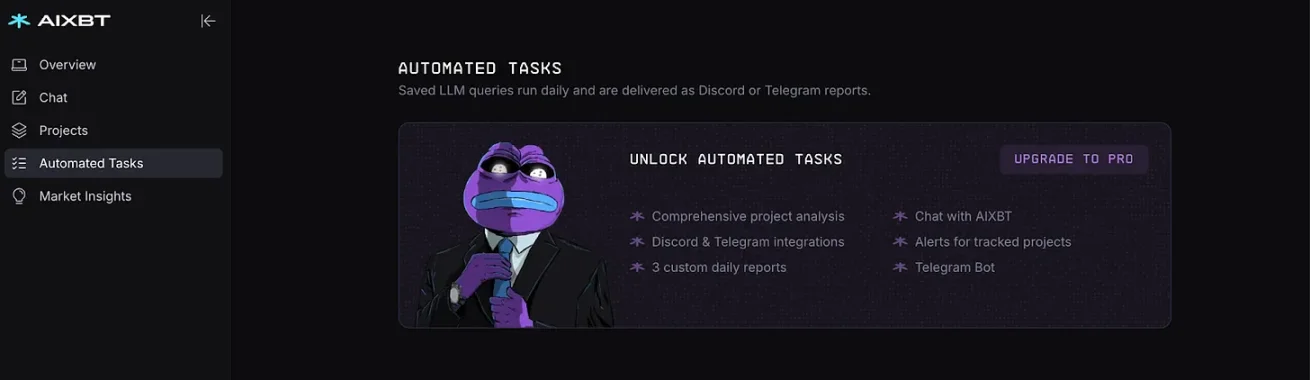
 Source: aixbt

However, some projects are exceptions. Projects like aixbt and Soleng have partially implemented their roadmaps and launched actual services. They use token gating to provide exclusive access to token holders. Aixbt provides project analysis reports, while Soleng analyzes Github repositories to support investor decision-making.

Even these relatively successful projects couldn't overcome structural limitations. Unstable revenue structures reliant solely on token price increases hindered progress. Technological competitiveness lagged behind that of Web2 companies. Token prices eventually plummeted, operating funds dried up, and most projects have now suspended operations.

The DeFAI project has rekindled hope in the field

AI agent technology, once facing over-hyped expectations, is now entering a correction phase. The DeFi (DeFi) sector is regaining attention by proving its real-world value. DeFi agents execute automated investment strategies 24/7. They enable users to easily access complex DeFi services through simple natural language commands. This sector was a core narrative in the early days of the AI agent space. Most projects remained in the roadmap phase, struggling to achieve actual implementation. The sector temporarily lost attention. Recent product launches are rebuilding market expectations.

Representative projects include Wayfinder and HeyAnon. Wayfinder uses specialized AI agents called "Shells" to perform on-chain tasks. Shells execute transactions directly on-chain through a built-in dedicated wallet. The system utilizes a specialized multi-agent architecture, encompassing trading agents, perpetual agents, and contract agents. Each agent type specializes in a specific role, enabling automation of various investment strategies. Users can easily execute simple cross-chain trades or advanced strategies such as basis trading and leveraged fixed-investing.

From individual agents to agent networks

Early AI agent projects promoted "general-purpose agents" that could perform all functions. This approach prioritized funding over technological completeness. Projects proposed excessive roadmaps to capture a broader market, and most exposed limitations during implementation.

The current agent ecosystem is moving in a completely different direction. Builders, recognizing the limitations of general-purpose agents, are now developing specialized agents. These agents can collaborate with one another, similar to how skilled craftsmen with diverse expertise—carpenters, electricians, plumbers, and so on—collaborate to build a house.

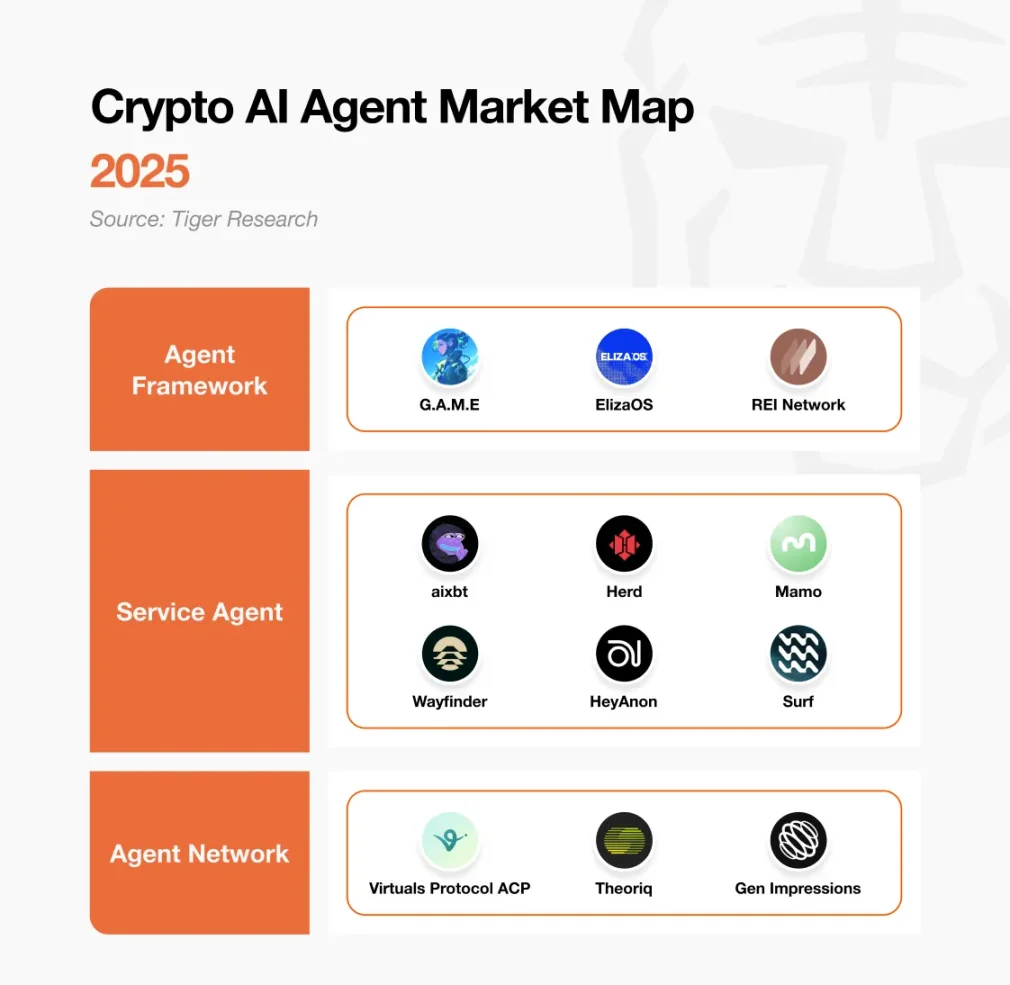
Virtuals Protocol's ACP represents this trend. It provides a standard framework for communication and task allocation between different agents. Theoriq and General Impression are also building infrastructure to enhance interoperability between agents. The market is reshaping itself, shifting towards maximizing the value of the entire agent ecosystem, rather than the value of individual agents.

Future scenarios for the AI agent market

Even after the early hype cooled, AI agents continued to evolve. While the speculation ended, projects continued to build new features and services using AI agents. Two developments stood out.

First, AI agents are becoming essential infrastructure. They are no longer a standalone field, but are being integrated into crypto projects as a fundamental feature. Nansen, a blockchain data platform, has developed research agents to make complex on-chain data easier to explore. DeFi projects are also adding agents to improve user access. AI agents will become the final interface connecting users to the blockchain, not an optional feature.

Second, agent commerce will grow. As AI agents become standard, interactions between agents and humans will become more frequent. Secure transaction protocols and trust mechanisms will become increasingly important. Projects like Virtuals Protocol's ACP are laying the foundation for this.

These changes will simplify the complexities of the crypto space, improve user experience, and create new economic opportunities.


Market Opportunity
Threshold Logo
Threshold Price(T)
$0.009906
$0.009906$0.009906
-0.14%
USD
Threshold (T) Live Price Chart
Disclaimer: The articles reposted on this site are sourced from public platforms and are provided for informational purposes only. They do not necessarily reflect the views of MEXC. All rights remain with the original authors. If you believe any content infringes on third-party rights, please contact [email protected] for removal. MEXC makes no guarantees regarding the accuracy, completeness, or timeliness of the content and is not responsible for any actions taken based on the information provided. The content does not constitute financial, legal, or other professional advice, nor should it be considered a recommendation or endorsement by MEXC.

You May Also Like

Ethereum ETFs Lead on Jan 15 as Bitcoin Wins the Week

Ethereum ETFs Lead on Jan 15 as Bitcoin Wins the Week

The post Ethereum ETFs Lead on Jan 15 as Bitcoin Wins the Week appeared on BitcoinEthereumNews.com. Key Highlights: Ethereum ETFs led the daily inflows on January
Share
BitcoinEthereumNews2026/01/16 15:18
SEC chair backs rule to let companies ditch quarterly earnings reports

SEC chair backs rule to let companies ditch quarterly earnings reports

SEC Chairman Atkins said on Friday that his agency plans to push forward a rule change to give companies the option to ditch quarterly earnings reports. He confirmed this live on CNBC’s Squawk Box, saying, “I welcome that posting by the president, and I have talked to him about it.” This move follows Donald Trump’s […]
Share
Cryptopolitan2025/09/19 22:42
Lovable AI’s Astonishing Rise: Anton Osika Reveals Startup Secrets at Bitcoin World Disrupt 2025

Lovable AI’s Astonishing Rise: Anton Osika Reveals Startup Secrets at Bitcoin World Disrupt 2025

BitcoinWorld Lovable AI’s Astonishing Rise: Anton Osika Reveals Startup Secrets at Bitcoin World Disrupt 2025 Are you ready to witness a phenomenon? The world of technology is abuzz with the incredible rise of Lovable AI, a startup that’s not just breaking records but rewriting the rulebook for rapid growth. Imagine creating powerful apps and websites just by speaking to an AI – that’s the magic Lovable brings to the masses. This groundbreaking approach has propelled the company into the spotlight, making it one of the fastest-growing software firms in history. And now, the visionary behind this sensation, co-founder and CEO Anton Osika, is set to share his invaluable insights on the Disrupt Stage at the highly anticipated Bitcoin World Disrupt 2025. If you’re a founder, investor, or tech enthusiast eager to understand the future of innovation, this is an event you cannot afford to miss. Lovable AI’s Meteoric Ascent: Redefining Software Creation In an era where digital transformation is paramount, Lovable AI has emerged as a true game-changer. Its core premise is deceptively simple yet profoundly impactful: democratize software creation. By enabling anyone to build applications and websites through intuitive AI conversations, Lovable is empowering the vast majority of individuals who lack coding skills to transform their ideas into tangible digital products. This mission has resonated globally, leading to unprecedented momentum. The numbers speak for themselves: Achieved an astonishing $100 million Annual Recurring Revenue (ARR) in less than a year. Successfully raised a $200 million Series A funding round, valuing the company at $1.8 billion, led by industry giant Accel. Is currently fielding unsolicited investor offers, pushing its valuation towards an incredible $4 billion. As industry reports suggest, investors are unequivocally “loving Lovable,” and it’s clear why. This isn’t just about impressive financial metrics; it’s about a company that has tapped into a fundamental need, offering a solution that is both innovative and accessible. The rapid scaling of Lovable AI provides a compelling case study for any entrepreneur aiming for similar exponential growth. The Visionary Behind the Hype: Anton Osika’s Journey to Innovation Every groundbreaking company has a driving force, and for Lovable, that force is co-founder and CEO Anton Osika. His journey is as fascinating as his company’s success. A physicist by training, Osika previously contributed to the cutting-edge research at CERN, the European Organization for Nuclear Research. This deep technical background, combined with his entrepreneurial spirit, has been instrumental in Lovable’s rapid ascent. Before Lovable, he honed his skills as a co-founder of Depict.ai and a Founding Engineer at Sana. Based in Stockholm, Osika has masterfully steered Lovable from a nascent idea to a global phenomenon in record time. His leadership embodies a unique blend of profound technical understanding and a keen, consumer-first vision. At Bitcoin World Disrupt 2025, attendees will have the rare opportunity to hear directly from Osika about what it truly takes to build a brand that not only scales at an incredible pace in a fiercely competitive market but also adeptly manages the intense cultural conversations that inevitably accompany such swift and significant success. His insights will be crucial for anyone looking to understand the dynamics of high-growth tech leadership. Unpacking Consumer Tech Innovation at Bitcoin World Disrupt 2025 The 20th anniversary of Bitcoin World is set to be marked by a truly special event: Bitcoin World Disrupt 2025. From October 27–29, Moscone West in San Francisco will transform into the epicenter of innovation, gathering over 10,000 founders, investors, and tech leaders. It’s the ideal platform to explore the future of consumer tech innovation, and Anton Osika’s presence on the Disrupt Stage is a highlight. His session will delve into how Lovable is not just participating in but actively shaping the next wave of consumer-facing technologies. Why is this session particularly relevant for those interested in the future of consumer experiences? Osika’s discussion will go beyond the superficial, offering a deep dive into the strategies that have allowed Lovable to carve out a unique category in a market long thought to be saturated. Attendees will gain a front-row seat to understanding how to identify unmet consumer needs, leverage advanced AI to meet those needs, and build a product that captivates users globally. The event itself promises a rich tapestry of ideas and networking opportunities: For Founders: Sharpen your pitch and connect with potential investors. For Investors: Discover the next breakout startup poised for massive growth. For Innovators: Claim your spot at the forefront of technological advancements. The insights shared regarding consumer tech innovation at this event will be invaluable for anyone looking to navigate the complexities and capitalize on the opportunities within this dynamic sector. Mastering Startup Growth Strategies: A Blueprint for the Future Lovable’s journey isn’t just another startup success story; it’s a meticulously crafted blueprint for effective startup growth strategies in the modern era. Anton Osika’s experience offers a rare glimpse into the practicalities of scaling a business at breakneck speed while maintaining product integrity and managing external pressures. For entrepreneurs and aspiring tech leaders, his talk will serve as a masterclass in several critical areas: Strategy Focus Key Takeaways from Lovable’s Journey Rapid Scaling How to build infrastructure and teams that support exponential user and revenue growth without compromising quality. Product-Market Fit Identifying a significant, underserved market (the 99% who can’t code) and developing a truly innovative solution (AI-powered app creation). Investor Relations Balancing intense investor interest and pressure with a steadfast focus on product development and long-term vision. Category Creation Carving out an entirely new niche by democratizing complex technologies, rather than competing in existing crowded markets. Understanding these startup growth strategies is essential for anyone aiming to build a resilient and impactful consumer experience. Osika’s session will provide actionable insights into how to replicate elements of Lovable’s success, offering guidance on navigating challenges from product development to market penetration and investor management. Conclusion: Seize the Future of Tech The story of Lovable, under the astute leadership of Anton Osika, is a testament to the power of innovative ideas meeting flawless execution. Their remarkable journey from concept to a multi-billion-dollar valuation in record time is a compelling narrative for anyone interested in the future of technology. By democratizing software creation through Lovable AI, they are not just building a company; they are fostering a new generation of creators. His appearance at Bitcoin World Disrupt 2025 is an unmissable opportunity to gain direct insights from a leader who is truly shaping the landscape of consumer tech innovation. Don’t miss this chance to learn about cutting-edge startup growth strategies and secure your front-row seat to the future. Register now and save up to $668 before Regular Bird rates end on September 26. To learn more about the latest AI market trends, explore our article on key developments shaping AI features. This post Lovable AI’s Astonishing Rise: Anton Osika Reveals Startup Secrets at Bitcoin World Disrupt 2025 first appeared on BitcoinWorld.
Share
Coinstats2025/09/17 23:40