

The trillion‑dollar question: Can OpenAI turn AI into profit as it readies IPO?
The artificial intelligence boom is approaching a defining moment.
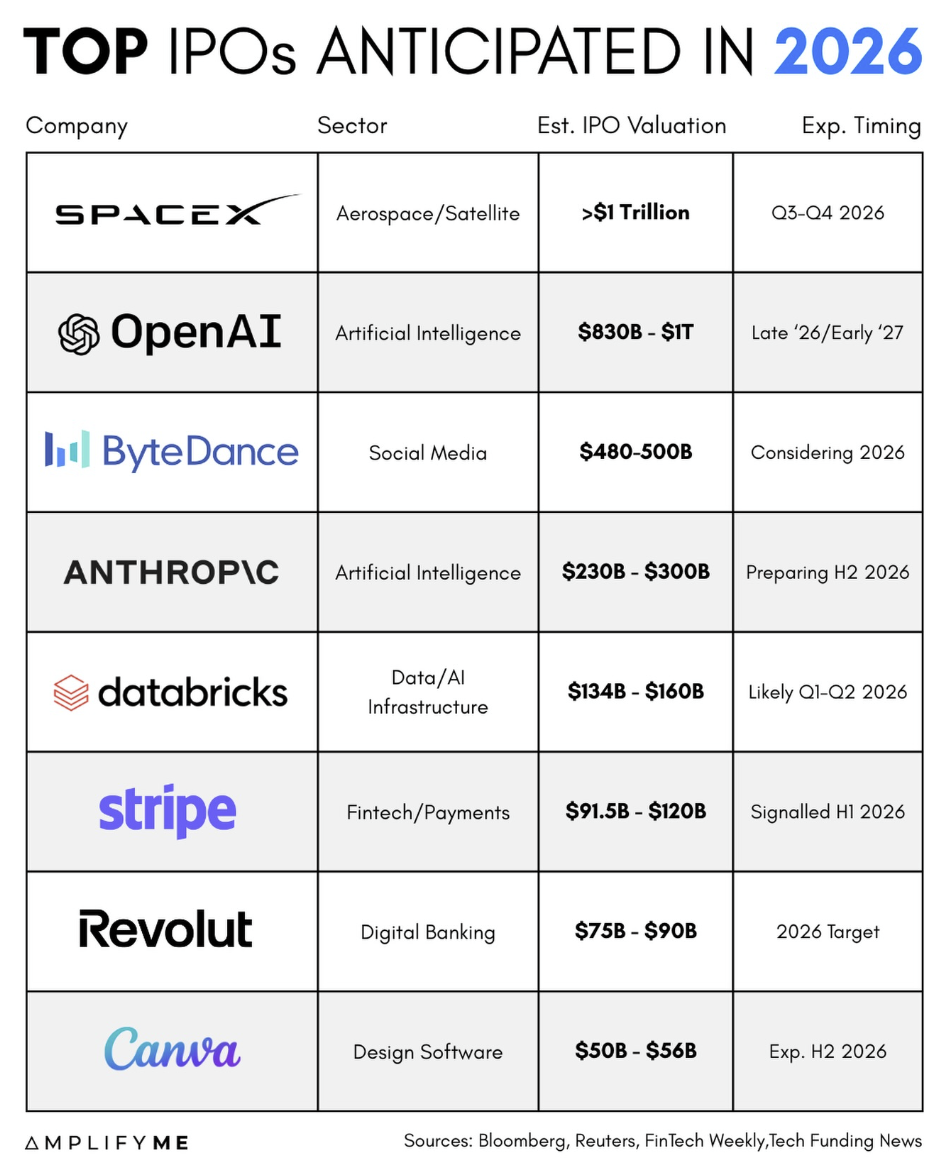
After years of private capital flowing into generative AI at historic speed, OpenAI is reportedly preparing for a public listing that could value the company at $1 trillion.
That figure alone would place it among the largest companies in the world.
But valuation headlines are not the story. The real question is whether the economics of generative AI can support such scale.
OpenAI is currently operating at massive revenue growth and massive cash burn at the same time.
That tension will determine not only the success of its IPO but the direction of the broader AI market.
How big is OpenAI already?
OpenAI’s annualised revenue reportedly crossed $20 billion in 2025.
That places it among the fastest scaling software businesses in history.
Internal projections discussed in financial media point to revenue potentially reaching around $280 billion by 2030.
Those figures are extraordinary. For comparison, many of today’s large public software companies took more than a decade to reach even a fraction of that scale.
If OpenAI reaches $280 billion in annual revenue, it would sit alongside the largest technology platforms globally.
At a $1 trillion valuation, the company would trade at roughly 3 to 4 times projected 2030 revenue.
On the surface, multiple does not look extreme for a company growing at triple-digit rates. However, revenue alone will not decide the outcome. Margins will.
Why are costs rising so fast?
Generative AI does not behave like traditional software. It requires a vast computing infrastructure to train models and ongoing hardware capacity to answer every user request. Each query consumes real resources.
Reports suggest that OpenAI’s compute commitments through the end of the decade could approach $600 billion.
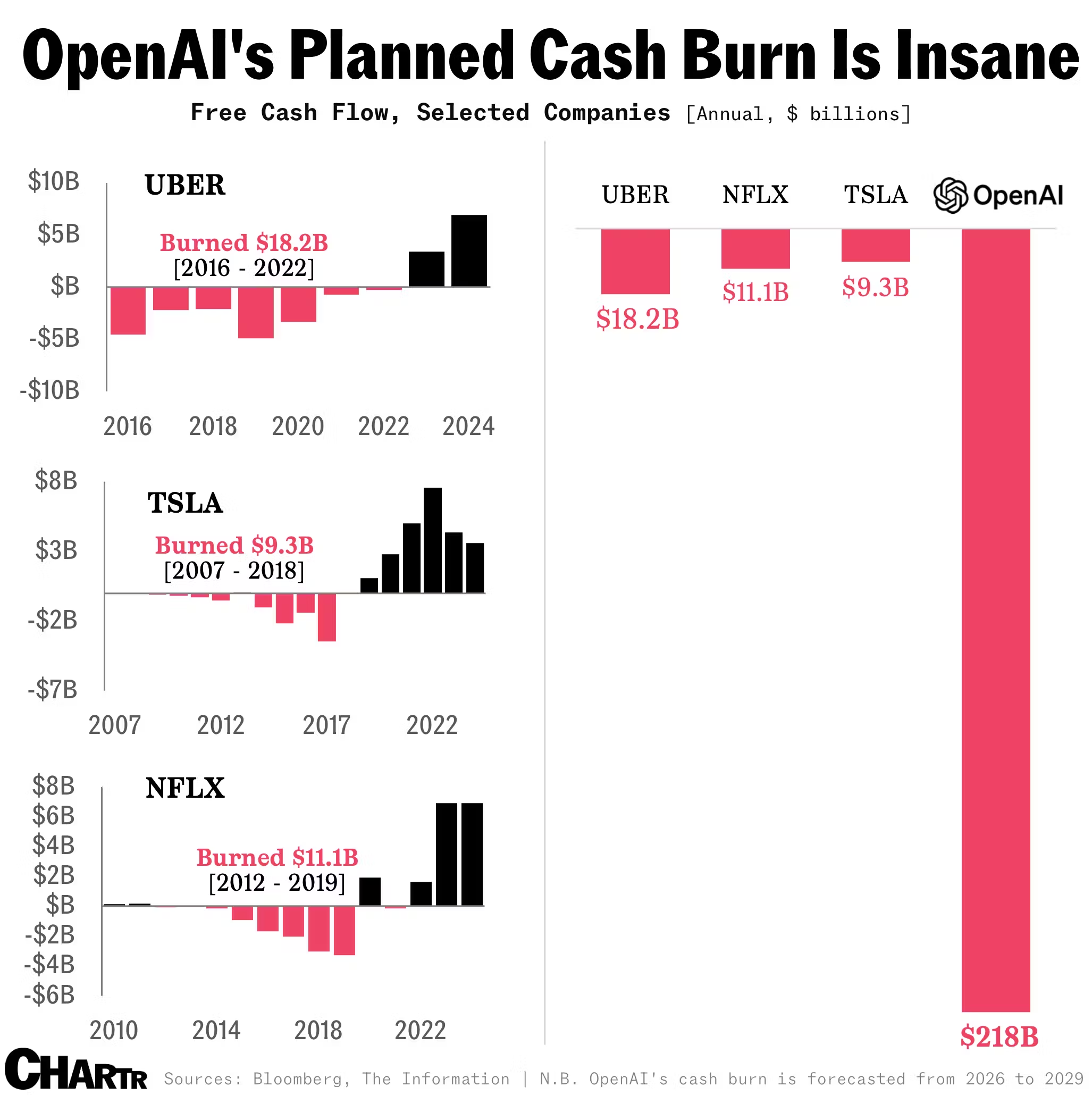
According to new reporting, the company now expects to burn approximately $218 billion between 2026 and 2029, which is about $111 billion more than internal forecasts made just two quarters earlier.
 Source: Sherwood
Sam Altman has publicly discussed infrastructure ambitions measured in the trillions over time. These are not abstract figures. They reflect GPUs, data centres, and energy contracts.
At the same time, reported gross margins fell from around 40% to roughly 33% as inference spending accelerated.
That decline offers a glimpse into the core risk. If usage grows faster than cost efficiency improves, margins compress even as revenue expands.
Public investors understand growth.
They have funded years of negative cash flow in companies like Amazon and Tesla. What they will focus on now is whether AI spending eventually becomes more efficient relative to revenue.
What would it take to reach profitability?
The path to profitability can be expressed in simple math.
Operating profit equals revenue times operating margin. For a trillion-dollar valuation to hold, earnings must support it.
If OpenAI reaches $280 billion in annual revenue by 2030 and achieves a 20$ operating margin, that would generate $56 billion in operating income.
At a price-to-earnings multiple of 20, that supports a valuation slightly above $1 trillion dollars.
However, if operating margins remain closer to 10%, operating income would be $28 billion. Under the same multiple, the valuation would fall well short of the trillion-dollar mark.
That difference comes down to three variables. First, the cost per token must fall through better model design and hardware efficiency.
Second, revenue mix must tilt toward higher margin enterprise contracts rather than heavy consumer usage.
Third, capital structure must limit annual depreciation from owned infrastructure.
Even modest improvements in these areas materially reduce the revenue needed to break even.
A few percentage points in margin translate into tens of billions of dollars in earnings at scale.
Can competition erode the upside?
OpenAI is not alone in this race. Anthropic is reportedly targeting profitability around 2028 and considering its own IPO timeline.
Google has integrated generative AI into search and cloud offerings. Other players, including Musk’s ventures and hyperscalers, continue to deploy capital.
Competition creates two pressures. The first is pricing. If enterprise customers can choose between multiple high-quality models, negotiating leverage increases.
The second is capital intensity. If rivals continue to spend aggressively on infrastructure, the industry may enter a cycle where revenue grows but returns on capital compress.
Whichever company lists first will likely set the tone for public market expectations.
If the first generative AI IPO shows improving margins and disciplined spending, it strengthens the sector narrative.
If it struggles to demonstrate a path to sustained profitability, valuations across the space may adjust.
 Source: AmplifyMe
What will public markets actually demand?
Private markets reward ambition, but public markets reward certainty.
Ahead of any IPO, investors will expect detailed disclosure around gross margin trends, compute costs, and long-term infrastructure commitments.
They will examine how much hardware is owned versus leased and how depreciation affects earnings.
They will also look at customer concentration and retention in enterprise contracts.
Governance will receive attention as well. Leadership transitions, legal disputes, and rapid scaling introduce volatility. Public investors will want stability and financial discipline alongside technological progress.
The broader market implication is significant. Semiconductor companies, data centre operators, and energy providers have benefited from AI spending.
If OpenAI and peers prove that infrastructure investment converts into durable earnings, those sectors remain supported.
If margins fail to expand, capital allocation across the AI ecosystem could tighten.
The AI market has been driven by belief in transformative potential.
The IPO phase will test whether that potential converts into sustainable financial returns. Revenue growth has already been proven. The next proof point will be margin expansion under the scrutiny of public shareholders.
The post The trillion‑dollar question: Can OpenAI turn AI into profit as it readies IPO? appeared first on Invezz


You May Also Like

Ethereum (ETH) Price Prediction: Whale Accumulation Surges as $2,140 Resistance Becomes Key Battleground

Whale ‘1011’ Pours Another $9M USDC Into Hyperliquid After $230M Liquidation

Pound Holds Ground as UK Business Activity Slips to One-Year Low



